|
Working together for climate action and good health |
Related newsScotland at the table with UN healthy air commission NHS Scotland net zero efforts expanded Greener NHS research funding boost Glasgow LEZ success sparks call for expansion Want to eat less meat? New study seeks volunteers NHS saves £82m a year through outdoor spaces MS charity: Scrap 20m rule for disability payment Analysis: Why people are left behind Inside Scotland’s widening health inequalities GPs back abortion protest buffer zones bill New Disabled Children and Young People Transition Bill Insight: Link workers’ vital role 
|
|
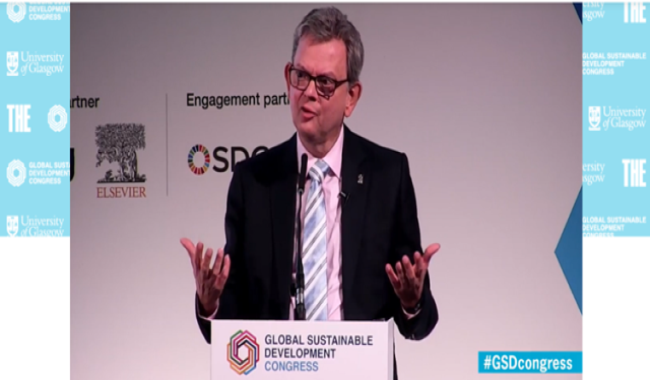
Professor Muscatelli Image Credit: © THE & University of Glasgow, Sustainable Development Congress
|
||
|
||
|
Hosting the first ever Global Sustainable Development Congress in collaboration with Times Higher Education (THE) a week ago, the University of Glasgow’s Principal and Vice Chancellor shared the importance of partnerships for good health and climate action.
Last week, the Global Sustainable Development Congress ‘Uniting higher education, governments, industry and society for a sustainable future’ brought together all sectors to discuss progress made around the UN’s sustainable development goals (SDGs).
Key to discussions were around themes of education, gender and inequality; health, wellbeing and demography; and sustainable cities and communities.
Professor Sir Anton Muscatelli spoke with healthandcare.scot about the event’s importance, the role of collaborative working to integrate sustainability across sectors, as well as Glasgow and Scotland’s role in global action:
“We’re very excited to have the first congress here in Glasgow. For us it was a real opportunity to highlight our own work across particularly these three themes that have been featured. We’re very proud of the fact that we’re seen as the top university in Scotland, 3rd in the UK and 19th in the world in the impact rankings the first time we participated.
“It’s also fantastic and very empowering for those areas like sustainable cities and communities, where we’ve ranked 2nd in the world because of the incredible work our colleagues do around projects of decarbonisation.”
One example of this is the Glasgow as a Living Lab Accelerating Novel Transformation (GALLANT) project, supporting climate resilience through a whole-systems approach while tackling health, social and economic inequalities.
Professor Muscatelli added that while presenting an opportunity to “showcase” work and empower colleagues to do more, the congress also acts as a “call to arms” for students and academics in Glasgow:
“This is the ultimate mission of our generation to be concerned with. This is our challenge, we’re here trying to solve the existential problem of our time – if we’re not here to help that, what are we here for?”
Urgent climate action
Earlier this year the NHS Scotland sustainability strategy was published, addressing the need for a net zero NHS, healthcare’s contributions to global warming and the impacts of climate change on health. A realistic medicine approach, sharing decision-making with patients, is highlighted to limit medicines waste while improve healthcare and reducing the NHS’s carbon footprint.
Scotland’s approaches and actions for health boards on the climate emergency were accompanied by the government’s acknowledgement of its wider role in meeting the UN’s SDGs.
Professor Muscatelli said it is incredibly important not to lose the momentum from COP26 to tackle the climate crisis, telling healthandcare.scot:
“It seems to me that one of the positive things we realised from many of the expert sessions which surrounded COP26 is that actually – this is within reach if we do the work.”
He recalls one such session in 2021 with Chris Stark, Chief Executive of the Climate Change Committee – independently advising on climate action – outlining that the investment needed from countries in the industrialised North is “absolutely doable”.
Professor Muscatelli continued:
“Coming back to the current economic crisis we face; it becomes even more of an imperative because we’ve seen responses to severe crises which are not as bad as what we would face in the full-blown climate crisis – we should learn that level of preventative spend.
“Urgent action really makes a difference and frankly, as many have said, action must take place over the next 7 years, that’s when the battle will be won or lost.
“So for me, that’s the hope: that the level of investment required to decarbonise our economies and our systems – and I mean the biggest CO2 producers in the industrial North – we can do it, it’s a realistic level of investment.”
Chris Stark also chaired a session at this congress on taking bold action to reduce environmental destruction alongside Susan Aitken from Glasgow City Council and a wider panel.
Susan Aitken raised the importance of working towards climate goals to avoid worsening health, particularly for those living in Glasgow’s deprived areas. She spoke about work to create a Low Emission Zone and increase access to green space to reduce air pollution and support those struggling with poor respiratory health.
Climate solutions for health
Professor Muscatelli says while there are incredible projects across Scotland, building cross-sectoral and global work for tackling health inequalities and climate change cannot be underestimated:
“I think climate action is absolutely essential to providing good health and wellbeing, and for tackling healthcare inequalities.
“We know that some of the biggest threats to human health globally is zoonotic transmission of diseases – we saw that in the case of COVID-19 in a particular context, but if you look at some of the work we’ve been doing in Glasgow around the One Health theme, we see that the potential there for more pandemics is huge.”
This ‘One Health’ approach brings together action on health, wellbeing, and the environment to reduce infection spread and has been highlighted by Public Health Scotland and the Scottish government as key to responding to global health threats.
Earlier this year following a parliamentary debate on antimicrobial resistance (AMR), the government outlined steps to tackle the public health threat of AMR – with environment and food safety as part of this One Health approach.
Professor Muscatelli added that climate change considerations are crucial in tackling health inequalities:
“We have seen how climate change can aggravate health inequalities here and globally – we know not only through what’s happened with COVID-19, but some of the other epidemics that have hit the world, how climate is a major driver in making things worse.
“Some of the issues around food production and food insecurity have a real impact on health inequalities and that is driven by climate change. So, there’s absolutely no doubt in my mind that climate change is a driver of many of the other SDGs.”
This comes as the first of five reports on the Health Foundation’s independent review into health inequalities in Scotland is published by the University of Glasgow.
The report highlights local environments and air quality, among other factors contributing to health inequalities.
Partnerships in sustainability
Professor Muscatelli says that partnering globally across all sectors is essential and explained how local projects play a role within such partnerships:
“I see partnerships through our School of Health and Wellbeing, I see that through our sustainable development theme at the Advanced Research Centre – it’s bringing social scientists who are experts on behaviour, it’s bringing anthropologists who can understand culture and behaviour together with other disciplines that will create effective solutions.
“It’s those things that are about locally-driven solutions as well to solving these challenges around health inequalities that are going to be really key if we are to address those particular SDGs.”
Considering the contributions from research and practice across the sectors of climate and health, Professor Muscatelli says that there are many areas of inspiring work from Scotland and Glasgow:
“To my mind one of the really interesting things is the way in which collaborations across disciplines really bring these issues to bear because some of the solutions in terms of addressing health inequalities may be mostly medical solutions – with sharing medical supplies and technology, for example – but in many cases, it is this collaboration.”
Read more: New green inhaler prescribing guidance; Realistic medicine to help the climate; Disposable gloves to protect patients and the planet
Sign up to our bulletin for key health & social care updates straight to your inbox and you can follow healthandcare.scot on Google News. |
