|
GPs call to accelerate primary care changes |
Related newsChief Medical Officer: ‘Critical connections’ priority Health and charity leaders join forces for NHS reform First Minster pledges people will see GP sooner Health and care in the Scottish budget Respiratory care vision unveiled 
|
|
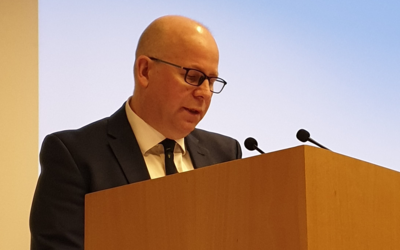
Dr Andrew Buist, chair of the BMA’s SGPC
|
||
|
||
|
Doctors’ leaders have called for a “considerable and concerted” effort to speed up changes taking place in primary care.
Dr Andrew Buist, chair of the BMA’s Scottish GP committee (SGPC), raised concerns over health boards’ ability to deliver staff needed for multidisciplinary teams and the budgets available.
At the Scottish Local Medical Committee Conference in Glasgow, he highlighted challenges in delivering the GP contract, which came into force last year and aims to expand primary care multidisciplinary teams.
He said it was always going to be more difficult because it relied on new ways of working between integration authorities, health boards and local medical committees – and said progress was “patchy”.
A survey of more than 600 GP practices found while some services – for example pharmacy support – are successfully being implemented, there is little advance in others, such as adult immunisations.
Dr Buist said: “So, it is clear that there needs to be a considerable and concerted effort to increase the pace of transformation.
“And we want to make sure that areas where implementation is going well can help those places where progress is slower.
“That means understanding why some places are ahead of others and spreading that learning more widely.”
Dr Buist said while every health and social care partnership (HSCP) area had a primary care implementation plan, budget constraints could be holding these back.
He said the Scottish Government had agreed to a request from the BMA to write to HSCPs to check they can deliver commitments made – and if not revise their workforce and financial projections.
He added: “If extra funding is required, then we are clear it must be provided, anything else means we are simply designing to fail.
“Because it is undeniably the case that if we continue as we are – with insufficient pace of progress across Scotland, and lack of ability to deliver on multidisciplinary teams– then we will not achieve full contract implementation by April 2021.”
He said GPs had to help lead the change, but delivery of more rapid progress was down to HSCPs, Scottish Government and health boards who must make it “a priority”.
“As a key example, health board must deliver the staff needed for multi-disciplinary teams, in the timescales set out,” he said.
“Every board needs to put this at the top of their to-do list.”
“And we need a clear, practical national workforce plan from the Scottish Government to make this a reality.”
Health secretary Jeane Freeman told the conference there were “excellent examples” of progress in multidisciplinary teams, which are making a “tangible differences” to both patients and GPs.
However she said the goal for the next 18 months has to be to “accelerate the pace of change”.
“I am well aware not all practices yet feel the benefit of the new contract, and like you I am impatient for progress,” she said.
“The primary care improvement fund to expand multidisciplinary teams will double from £55m to £110m next year.
“We will step up our efforts to closely scrutinise and challenge primary care improvement plans.”
Ms Freemans said the first meeting between chief executives from local authorities, health boards and chief officers of HSCPs had taken place this week, to discuss the pace of integration and how to improve it.
She said: “Without doubt the road we have embarked on is a challenging one.
“Primary care – GP practices as part of that – is the bedrock of our National Health Service. So it is crucial we work together, we get this right.”
|
