|
European first for ‘next generation’ robot surgeons |
Related newsCardiac innovation gets public showcase New model can predict pre-eclampsia risk Social robots show potential in patient support Scotland’s Clinical Entrepreneur initiative returns Robotic surgery shows pioneering path to the future Strategies for female healthcare innovators Edinburgh IJB faces judicial review over cuts New Edinburgh hub set to transform global healthcare Edinburgh welcomes outdoor brain health centre NHS Lothian escalated over CAMHS performance Youth mental health pilot looks to the future Veteran support cut in ‘stark’ review 
|
|
|
||
|
||
|
A Scottish hospital has become the first in Europe to pioneer the use of state-of-the-art robot ‘surgeons’ that mimic a human arm.
Doctors at the Western General Hospital in Edinburgh have performed several procedures using the devices to treat patients with serious bowel disease or bowel cancer.
The Versius robot – described as a “leap forward” in surgical technology - works in a similar way to a computer games console and is capable of moving and rotating its ‘wrists’.
The surgeon uses to joystick-type controls to manoeuvre the robotics arms and perform delicate keyhole surgery.
The ‘next generation’ of robotically assisted surgery is said to decrease patient recovery times and reduce pain.
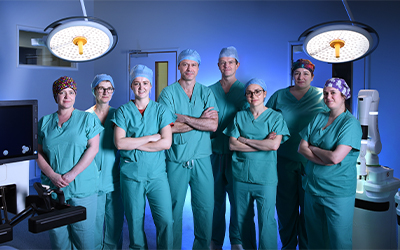
Consultant colorectal surgeon Doug Speake has led the introduction of the technology into the NHS and Europe together with colleagues at NHS Lothian.
“This is the next revolution in surgical technology. We have gone from open surgery, to keyhole surgery, to robotic surgery. This is the future,” he said.
“It is a leap forward in surgical precision meaning patients recover faster and ultimately get home sooner. It is better for the patients and it is actually better for us.
“We were the first in Europe to use this technology. The robot puts the Western General Hospital and Edinburgh on the map as a centre for excellence and training.”
Since November, around 30 patients in the colorectal unit – the busiest in the UK – have undergone procedures using the robot, with some returning home within three days.
Professor Alastair Campbell, a retired professor of medical ethics, was one of the first patients in Europe to undergo a procedure with Versius when he had an operation there in November.
The 81-year-old was referred for surgery after medical investigations identified a polyp, which could have been the signs of very early stages of colon cancer.
He had a section of his colon removed and rejoined as part of a procedure carried out using the Versius robot.
Professor Campbell said: “The process was fully explained to me and I was very happy to take part and give it a go. I’m glad I did. I watched a video which explained how it worked and the benefits.
“The scars were very small and they have all but faded already. There was a bit of post operative pain, of course, but it was controlled very quickly and effectively.
“I’m very lucky. I am quite fit and I wanted to be home as quickly as I could after the procedure so I was pleased that within three days, I was home.”
|
