|
Review member questions cost of care reforms |
Related newsAll public bodies must focus on health, urges charity New social care minister appointed Health and charity leaders join forces for NHS reform Holyrood passes Care Reform Bill Fixing social care funding must be council “priority” Lived experience at centre of care advisory group 
|
|
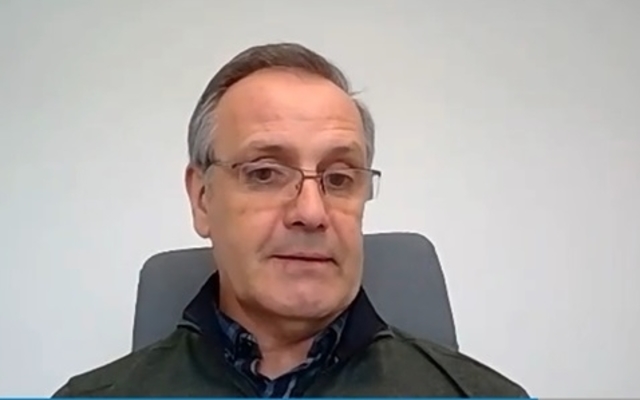
Adult social care review chair Derek Feeley
|
||
|
||
|
The sums underpinning a major review of adult social care in Scotland are being called into question from multiple angles, with even those close to the process now suggesting estimations could be short by hundreds of millions of pounds.
Councillor Stuart Currie, who speaks for health and social care for the local government umbrella group COSLA and sat on the review, claimed that “some of those solar calculators were in a dark room at times when calculations were being made.”
COSLA estimates the true cost of the proposals could approach £1bn, significantly above review chair Derek Feeley’s estimate of £660m, and Councillor Currie questioned how this could be paid for without taking money from other services when the SNP has committed to not increasing income tax.
The comments were made during a lively session on the future of adult social care in Scotland at the ALLIANCE’s Equally Connected: Equally Valued conference.
Similar concerns were voiced by Scottish Care leader Dr Donald Macaskill, who said there were “lots of financial holes in the Feeley report”.
“The biggest one, is that we are yet in Scotland to have a grown-up debate about either a national insurance, a personal insurance, as happens in Germany, Denmark and Sweden, or a mixed form of paying,” he said.
“If we’re wanting a National Care Service that’s worthy of its name… then we’re going to have to pay for it – and we’re not having that discussion. Anybody.”
Most of the panel pressed for the report’s 53 recommendations to be implemented in their entirety – while COSLA’s Stuart Currie argued for councils to keep their role in the delivery of social care.
Kevin Stewart, the newly-appointed Minister for Mental Wellbeing and Social Care, raised eyebrows when he told the session further consultation was needed, despite the extensive engagement that had underpinned the review.
Julia Smith, a social care user and a member of a panel that advises the Scottish government, expressed disappointment:
“It saddens me to hear the minister say that consultation is coming. We at the people-led policy panel have been working for three years to answer the questions the minister just posed.”
Mr Stewart said the government would be “in listening mode” and that he wanted to hear from “as many people as possible, not just the usual suspects”.
When pressed on whether all of the report would be implemented, Mr Stewart said that creating a National Care Service was a key plank of the SNP’s manifesto that had just seen them returned to office by voters.
The Scottish government has pledged to begin to consult on the legislation within the first 100 days of being in office, with Health Secretary Humza Yousaf promising a National Care Service would be up and running within five years.
Speaking after the event, Professor Ian Welsh, CEO of the ALLIANCE, said it was important that people who use social care and carers were involved as “equal partners” at the table as the reforms went ahead.
“There was consensus amongst the panel on some issues, including the need for more accountability and investment in the new system, and for social care to be reframed in Scottish society and culture.
“But there were also some important points on which the panellists disagreed, including whether there should whole-scale adoption of the recommendations made by the Independent Review of Adult Social Care, and whether local authorities should retain control.
“As countless reports suggest – including the Independent Review, our own engagement to inform this, and our My Support My Choice research – it is essential that social care is designed to respond to people’s rights and needs, and that people with lived experience and unpaid carers are meaningfully involved in discussions about its future.
“People who access social care and unpaid carers have first-hand experience of what works well for them, and the unacceptable barriers that persist to quality, timely, appropriate support.
“They – and the third and independent sector providers who work for and with them – have invaluable ideas and expertise to inform the planned redesign and potential creation of a new National Care Service and must have seats as equal partners around the decision-making table.”
healthandcare.scot is pleased to be the media partner for the ALLIANCE’s Equally Connected: Equally Valued Conference.
Read more: Social care review: What does the report say?; ‘Top down’ care review plans branded ‘huge mistake’; Election social care funding plans ‘fall short’
Sign up to our bulletin for key health & social care updates straight to your inbox. Tags: Scottish Government; Social Care; Unpaid Carers. |
