|
Comment: Is a deal with private hospitals inevitable? |
Related newsFrom 14 to 5 – one lesson from Denmark NHS Scotland chief named as battle lines emerge Briefing: The 5-year plan for NHS, care and science Health and care ministers’ portfolios revealed Constance to be new health secretary North cancer setup to remain but formulary in doubt 
|
|
|
||
|
||
|
The Scottish government, and by extension the NHS in Scotland, has long exhibited a degree of hostility towards partnerships with the independent sector. Covid might be about to change that.
News that BMI healthcare is to spend £20m converting a commercial office space near Glasgow into a private hospital suggests a degree of confidence in the sector.
While the government remains tight-lipped about any future deals, as in England the Scottish health service has partnered with private sector hospitals to provide safe sites for the most urgent surgery to go ahead during the pandemic.
A lessons learned document published just this week suggested the government should “consider the impact of non-NHS involvement on addressing backlogs of care”. In the years ahead, it’s difficult to see any plans to boost NHS activity being achieved without using private hospitals.
The new Glasgow hospital will be BMI’s fifth in Scotland. Spire and Nuffield also have hospitals north of the border. According to BMI, it will host two operating theatres and a comprehensive out-patient service that includes diagnostics – so could easily support NHS work.
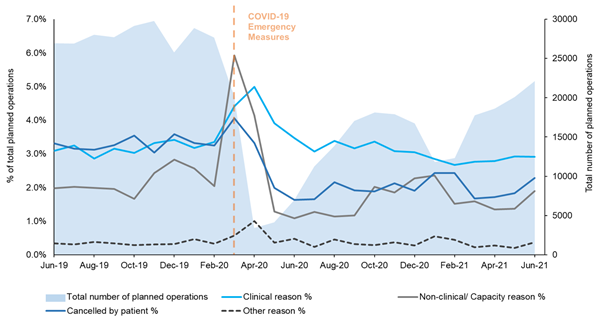
The waiting list for one of eight key diagnostic tests is 25% higher now than it was at the start of the pandemic, with long waits becoming more pronounced in endoscopies in particular. Meanwhile planned operations are still running well below pre-pandemic levels.
Total planned operations and percentage of cancelled planned operations, by reason, up to June 2021
Source: Public Health Scotland
Whenever the government’s press office gives a quote on private hospitals, they stress that private sector capacity in Scotland is “very small”. When it emerged that that private call centres were being used to do contact tracing, the First Minister was quick to say the operation remained firmly under NHS control. It points to a wider political unease about the independent sector. The SNP under Alex Salmond made a big deal of rolling back its involvement in the health service.
At one point the former leader even pledged to “eradicate” private healthcare in the Scottish NHS. Mr Salmond’s successor, Nicola Sturgeon, pledged in 2015 to “effectively eliminate” the use of private sector providers for planned care over the next 20-year period.
But faced with continued challenges, a 2018 waiting times improvement plan contained a single paragraph pledging a “more efficient and strictly limited” use of the independent sector. Behind this brief reference, the government was taking on a central role in co-ordinating the use of private providers, by setting up two national contracts – one for insourcing, one for outsourcing – that NHS boards could use to buy services.
The aim was to bring down costs from the previous model, where individual NHS boards had commissioned activity themselves. As part of this, the Scottish government planned to utilise “all the available private sector capacity in Scotland over the next few months.” The sums are small in comparison to spending in England – around £18m over a year-and-a-half period – but this represented about a fifth of all the funding to reduce waiting times provided to health boards.
The agreement, which was revealed after a series of freedom of information requests by healthandcare.scot, was paused at the start of the pandemic. At this point, a new national deal was struck to carry out urgent operations – primarily for breast and skin cancer patients – in the private sector. This continued after Christmas as pressure on the health service rose again.
A quirk in transparency legislation means the devolved administrations are not required to publish contracts in the same way the UK government is. The Scottish government has refused to say whether the deal remains on a not-for-profit basis, as was the agreement at the start of the pandemic.
A plan that will set out how the NHS in Scotland can become 10% more productive than it was before the pandemic is eagerly awaited. The pledge, which relates to in-patient activity, day case and out-patient activity, was made in the Holyrood elections and a detailed strategy is due soon.
Part of the answer is likely to be greater standardisation across the health service, as well as a chain of diagnosis ‘one stop shops’ and elective treatment centres. But all of this will take time, and the SNP says the NHS will be achieving 110% of pre-pandemic levels within a year of its restart plan.
So, a renewed partnership with the independent sector, despite the political complications, looks inevitable.
This article was originally published in the Health Service Journal.
Sign up to our bulletin for key health & social care updates straight to your inbox. Tags: NHSScotland; Scottish Government. |