|
Call to ’modernise’ reporting of serious incidents |
Related newsBloods and Go service for Lanarkshire NHS IT ready to take ’transformative’ step A new health strategy “every seven weeks” New directions to NHS on staffing and deficits Scotland at the table with UN healthy air commission 
|
|
|
||
|
||
|
A national system for reporting the most serious patient safety incidents still needs ‘significant work’ two years on from its introduction, a report has found.
Healthcare Improvement Scotland (HIS) said a new system introduced in January 2020 has revealed widespread inconsistencies between NHS boards about what constitutes a serious adverse event.
These are classed as incidents that may have caused permanent harm, including patient deaths.
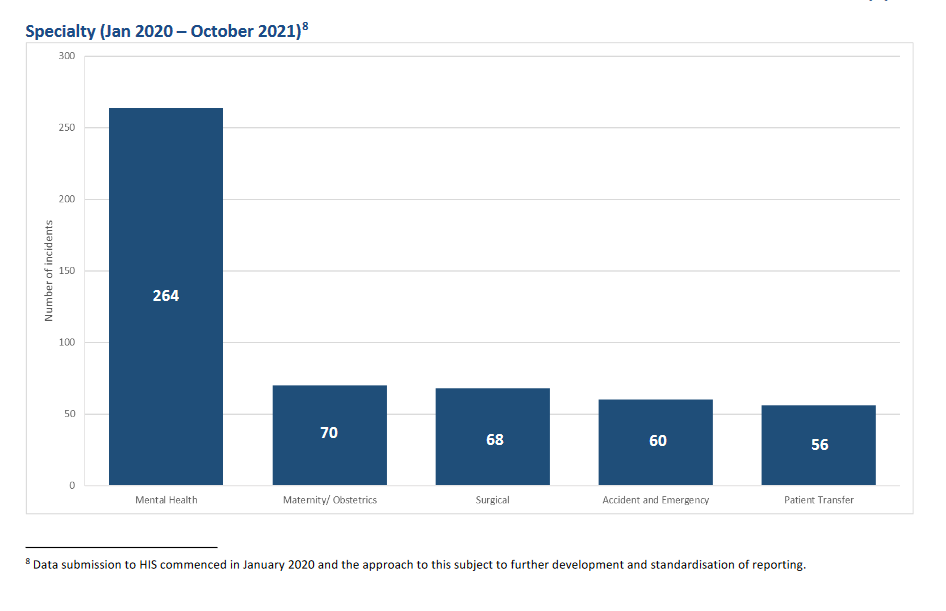
Results from the first two years of a national database show that mental health accounted for more reports than all other specialities put together. The most common reasons for reviews were unexpected deaths, suicides and treatment issues.
HIS says it is now working to ‘modernise’ the process, stating: ‘Applying standardisation to the level of review an adverse event receives will provide assurance that the most serious of adverse events are managed consistently across NHS Scotland.
‘This will support NHS boards to provide assurance to the public that no matter where the adverse event takes place in Scotland, the same level of review will be undertaken.’
In September 2019 then-Health Secretary Jeane Freeman commissioned a national system for the recording of Significant Adverse Event Review (SAER) for Category I Adverse events, following concerns about inconsistent recording. At the time Ms Freeman, who stood down as an MSP earlier this year, said ‘we have one NHS in Scotland and I expect now to see greater consistency’.
However the 12-week implementation timetable set by Ms Freeman meant a manual system, in which boards submit returns each month, had to be used. This has proved “challenging and time consuming” and HIS says it is now working to identify a digital notification system.
The oversight body says it will work to standardise reporting across the type of incident, the speciality in which it took place and the outcome. This is expected to be in place by winter 2023.
Analysis by healthandcare.scot revealed reporting levels varied dramatically from board to board even after adjusting for population. NHS Tayside, which had reported fewer reviews to the national database than boards of a similar size, said that suicides and drug-related deaths were investigated but did not normally trigger a review.
In response to the findings, NHS Forth Valley said it followed national guidance, although an external review team later that year voiced concerns about reporting at the board’s A&E department.
The HIS report says: ‘The variation in event type and specialty descriptions created significant differences in the number of reviews undertaken within each event type.
‘…Following this early analysis of data, it was clear that significant work is required to achieve robust data management, analysis and national standardisation.
‘Moving forward, a whole systems approach with a strong commitment from NHS boards will be required to address this.’
Read more: New NHS infection-fighting body launches; Prosecutors probe hundreds of covid hospital deaths; New safe care hub for Scotland’s health and care staff
Sign up to our bulletin for key health & social care updates straight to your inbox. |