|
First Innovation pathway medicines accepted |
Related newsNorth cancer setup to remain but formulary in doubt Scots patient first to join leukaemia study New strategy to unlock genomic medicine ‘Substantial’ drop in cancer deaths Single approach needed for Scottish cancer services Chief officers update Brexit medicine supply guidance 
|
|
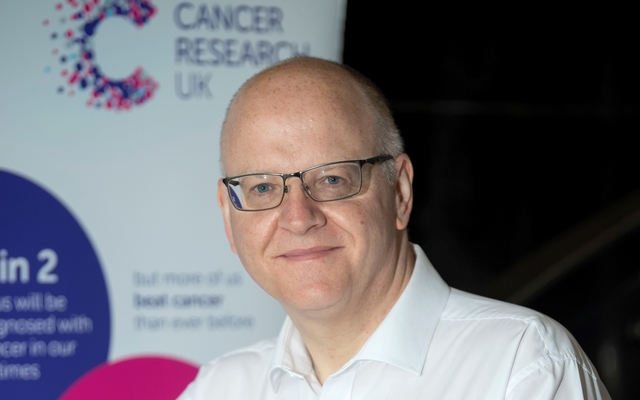
Image: © Cancer Research UK
David Ferguson, Cancer Research UK
|
||
|
||
|
Cancer charities have welcomed a decision by Scotland’s NHS medicines watchdog to give the green light to four treatments that offer new targeted treatment options for people in advanced stages of their illness.
Three of the medicines accepted by the Scottish Medicines Consortium – sacituzumab govitecan (Trodelvy) for treating advanced triple negative breast cancer, sotorasib (Lumykras) for advanced non-small cell lung cancer with a specific KRAS G12C mutation, and lorlatinib (Lorviqua) for so-called ALK-positive non-small cell lung cancer – had all been given so-called Innovation Passports in a UK wide ‘Innovative Licensing And Access Pathway’ (ILAP) scheme to bring potentially ground-breaking medicines to patients faster.
An immunotherapy, dostarlimab (Jemperli), for women with endometrial (womb) cancer whose disease has progressed despite treatment with chemotherapy, was also accepted for use in NHS Scotland.
Both sacituzumab govitecan and sotarsib have been accepted on an interim basis because, with the medicines targeting relatively few patients, SMC has asked for additional evidence before making a long-term decision.
David Ferguson, Cancer Research UK’s Public Affairs Manager in Scotland, said:
“It’s fantastic that sotorasib has been approved on an interim basis to treat some patients in Scotland with non small cell lung cancer.
“This first-of-its-kind medicine targets a specific gene fault that doctors were previously unable to treat with drugs.
“This medicine is the product of decades of work by researchers, including those from Cancer Research UK who helped unravel how the mutation drives cancer growth.
“Scotland is the only part of the UK where lung cancer is the most common cancer, so it will be welcome news for patients and their families that this breakthrough treatment is now being made available for people with advanced forms of the disease.
“It’s good too that two new drugs have been approved in Scotland to treat advanced womb cancer and triple negative breast cancer.
“Dostarlimab is a type of immunotherapy that works by attaching to a particular protein on the surface of cancer cells. Its interim approval means people with womb cancer whose disease has progressed will have another treatment option available to them.
“And it will be very welcome to some people with triple negative breast cancer that a drug called sacituzumab govitecan has been approved for use in Scotland.
“People with this type of breast cancer have fewer treatment options than people with other types of the disease. This decision makes a new treatment available that could give them more precious time with their loved ones.”
Hilary Maxwell, CEO and Chair of the patient advocacy organisation GoGirls, welcomed the decision to allow a new treatment for endometrial cancer:
“Today’s news will bring relief to many people living with endometrial cancer, especially those living with an advanced form of this disease.
“For nearly 30 years, it has been treated as a ‘forgotten cancer’, with very limited treatment advances and options. The SMC advice is the first step in changing this, bringing hope to patients and their families.”
Dr Alison Stillie, Consultant Clinical Oncologist at the Edinburgh Cancer, added:
"Until today, progress in endometrial cancer treatment has been much slower than with other gynaecological cancers. The decision on dostarlimab - a targeted immunotherapy - will make a significant difference to the management of advanced endometrial cancer now and in the future, and will be key to improving outcomes for people living with this cancer in Scotland."
In all, the SMC today accepted five medicines – the fifth being the first oral preventative treatment for hereditary angioedema in adults and adolescents, a rare inherited condition that causesswelling.
SMC chairman Mark MacGregor said he was pleased to accept the medicines for use in NHS Scotland:
“Sacituzumab govitecan, sotorasib and lorlatinib are the first medicines the SMC Committee has considered after the award of an Innovation Passport in the new ILAP process. We’re delighted that this exciting new collaboration with partners in MHRA, NICE and AWTTC is progressing well and patients in Scotland can now access these three medicines.
“A diagnosis of triple negative breast cancer can be devastating for patients and their families, particularly as the prognosis is so poor. We hope that our decision to accept sacituzumab govitecan, will offer patients with this form of breast cancer the prospect of a better quality of life and valuable extra time with family and friends.
“We were also able to accept sotorasib (Lumykras) for NSCLC, the first targeted therapy for patients with this specific type of NSCLC, and from our PACE participants we know that this decision will be welcomed. While evidence on its effectiveness is limited, the committee accepted sotorasib subject to future reassessment.
“There are very few treatment options for endometrial cancer so we know that our decision on dostarlimab will be welcomed by patients and clinicians. Dostarlimab may be a useful additional treatment but as the evidence considered was limited, the committee has accepted its use subject to reassessment once further evidence is available.”
Read More: Welcome for new breast cancer treatments; Pandemic sees sharp fall in antibiotic use; Watchdog approves ‘game-changer’ HIV treatment;
Sign up to our bulletin for key health & social care updates straight to your inbox. Tags: Cancer; Medicines; NHSScotland. |
