|
MSP voices concern at unequal care workforce |
Related newsParty health and care leads are named Briefing: Social care in the manifestos Collective bargaining promised for social care Bid to block IJB voting rights extension Councils warn of social care cuts ahead Loneliness: a public health crisis for Scotland 
|
|
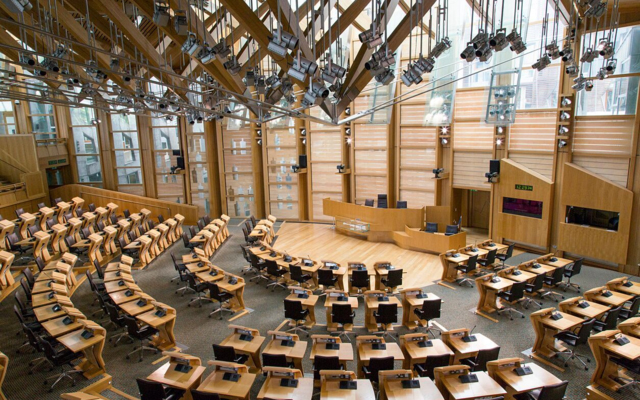
Image: Holyrood
|
||
|
||
|
An MSP has criticised the way councils fund social care, pointing to an “astounding difference” between workers employed in-house and those working for private providers.
Differences in the way staff are paid, as well as lower mileage allowances, were raised by a mid-Scotland and Fife MSP in his statement at the start of a parliamentary debate he had initiated on social care staff pay last week:
“The difference between council staff working as carers and those in the private sector is astounding. It cannot be allowed to continue,” Alex Rowley told his fellow MSPs.
“Council staff will be paid for the hours that they work, not only for the hours that they spend in a person’s house. They will get the same travel allowance as all public sector workers.”
“How can it be that we have two sets of workers, doing the very same job and being paid by the public purse to deliver the same public services, being treated so differently?”
Many social care services are procured from independent and third sector providers by local authorities, but a practice of commissioning specific time blocks of care means other costs are usually not covered.
Responding to the debate, the chief executive of the Coalition of Care & Support Providers in Scotland (CCPS), Annie Gunner Logan told healthandcare.scot that the level of funding councils award themselves for their own in-house services and the much lower level they award to everyone else, including the third sector, is astounding:
“Councils do indeed pay their own workers for time spent travelling between clients, but they only pay providers for direct contact time – often by contracting and paying for care by the minute.
“The same imbalance applies to other workforce costs such as training, development, criminal records checks and much more, where councils foot the bill for their own staff but leave commissioned services to pick it up themselves.”
At a recent session of the Scottish parliament’s health and care committee, Ms Gunner Logan called for an immediate end to competitive commissioning within social care which she considers unethical.
She said she would welcome a move to ethical procurement “that recognises fair work and exploration of more collaborative approaches”.
In a later contribution to the parliament debate on social care staff pay, Gillian Mackay from the Scottish Greens said a focus on cost within procurement has squeezed pay and conditions in some areas, and said a move to a system of national collective bargaining could see improved pay, terms and conditions delivered to all care staff.
But Annie Gunner Logan suggested that, until ethical commissioning is written into official guidance for both authorities and providers, then commissioning authorities will ‘shirk the blame’:
“Gillian Mackay was very clear that ethical commissioning is the key to solving this issue, and she’s quite right – but commissioning authorities are still a very long way from that, preferring to focus on ethical behaviour as a matter purely for providers to consider, and not to apply the same ethical standards to the policies and processes they design and implement.
“That needs to change, and CCPS is taking a strong lead on that with its ground-breaking Commissioning & Procurement Programme.”
Mr Rowley, a Scottish Labour MSP, said these methods of commissioning had been carried out by “all political parties when in power” but that it was time to recognise “care on the cheap does not and will not work”.
His party is calling for an immediate pay rise for care workers to £12 an hour, and have committed to work towards a further rise to £15.
Kevin Stewart, Social Care Minister, said a £15 hourly rate would cost £1.75bn and told parliament that we must be “realistic about what is achievable”.
Care workers will receive a minimum of £10.50 an hour from next month, following two successive government-funded pay rises.
However getting the money to social care workers employed by Scotland’s 1,200 different providers has not been without difficulties with Mr Stewart telling parliament that “other anomalies” had arisen throughout implementation.
Annie Gunnar Logan said the pay rise roll-out has created issues with other staff in the sector and risks an “exodus of managers and supervisors”:
“We applaud the measures taken by the Scottish Government to increase pay at the minimum level, but the way in which these pay rises are being implemented is eroding pay differentials to the point at which some senior staff feel they’d be better off returning to a more junior role, because the additional responsibilities they have to fulfil aren’t matched by additional reward.”
In the parliamentary debate, Scottish Conservative social care spokesperson Craig Hoy MSP said the government may not reimburse private sector providers for increases, which will then feed through the system.
Read more: Call for ‘revolution’ in social care commissioning; Budget: Major increase in social care spending; MSPs to probe alternatives to relying on GPs
Sign up to our bulletin for key health & social care updates straight to your inbox. Tags: Scottish Parliament; Social Care. |
