|
A rebuttal to the National Care Service discontents |
Related newsSceptical response to government’s care proposals Scotland’s IJBs becoming "financially unsustainable" Bid to block IJB voting rights extension Users to get voting rights at IJB meetings Search on for permanent Care Board chair The in-between: what’s happened to care reform? 
|
|
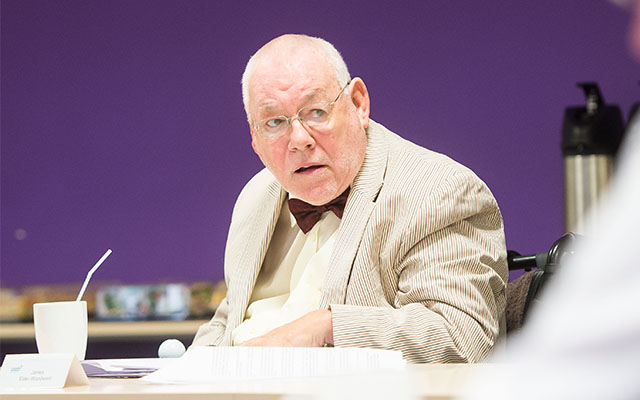
Dr Jim Elder-Woodward OBE, a disabled activist
|
||
|
||
|
The Scottish government last month published the first of a series of bills to bring into existence a National Care Service (NCS).
Trade unions and councils were quick to slam the legislation, which has been described as an expensive ‘power grab’ that will strip long-held powers from local authorities.
Dr Jim Elder-Woodward OBE is a disabled activist who was part of the advisory panel behind the Independent Review of Adult Social Care, the findings of which have paved the way for the creation of an NCS. In this piece, Dr Elder-Woodward responds, from the perspective of a service user, as well as a former commissioner, manager and researcher of social care support, to some of the most common criticisms levied at the Scottish government’s plans to reform social care support.
The Disabled People’s Independent Living Movement cautiously welcomes the introduction of the National Care Service. It has also welcomed the opportunity to be involved in its co-design on a par with the many other stakeholders who have previously dominated access to the support needed to execute their right to equal and full citizenship.
For years, many disabled people who were conscious of their oppressed state within society, have been calling for greater uniformity and universality of service provision, and a much more meaningful say in the development and running of their social care services in Scotland. They didn't like the broken and disjointed system, which frequently denied their freedoms of movement, family life, etc.; and which kept them in a state of perpetual poverty through its charging policies. But mostly, they welcomed the paradigm shift within the NCS from a system which merely met the needs of a few to survive, to one which promises to enable all in need to thrive.
Ultimately, trust in the current system has waned. Such waning has been accelerated by the exercise of the New Public Management within social care support, which gives priority to the pound over the need, often without acknowledging the resulting harm. That trust is further depleted by the vilification of those seeking help. Some are now even discussing the need for a period of “Truth and Reconciliation”. They look to the Independent Living Fund Scotland (ILF) and ask: “If they can work hand in glove with disabled people to provide an exemplar model of service delivery which is universally consistent, why can’t the mainstream system?” Such questions lead to further thoughts: if the ILF is such a successful model, welcomed by disabled people, why is the Scottish government letting it wither on the vine, by not re-opening it to new clients, as attrition develops.
Nevertheless, there are discontents who wish to retain power over the present disjointed and discredited system. Space does not allow discussion of all their arguments; but I should like to examine two of them.
Funding of social care support
The first is that social care support is innately local. It is impossible to separate it from housing, education and infrastructure which are all delivered by local government. Separating these will fragment social care support.
In answer, there is no inalienable right over who should control the gateway to people’s equal citizenship and quality of life. The present system is solely the result of the historical development of social welfare, which can be traced back to the end of the 16th century. At that time parishes rather than the church were given responsibility for administrating ‘relief’ to the ‘needy’; and a Scottish ‘poor rate’ was levied on the people of the parish for that purpose. Those in need of ‘parish relief’ had to go back to the parish where they were born to seek assistance. That is the historical basis of local control of people’s survival and participation in civic life.
Later those parishes become local authorities, which under the 1948 National Assistance Act were given the role of providing residential care (the successor of Poorhouses) and home helps for mothers of new-born babies. Local control of social care support is a historical phenomenon, nothing else. In any case, within the National Care Service (Scotland) Bill, local care boards will still plan, commission and procure community health and social care services, but this time, to standards set and monitored by Ministers and with those who experience services sitting on the board as equal participative members. As for the testimony of co-ordinated policies, and actions; if only local authorities had developed joint policies between housing and social care support, perhaps there would be less homeless people on the streets. Even within social care support itself, there is a lack of joined up thinking, e.g., around the transition of child and adult care.
Funding of social care support
A second argument is that poor service delivery of social care support is due to the lack of funding by central government.
I find this difficult to compute. For example, the Scottish government has spent millions on projects to stimulate self-directed support (SDS), the present default position of social care support, up and down the country. Yet, SDS has not been implemented in line with policy intent. In addition, in 2019 the Scottish government gave local authorities an extra £30m to implement free personal care. Yet, two years later the Scottish government published figures showing local authorities had raised an additional £800,000 in social care charges.
While some disabled people benefited from the free personal care policy, many did not as they are still charged for home and community support. In some cases, this money was spent on other parts of local expenditure; and new types of “loopholes” were found to allow charging to continue. These included re-defining ‘personal care’ activities as ‘social care’, and increasing contributions towards the cost of ramps, stair lifts and hoists for private home owners. The amount raised by such contributions increased by £1,300,000 in one year in this one area alone.
Machiavellian manoeuvres like this have allowed the continued growth of social care charges, despite the introduction of free personal care; and, again, adds to the further diminution of service users’ trust in the present system. During the present era of perma-austerity, they have been demonised, as well as psychologically and physically harmed, by a system of care and support which has put the pound before the person; and in so doing so, so-called person-centred services have, in effect, depersonalised the person. They now demand a system which will recognise their right to supports enabling their equal and full participative citizenship. Hopefully, the proposed NCS will meet that demand.
Dr Jim Elder-Woodward OBE is currently on the board of both Inclusion Scotland and Capability Scotland. He has written a number of articles and papers on disability and independent living, including co-authoring a book for social care workers on the subject.
Read more: Cool reception for NCS legislation; ILF: “We stand ready to reopen”; Embedding voices of experience into NCS plans
Sign up to our bulletin for key health & social care updates straight to your inbox. |
