|
Lack of structure holding back social prescribing |
Related newsConcern at cap on psychology service Briefing: Mental Health in the manifestos Strategy to make mental health services peer-led Pharmacy’s road to stigma-free drug dependency care Medical trainee abuse reports ‘shut down and silenced’ 
|
|
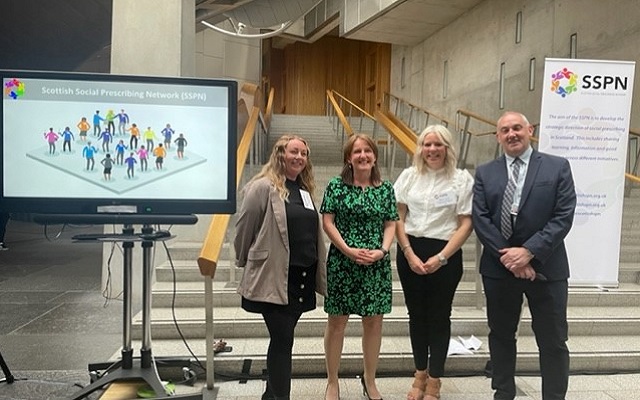
Representatives of the Scottish Social Prescribing Network (SSPN) at their parliamentary reception last month, with Maree Todd, Minsiter for Public Health, Women’s Health and Sport, and Paul McLennan MSP.
|
||
|
||
|
Social prescribing has been a part of Scotland’s health and care offerings since at least the 1990s, and has become more widely used with the establishment of community link workers (CLWs) who provide a connection between primary health care teams and non-clinical community organisations.
A key focus of a recent Scottish parliament committee inquiry, social prescribing has widespread support from healthcare professionals and policymakers but its wider rollout has been limited by insecure funding arrangements and an “abysmal failure” to communicate the role of social prescribing to the public.
Alison Leitch, representing the Scottish Social Prescribing Network, speaks to healthandcare.scot about the next steps for social prescribing in Scotland and what policymakers can do to fully embed this alternative approach to primary care in Scotland.
Alison Leitch works as part of the Edinburgh Community Link Worker Network, an early adopter of the Scottish government’s pledge to establish 250 more CLWs across Scotland. Her organisation is one of eight members of the Scottish Social Prescribing Network (SSPN) steering group which is made up of social prescribing programmes, medical students, and cultural partners.
Established in 2020 to fill the void of formal governance of social prescribing programmes in Scotland, the SSPN works to raise the profile of social prescribing and provide a space to share good practice to the ever-growing variety of schemes fighting against the social determinants of health – including poor housing, social exclusion, and deprivation - in their communities.
The key aim of the SPPN is to embed social prescribing into Scotland’s health and care system, and for it be recognised as an instrumental link between health care and the community. However, a lack of formal governance and structure to social prescribing has held back the approach.
“To us, the glaringly obvious thing is that there’s no overarching structure to social prescribing in Scotland,” Ms Leitch explains.
“We don’t want it to become prescriptive. But we would like just an overarching structure to be in place. It just makes it embedded and creates the foundation for it to then be adapted to best suit the needs of the local population.”
She says that an overarching structure would allow for social prescribing to become firmly embedded into health and social care in Scotland:
“Just to create that foundation – we’re not saying the Scottish government should be rolling out what a programme should look like, because every local authority and community is different.
“But if some minimum requirements were set so that there is a mechanism to show results and gauge if policies and strategies have been achieved, then this would also allow the role to be recognised in line with multi-disciplinary teams of other professionals.”
As a result, the network faces its major two-pronged challenge: needing to raise awareness to get policymakers, health practitioners and the public to ‘buy-in’ to the potential of social prescribing, without the formal oversight and evaluation structures to support the needed evidence-base to champion it – and that’s without taking into account pressures faced by the voluntary and third sector organisations who provide the bulk of social prescribing, of which many are facing insecure and short-term funding arrangements.
Case studies of those who have been able to take control of their health - often people who have struggled with poor mental health - with the help of social prescribing initiatives is often enough to get that buy in from policymakers and the public. There is increased recognition that the social model of health can reduce the pressure on NHS services, including GPs.
Ms Leitch says, “everybody seems to get it” but increased recognition of social prescribing’s benefits has not yet translated into meaningful action to more formally establish the network.
The need for this becomes even more apparent when looking at the far-more formalised arrangements over the border:
“In England you have a head of social prescribing within the NHS; in Wales, it's within Public Health; and in Northern Ireland, it sits within the Department of Health,” Ms Leitch says.
“In Scotland we don’t have anything like this. Social prescribing currently sits across two ministerial portfolios, so in both Kevin Stewart’s and Maree Todd’s there’s talk of it.”
Social prescribing in future policy
More recently, the SSPN has celebrated a major success in its mission to raise awareness: it held a successful parliamentary reception attended by more than 70 guests, including the Minister for Public Health, Women’s Health and Sport.
Paul McLennan, MSP for East Lothian and sponsor of the event, told attendees that social
prescribing is a “no brainer”, as he celebrated the most recent Scottish parliamentary election ushering in “an intake of politicians who now understand the value of social prescribing”.
The key next step for social prescribing according to the MSP is for policymakers to understand what shape local services should take and how these will to best meet local people’s needs.
The Scottish government had put in place an additional 218 CLWs by March last year since their 2016 pledge, but access varies greatly between regions. The Scottish government said provision of link workers “was never intended to be universal”.
Voluntary Health Scotland (VHS) is being funded to map the availability of government funded CLW programmes across Scotland, and the SPPN intends to undertake a similar exercise but to also include those in the third sector.
VHS has also recently undertaken a review the training and developmental needs of CLWs, with the view of developing national standards.
Back in 2019, a predecessor of the health and sport committee found that a barrier to health practitioners’ use of social prescribing was a lack of both quality assurance of third sector programmes and strong evidence for its long-term effectiveness. While many organisations carry out their own evaluations for their stakeholders, Ms Leitch says the lack of cohesive system for measuring, evaluating and reporting on the value of social prescribing programmes remains a barrier to further buy-in:
“For the Link Worker Programme, there’s no state required evaluation. In Scotland there’s no central point for any evaluations to be held. The English network have a section on their website.
“We shout about [our evaluations] when we publish them and we plan to host them on our own websites but there’s no central point in Scotland.
“And so if you don't know about the networks then you don't know about the work that's going on, they don't know about evaluations.”
The Scottish parliament’s Health, Social Care and Sport Committee’s recently completed inquiry into alternative pathways to primary care revealed mixed enthusiasm and knowledge of social prescribing among GPs.
The SSPN sees early engagement with doctors at the beginning of their career as crucial to the wider rollout and awareness of social prescribing. They say that, through the English social prescribing network, there are now student champions in each of Scotland’s medical schools who are keen to work with local social prescribing programmes.
The SSPN has also recently worked with first year medical students at the University of Edinburgh, as well as students on Scotland’s first graduate entry medical programme, ScotGEM. The latter, according to Ms Leitch, is trying to incorporate more social prescribing throughout its curriculum which she sees as “really positive”:
“Any social prescribing programme wants to be able to promote their message and if they can get medical students on board, and that's the idea of focusing on young doctors and the training doctors since they are the ones that absolutely get it and see its value.”
The Scottish Social Prescribing Network (SSPN) is free to join and any organisation or individual carrying out or interested in social prescribing in Scotland is encouraged to become a member.
Read more: Alternative pathways inquiry reveals obstacles; Insight: Links workers’ vital role; GPs ‘unaware’ of social prescribing options
Sign up to our bulletin for key health & social care updates straight to your inbox. |