|
Autism groups lead call to scrap Commissioner plans |
Related newsProviders: children’s service cuts ‘devastating’ 40 years of disability with attitude Voices of disabled key to policy development Inpatient CAMHS care too variable 
|
|
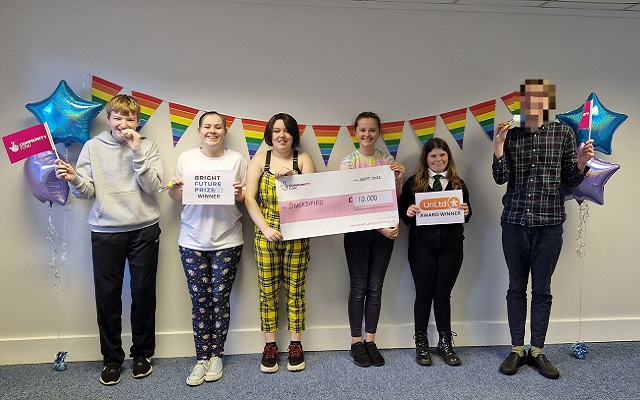
Kaydi Scottsville, the CEO of Diversified: Scotland’s Autistic Youth Led Charity (second from left),
with other members of the charity |
||
|
||
|
Organisations led by autistic people across Scotland have come together to voice “considerable concern” at the creation of a Commissioner for Learning Disabilities, Autism and Neurodiversity, suggesting clarity about the roles of existing commissioners is more important than adding to confusion over who people should go to when their rights are breached.
The Scottish government has committed to establish a dedicated champion within its proposals for a Learning Disability, Autism and Neurodiversity Bill, due to be consulted on later this year.
The National Autistic Society (NAS) Scotland and Scottish Autism have led the campaign for a commissioner, a role they say is vital to help people “fight their corner”.
However, organisations run by and for autistic people say there is little support for the proposals among their memberships.
Representatives from five autistic-led groups, collectively supporting thousands of autistic people across Scotland, have come together to ask the Minister for Mental Wellbeing and Social Care to rethink the plans.
Autism Understanding Scotland, Scottish Ethnic Minority Autistics (SEMA), Diversified Scotland’s Autistic Youth Led Charity, Autistic Mutual Aid Society Edinburgh (AMASE) and Autism Rights Group Highland (ARGH) say the campaign for a commissioner continues despite a lack of support from disabled people organisations (DPOs).
In a letter sent to Kevin Stewart, the groups say the Scottish government “risks wasting money on something that is duplicative, ineffective or even counterproductive”.
They say funding should instead be focused on improving access to assessment and post-diagnostic support and raising awareness of existing commissioners.
The four co-signatories healthandcare.scot spoke with say a new commissioner’s office will not be any better placed to deal with individual breaches of autistic and neurodivergent people’s rights than other existing structures.
Marion McLaughlin, CEO of Autism Understanding Scotland, tells us a commissioner will not be able to affect the level of change and improvements needed for autistic people:
“One of our big concerns is that saying that we need a commissioner is very much putting the cart before the horse. We haven't done a proper audit of the commissioners that are out there, we've not done a proper audit of the laws to see where the gaps are, and we've not done a proper audit of the routes to address the issues that we face.
“Until we do these things, we don't know what is actually going to be the most effective way ways to address the issues that the autistic community is facing.”
Autistic people in the UK have their rights safeguarded through the Equality Act (2010) and the Human Rights Act (1998).
Four United Nations Human Rights treaties, including Article 19 of the Convention on the Rights of Persons with Disabilities (CRPD), are also set to be incorporated into Scots law via a Human Rights Bill this parliamentary session.
Scottish Autism and NAS say the current system “frequently and persistently” fails to enable the human rights of people with a learning disability and/or autism, and that a commissioner would help to close the accountability gap.
Kabie Brook, Chair of ARGH, questions the need for another layer of legislation:
“We want to make our existing protections work – we already have the right laws in place. Can we have more advocates, can we make it easier so that people stop ignoring our rights? We know that the legislation isn’t working but why can’t we make it work without an extra layer?”
Kaydi Scottsville, the CEO of Diversified: Scotland’s Autistic Youth Led Charity, says money for a commissioner would be better spent directly addressing the core issues autistic people face to give them a better quality of life – rather than “another person sitting behind a desk not understanding our community’s true needs”.
Autism Understanding Scotland’s Marion McLaughlin highlights concerns that another commissioner could muddy the waters of accountability even further:
“If we decided that we want to go to the commissioner, because things aren't right for our autistic child, would we go to the Children's Commissioner? Would we go to the Equality and Human Rights Commissioner? Would we go to the Learning Disability, Autism and Neurodiversity Commissioner?
“I can guarantee you, what would happen is, we’d go to one and then get told to go to a different one. Autistic people and their families are already fed up with being pushed from pillar to post.
“I think tooling up existing commissioners and tooling up existing support structures is something that’s going to be a lot cheaper, faster and will streamline things more for us.”
Sofia Akbar from SEMA tells healthandcare.scot that more siloed working from commissioners will make things especially harder for autistic people who face discrimination in multiple ways:
“What I hear most from parents and carers of autistic children is that their additional support needs
are ignored because they’re not white and it’s instead interpreted as a cultural deficit. Would they complain about the racism or the ableism?
“We’re putting too many things in compartments and that just ruins it all. We have the Children’s Commissioner and the Human Rights and Equality Commissioner which takes into account intersectionality. We need to just fix those.”
“Listen to us, don’t speak for us”
Scottish government analysis of the responses to its Learning, Disability, Autism and Neurodiversity Bill pre-consultation exercise shows a majority of DPOs it spoke to are “sceptical” toward the creation of a new commissioner.
In contrast, groups established by parents of autistic people – like Scottish Autism and the National Autistic Society – have strongly backed the proposals.
It comes as a Scottish parliament committee raises fears over the growing costs of independent officeholders. Proposals for a Learning Disability, Autism and Neurodiversity Commissioner will be one of potentially seven new offices.
The DPOs healthandcare.scot spoke with say they are eager to continue to work closely with the Scottish government as key drivers for positive change, but that this campaign has so far been “done to the autistic and learning disability and wider neurodivergent communities as opposed to with us”.
Kaydi Scottsville from Diversified Scotland’s Autistic Youth Led Charity says it is concerning that autistic people – especially younger people – have not had as much prominence of a voice as they should have had throughout the pre-consultation exercise:
“Young people are our next generation of change makers, we advocate hard to be heard but our voices are being silenced. Why are non-autistic voices leading the way and telling us what we need rather than listening to those it actually affects?
“We need to stop being seen as inferior or less than those who are neurotypical.”
ARGH’s Kabie Brook says the way the 'for us' organisations, like Scottish Autism and NAS, speak to autistic people can feel “infantilising”.
Marion McLaughlin from Autism Understanding Scotland continues:
“A lot of politicians aren’t necessarily aware of ARGH and SEMA, AUScot, and other autistic people’s organisations so they don’t know they should be consulting with us when deciding what to advocate for regarding autism policies. If they know we exist, they often don’t realise that many of us are actually professional organisations that do an awful lot of work supporting our own communities.
“When we talk about autism, we aren’t just talking about our own lived experiences, we’re talking about the lived experiences of the people we support as well.”
The Scottish government says it will now facilitate three new panels made up of people with lived experience, professionals and stakeholders to design a consultation on the Learning Disability, Autism and Neurodiversity Bill.
Sofia Akbar from SEMA says it is just parent-carers, rather than autistic people, who want a commissioner and that autistic advocates feel let down:
“There is emotional turmoil for all of us because we are continuously ignored. We are being othered, we’re told we’re being too aggressive and that we want change too fast.
“If Scotland is going to be a leader in human rights, then listen to our voices. What’s so hard about that?”
Scottish Autism and the National Autistic Society Scotland were approached for comment.
Rob Holland, Director of the National Autistic Society Scotland, said: “Too often we hear from autistic people and families that do not have the support they need to live fulfilled lives on their terms. This is not for want of good laws, strategies and policies, but there is a gap between the support people should receive and what they actually receive.
“A Commissioner for autistic people and people with a learning disability in Scotland would be the first of its kind in the world, injecting accountability into the system to ensure people get the support and services they need.
“We recognise that our charities are part of a broader landscape of autism organisations, and that there are different views about how to proceed with the Bill. Regardless, we hope to work alongside other autism organisations and our learning-disabled colleagues to achieve the change that is desperately needed.”
Dorry McLaughlin, Chief Executive of Scottish Autism, said: “Scottish Autism is approached constantly by autistic people and their families who have been let down by those that should support them, who do not receive the services to which they are entitled, and who have to fight for the support they need. We hear these stories daily from people coming to our one-stop-shop, our advice line, our post-diagnostic support services and those looking for support with social care and education.
“The proposal for an autism commissioner has been put forward in order to suggest a mechanism for holding government and services to account for delivering on people’s rights, promoting good practice, and for working with the autistic community to set an agenda for this work. It has widely been supported by the autistic people and their families with whom we have engaged – in a recent survey of 1,215 autistic people, families and professionals undertaken by Scottish Autism and National Autistic Society Scotland, 96% of respondents supported the idea of a commissioner.
“We recognise that there are differing views on this proposal and other organisations whose voices are crucial to this debate have made their views known in forums provided by the Scottish government. The Scottish government have committed to hearing from a range of perspectives as they consult on a bill to protect the rights of autistic people and we trust that this will happen.”
Read more: Too many commissioners?; Consultation on Disability Commissioner Bill; Powerful new advocate for patient safety proposed; Fears learning disability champion no longer priority
Sign up to our bulletin for key health & social care updates straight to your inbox and you can follow healthandcare.scot on Google News.
|