|
Council care failures echo Shakespearean tragedy |
Related newsThe in-between: what’s happened to care reform? National Care Service plans scrapped Scotland makes world-leading commitment to care Action for social care workers “can’t wait” Review: More social care staff should be regulated Call for windfall tax on care agency profits 
|
|
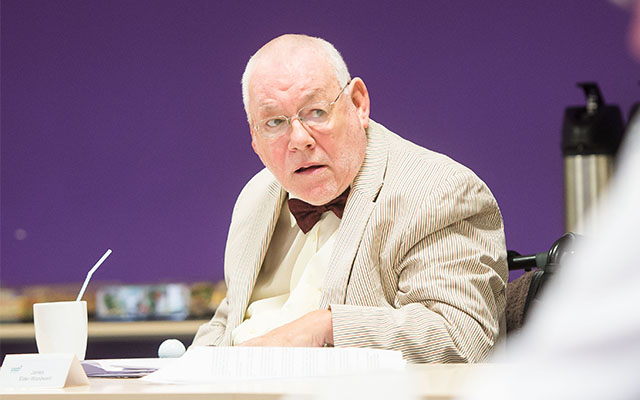
Dr Jim Elder-Woodward
|
||
|
||
|
Disabled activist Jim Elder-Woodward reflects on COSLA’s history and, now with the signing of the Verity House Agreement, future in the running of social care services across Scotland.
The set-up of a National Care Service, Dr Elder-Woodward argues, should have been an opportunity to reassess the role of councils in social care, as he draws parallels between their control of a ‘broken and unjust’ system and Shakespeare’s King Lear.
However, he questions whether local authorities are willing, as Lear is, to confront their past failures and build a fairer system.
In Act 3, scene 4 of Shakespeare’s play, we find Lear being welcomed into a heathland hovel. There is an almighty storm brewing outside the shack, which is, itself, in the barren heathland out with mediaeval, ‘civilised’ society, of which he once was King. He cries out:
Poor naked wretches, whereso'er you are,
That bide the pelting of this pitiless storm,
How shall your houseless heads and unfed sides,
Your loop'd and window'd raggedness, defend you
From seasons such as these? O, I have ta'en
Too little care of this! Take physic, pomp;
Expose thyself to feel what wretches feel,
That thou mayst shake the superflux to them,
And show the heavens more just.
Lear is coming to terms with his oppressive behaviour as a King and beginning to sympathise with those casualties in the heathland. Although many of whom were cast out by being diseased or impaired, several of them were politically banished by him as King. Now, banished himself, Lear experiences the same abandonment and exclusion.
Reading this extract, I reflect on today’s debacle over the control of the broken and unjust social care system in Scotland.
Those of us who “bide the pelting of this pitiless storm” of today’s social care support system can certainly empathise with the “poor naked wretches” Lear addresses.
We might not be in the same dire straits as them, but, for example, in his book “The needs of strangers”, Michael Ignatieff likened the wastelands of today’s psychiatric system to Lear’s medieval heathland.
Indeed, in the province of today’s society of rough sleepers, food banks, suicides of those stigmatised and down-trodden by the welfare state, and criminals through poverty, the outcome of such little action of meaningful care and support can be clearly visible.
Not so visible is the post-colonial social care support system, within which professionals retain the power they had within institutions over the lives of those who now receive their ‘time and task’ care in the community.
So, Lear’s lament:
How shall your houseless heads and unfed sides,
Your loop'd and window'd raggedness, defend you
From seasons such as these?
may well fit today’s welfare state, in this season of austerity and post-COVID artic chill, the consequences of which can be heard in the words of one recipient, who describes the outcome of the ubiquitous cutbacks in service delivery:
"When my carer comes in the morning I (now) go to the toilet, and before she goes, she puts on an incontinence pad for me so that I can do the toilet in my chair. I have been told to wet or soil myself. When they come back at night to make my dinner, they change my pad. I am so embarrassed; I don’t let my friends visit me anymore."
This quote shows how the present system runs rough shod over the dignity and privacy of the person.
The proposed National Care Service (NCS), it is said, will support the dignity of the person when supporting them. It will also standardise provision across the nation to enable people to experience the same rights-based, ethically commissioned provision, no matter where, in Scotland, they live.
However, the Convention of Scottish Local Authorities (COSLA) were not pleased to be losing sole control of their 17th century Poor Law system of welfare support.
Here, ‘paupers’ had to return to the parish of their birth to prove they were ‘deserving’ of ‘parish relief’. This system has developed into today’s social care support services, which delivers a disjointed resource-led system. Since the late 1970s, such service provision has operated on the disreputable principles of neoliberal management, where the pound trumps the need.
Nevertheless, during the 20th century, the 1972 Chronically Sick and Disabled Persons (Scotland) Act (s15) and the 1986 Disabled Persons (Services, Consultation and Representation) Act (s10) made statute that, when appointing non-members to committees, local authorities should appoint people with lived experience of disability. In fact, the 1986 (s10) legislation states:
Where any enactment provides for the appointment or co-option to any council, committee or body of one or more persons with special knowledge of the needs of disabled persons, such appointment or co-option shall only be made after consultation with such organisation or organisations of disabled people as may be appropriate in each case.
There is little evidence these clauses were ever enacted. Indeed, one commentator has wondered if they ever were, would we be in the same ‘mess’ as we are now?
The NCS was supposed to be based on the lived experience of those receiving social care support.
Now the Scottish government has signed the Verity House Agreement with COSLA, behind the backs of those who were supposed to be pivotal to the development of the NCS.
This Agreement now states that the default position of social care support will be at the local level, and any ‘national’ policy must be agreed by local authorities. In addition, the NCS National Board will be overseen by a tripartite group, consisting of COSLA, the NHS and the Scottish government – so any decision of the NCS Board can be vetoed by any one of this tripartite group.
Members of COSLA have never acknowledged the harm that has been done by their complicity within the neoliberal management of social care support over the last 50 years. Neither have they entered meaningful dialogue with their service users. Indeed, one former Director of Social Work has reputedly told a group of disabled people: “We can’t afford your human rights”. Try saying that to women, or those with other ‘characteristics’ within equality legislation.
With such a history, I wonder if those members had ever contemplated on their management of social care support, over the past half century, and came to the same conclusion as Lear: “I have ta’en too little care of this”.
I wonder if there should be a period of ‘truth and reconciliation’ before moving towards a ‘new’ system still dominated by COSLA members. Indeed, in scene 4 of Act 3, Lear now wants to take his own medicine (“physic” for internal use and “pomp” for external). He wants to “show the heavens more just”.
Is that what COSLA members want?
The views of columnists and people who write other guest insights articles are their own.
Read more from Dr Jim Elder-Woodward: Ready to fail - or already failed?; Where is lived experience in care regulation review?; £153 a week for bread and jam; The right to have needs met by the NCS; A rebuttal to NCS discontents; Don’t let ILF wither on the vine
Sign up to receive our bulletin for key health & social care updates straight to your inbox. |
