|
Piecemeal approach to serious NHS errors handling |
Related newsScotland’s Clinical Entrepreneur initiative returns Parties must explain how they’ll save the NHS Innovation and Scotland’s first digital hospital NHS is working to address “unacceptable” abuse NHS board savings push could see AI replace staff NHS problems ‘still need fixed’ despite pandemic focus NHS whistleblowing champions appointed Briefing: Scotland’s health & care intelligence Scots warned not to assume virus immunity Scotland reaches testing target & expands eligibility Nine NHS boards predicting deficits 
|
|

Image: © VILevi
|
||
|
||
|
Scotland’s NHS boards have still not adopted a consistent approach to how they report and investigate the most serious incidents, including unexpected patient deaths, 18 months on from a new system being introduced.
Boards have commissioned reviews into nearly 800 of the most serious failings since January 2020, data released under freedom of information legislation reveals.
Different boards class different incidents as ‘adverse events’ and the rate of reporting is much higher in some parts of Scotland than others – including for drug-related deaths and suicides.
Around 50 significant adverse event reviews (SAERs) - which are supposed to facilitate learning and to include unexpected deaths, suicides and infection control failings - have taken place every month over the last year-and-a-half.
Healthcare Improvement Scotland, which runs the national database, told healthandcare.scot it is continuing to work with NHS boards to achieve a “standardised approach, including terminology and definitions”.
Fraser Morton, a father whose baby son Lucas was stillborn at Crosshouse Hospital in November 2015 and who has since campaigned for improvements to the way errors are reported and learned from, said little had changed.
“They are still wrestling with the same issues which had plagued our adverse event system since they were first raised by [NHS whistleblower] Rab Wilson in 2012 when Nicola Sturgeon was Cabinet Secretary for Health. These same issues undoubtedly were a contributory factor in the death of Lucas and countless others across many years.
“We will never know the true number, which is appalling in itself and indicative of the general malaise in healthcare’s approach to investigation, scrutiny and transparency. These problems have persisted despite no fewer than five changes of Cabinet Secretary.”
The impetus for the changes came after concerns were raised that NHS Ayrshire & Arran had used its own definition of what constituted an ‘adverse event’.
In September 2019 former Health Secretary Jeane Freeman asked Healthcare Improvement Scotland to work with boards to bring in a more consistent approach, stating ‘we have one NHS in Scotland and I expect now to see greater consistency’.
But analysis of data released to healthandcare.scot shows the approach to carrying out the reviews still varies dramatically, despite the new standardised approach being published in January 2020.
As part of the changes, NHS boards were asked to report and undertake Significant Adverse Event Reviews for category I adverse events to a new national database.
These are defined as ‘occasions that may have caused permanent and significant harm, including patient deaths’.
Some health boards continue to follow different definitions of what constitutes a category I event according to Healthcare Improvement Scotland, who told healthandcare.scot “it is not possible to compare data on a like-for-like basis across NHS boards.”
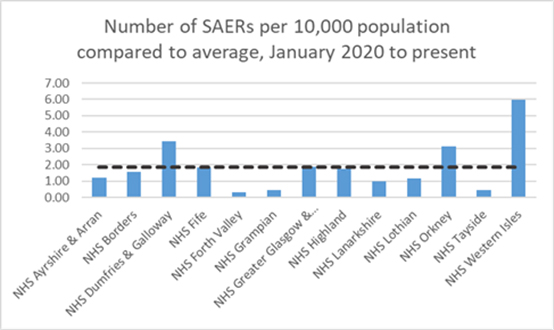
The level of reporting varies dramatically between boards, even after adjusting for population.
NHS Fife, which has a population of around 370,000, reported carrying out 68 category I reviews between January 2020 and May 2021, while neighbouring Forth Valley, which looks after 300,000 people, carried out just ten.
NHS Greater Glasgow & Clyde carried out more than twice the number that NHS Lothian did, despite being around only 30% bigger in population terms.
A spokesperson for Healthcare Improvement Scotland said the pandemic had a “major impact” on this area of work, adding:
“Each NHS board is responsible for applying the National Framework for learning from adverse events through reporting in the context of its own local incident reporting systems and governance processes.
“There remains some variation in how the National Framework is applied in practice. For example, some NHS boards record certain adverse events as category I events, where other NHS boards do not. This means that it is not possible to compare data on a like-for-like basis across NHS boards at this time.
“Healthcare Improvement Scotland plans to publish a report on the progress of the SAER notification system later this year, with recommendations and a more detailed analysis of findings from the data.”
healthandcare.scot asked three boards that had significantly lower rates of reported SAERs than average levels if they were confident serious failings were being identified, recorded and investigated properly.
A spokesperson for NHS Tayside said the board actively encouraged staff to record any adverse event, no matter how small:
“We recognise that there are inconsistencies in how health boards across Scotland categorise their significant adverse events and one area that differs is the reporting of suicides and drug related deaths.
“In NHS Tayside, although these events are significant and are reviewed, these deaths do not automatically trigger a significant adverse event review, depending on the circumstances surrounding the incident.”
The spokesperson added significant clinical incidents are “always extensively investigated”.
NHS Forth Valley, which has reported 0.33 SAERs per 10,000 people to Healthcare Improvement Scotland since January 2020, in comparison to a national average of 1.86, said:
“The number of significant adverse events in all areas will vary from year to year and we ensure that all incidents are fully investigated and reported in line with national guidance.”
NHS Grampian, which is also below average levels of reporting, did not respond to a request for comment.
In a statement, the Scottish government said: “NHS boards are responsible for applying the framework for adverse events and Healthcare Improvement Scotland is working with boards to address the variation in recording.
“This is work in progress and we expect the framework to deliver greater consistency as it develops.”
Read more: New NHS infection-fighting body launches; Prosecutors probe hundreds of covid hospital deaths; New safe care hub for Scotland’s health and care staff
Sign up to our bulletin for key health & social care updates straight to your inbox. Tags: Hospital & Specialist; NHSScotland. |