|
Leading from the north |
Related newsChildren’s doctor new Chief Scientific Adviser Scots honoured in health, care and sciences Scottish human rights head moves to COVID-19 Inquiry Edinburgh GP to chair BMA in Scotland RCGP: Future of general practice model at risk Inaugural award for NHS Grampian R&D Director Gene study helps islanders prevent disease New NHS Orkney head steps down after lockdown row Inspectors praise Dundee psychiatric unit New health & social care governance initiative EU staff qualifications & registrations confirmed Health Secretary to give evidence on rural GPs 
|
|
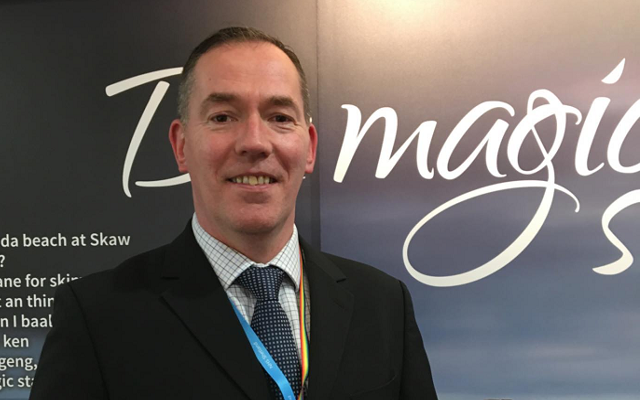
Michael Dickson, Chief Executive of NHS Shetland and NHS Orkney
|
||
|
||
|
With a background as a qualified nurse, working across the NHS in England and Northern Ireland and the independent sector in leadership positions ushering in major change and improvement, Michael Dickson took the reins of NHS Shetland just weeks before covid-19 struck.
healthandcare.scot spoke to the Chief Executive of NHS Shetland - and more recently NHS Orkney - about how the most rural and remote places can be the forebearers of unparalleled creativity and innovation in times of hardship.
Two things set Scotland apart from England, according to Michael Dickson – an appreciation for the innovation offered by smaller areas and the joined-up way of running services with public health at the heart.
“One of the things that is so amazing about working in the NHS in Scotland is that there is that recognition that health care is not about just Glasgow, Edinburgh, Aberdeen - it's about health care. I would hate for everything to be about the beacon hospitals.
“And also, the other thing that we don't have in England, is we don't build in public health from the start of our thinking. I can't stress how different that makes things. If you think about prevention, and how we make Scotland as a nation, a healthier, stronger community - that's transformational. It’s a multigenerational approach taken by Scotland and it’s really brave.”
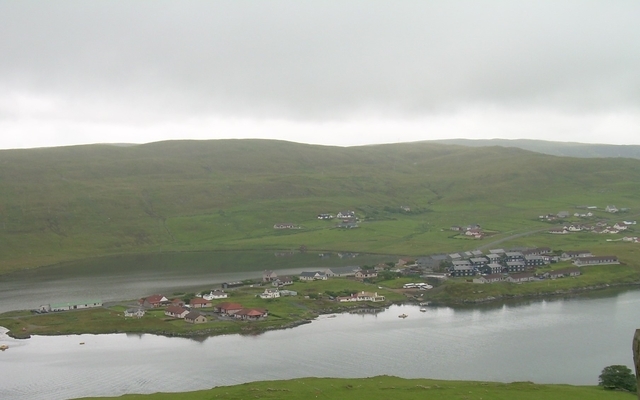
Shetland is no stranger to innovation says Michael Dickson, who took up the reigns of the health board in January 2020 after working on the NHS England “Getting it Right First Time” improvement programme designed to help improve patientcare. A tight-knit community, where staff “live and breathe” changes to service design means there’s a feeling of connectedness in Shetland and Orkney where impacts of decisions are felt more keenly by all:
“There is something different and quite special about working in a community that is quite so isolated, because there's a degree of resilience that comes with that community that you wouldn't necessarily get if there was a connected land bridge for example. People kind of get on and do manage, so that that kind of drives innovation and there is a steadfastness or stoicism.”
And it was the closeness of Shetland’s community that proved to be invaluable when covid-19 hit just a few weeks after Mr Dickson joined the team – the day, following a briefing with other chief execs, when he had to explain to his staff what was likely to be in store was, he says, the worst day of his entire career:
“Not only were we briefed about what was happening in terms of what to expect with covid-19, but I had to go back to a community – a brand new community for me, I had only been in position for a few weeks – and deliver potentially really stark news about what we're facing.”
This was made all the worse by Shetland having some of the earliest covid-19 cases in the UK – the region was hit particularly badly during the pandemic’s early months:
“We had no ability to test, we had no rules to be able to treat anyone, our nurses were going out and they were seeing the cases. And we were at one point, the hotspot for Europe, for getting it, because per capita, we had more cases than anywhere else that you had to put different colour on the graph because we were so hard hit. And that changed everything.”
At a time where towns and cities across Scotland saw formal care services shut down, and communities were mucking in to establish networks of informal support for those most at need, Shetland’s tight-knit population was already well placed to respond.
And the response, Mr Dickson says, was “unbelievable”:
“The NHS is a part of the community here as much as the community is as part of the NHS.
“The first question was, what can we do? How can we help? And can we volunteer?”
FB Live
Public communication during covid faced challenges, but Michael Dickson and the rest of the NHS Shetland and NHS Orkney teams – the latter of which Mr Dickson has also led since June 2020, following the standing down of the incoming chief executive after he broke travel guidance – have seized on new technologies to get their message heard.
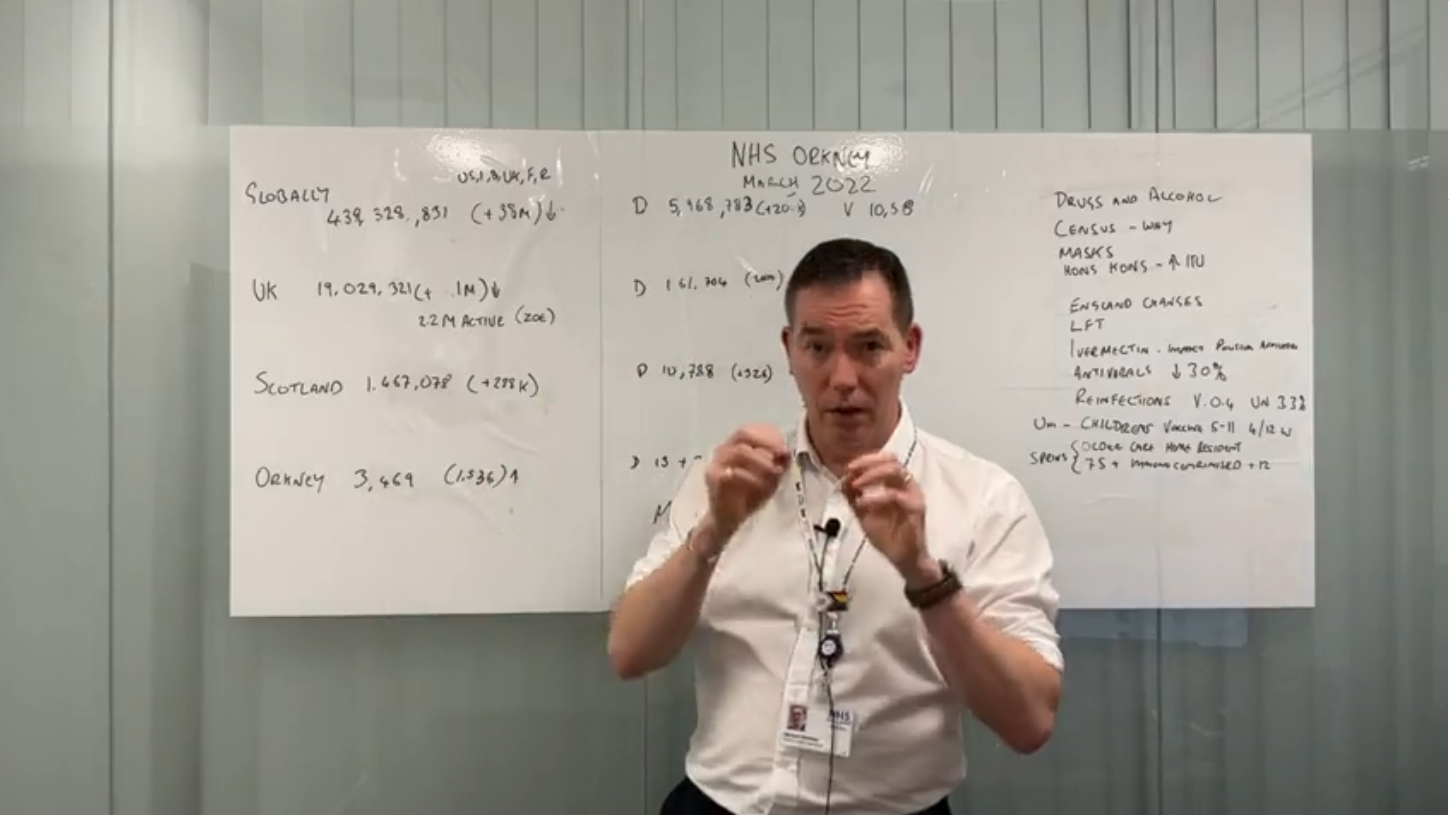
“There was a desperate need to talk to the community in a way that was direct and open and transparent. So I did one Facebook Live session, and it was myself and comms and Neil, our Spiritual Care Lead, and we just talked into an iPad and then we did that every single week, from March 2020 through to July.
“It started off as this kind of way to get to start engaging with the community then it started to build from there. So the second session, I talked about the consequences of covid, so, simple stuff.
“We showed people around the ventilation unit that we set up, because again at the time people weren’t allowed to go to the hospital to visit. We were getting our public health team to come and talk about the steps we could all take to help protect ourselves. And it was, and it still remains, a very direct route to interact in a way that again, you wouldn't get before.”
Using Facebook Live may have had humble beginnings but it soon evolved into a staple of the board’s communication campaign and remains hugely valuable as it grows and adjusts to the changing needs of the community. Mr Dickson says the Lives “equalise” public engagement, allowing people from home to ask questions or learn what’s going on:
“This was about a local picture about what we're doing in Shetland about how people could be confident that all of the various partners in Shetland were working together. It provides a degree of direct reassurance. We’re able to pick up local issues as they develop, and we have had people come in and talk about access to services in a way that they might not have been able to without.”
Patient travel
Since the beginning of the year, a mobile theatre has been operating at the isles’ Gilbert Bain Hospital, allowing as many as 400 people to undergo cataract removals, ear, nose and throat operations and - for the very first time on Shetland – joint replacements.
People in the most remote parts of the Northern Isles would previously have been expected to travel upwards of two-days to access some of these procedures in Aberdeen, but travel restrictions during lockdown curtailed this practice and the Scottish government had funded the Vanguard clinic for 12 weeks in recognition of the growing backlog of operations.
A consultation on the Scottish government’s proposed health and care strategy for older people revealed patient transport as the most common complaint. But Shetland is already ahead of the curve here too - a focus of the board has been to find other ways to take healthcare to the patient, in new methods of healthcare delivery it aims to continue long after covid-19:
“Doesn't that make sense that we get the experts to travel to the patient, rather than unnecessarily putting the patients who are often older, more ill, more infirm on various transport mechanisms to get them to the people that provide that care?” he explains.
“If we can do things in Shetland, that's great. But if we can get really creative and do things, even close to your home, or even in your home using remote technology, then that's fantastic.
“It's a shift in dynamic and I think it speaks well for the future, the we can innovate, and we can drive forward, unique ways of working that can be replicated in other evidence. And I think with that there has been a lot of support by the Scottish government for us to take these things forward. Because, you know, we're often working at pace, we're often working with small numbers, which means that the impacts of things that we did can really be felt and can be felt quite quickly.
“We've introduced new technology and we have done stuff in our isolated communities that we didn't think was possible before”
Challenges and the future
Like all health boards across Scotland, Shetland and Orkney face challenges in staffing their health and care workforce – perhaps facing even more of a struggle due to the isolated and remote nature of their communities.
The Scottish government has committed to lay out a workforce plan specifically for rural areas, though this is not expected until 2024.
In the meantime, Mr Dickson says both Orkney and Shetland are focusing on the unique challenges of working in remote areas offers and how this can aid people’s development – even if they only come to work for a short time:
“People's priorities have changed because of the pandemic so we need to offer the broadest approach to employment as possible. And for some people that might be about coming to work in Shetland or Orkney for three months, and then going off and doing something else - that's great, because we get the benefit of their expertise and they get the opportunity to study or develop or grow. And that's a critical part of our workforce strategy moving forward.”
Workforce, Mr Dickson explains, will be at the very heart of covid-19 recovery. But he warns that we must learn lessons from the lessons of covid-19 and not push staff too quickly to deliver more than they are capable.
“They've been through two years of an unprecedented nature. And we need to recognise that they need a few moments to catch their breath, to regroup. If we just expect everything to revert back to normal, then I think it would have severe consequences for our workforce.
“Even if covid vanished tomorrow we still won't go back to everything as it was - the NHS has to navigate a different path.”
Read more: Islands surge ahead in vaccination rollout; Islands & rural areas ‘overlooked’ in NCS; Insight: How covid changed the way we communicate
Sign up to our bulletin for key health & social care updates straight to your inbox. Tags: Covid-19; Senior Leadership. |