|
NHS leader: NCS threatens smaller boards |
Related newsSceptical response to government’s care proposals Bid to block IJB voting rights extension Holyrood passes Care Reform Bill Carers charities urge greater transparency in reforms National Care Service plans scrapped Minister: NCS has exposed "polar opposite" views Borders welcomes community dementia nurse NHS Borders decides it’s time for change Honest conversation needed as NHS Borders struggles on ‘Ground-breaking’ mental health support to go national Hospital planned ops cut by half ‘for some time’ 
|
|
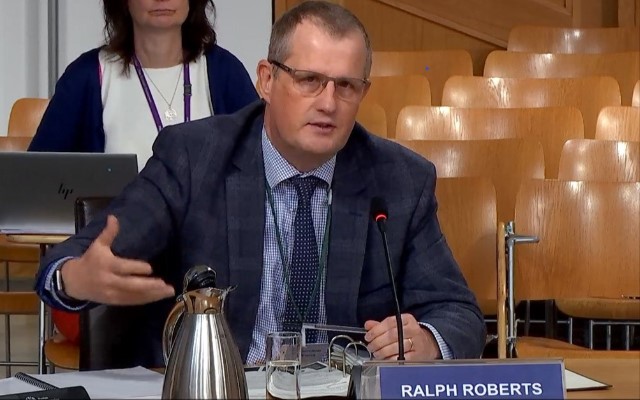
Image: Scottish Parliament TV
Ralph Roberts, CEO, NHS Borders
|
||
|
||
|
The chief executive of NHS Borders has questioned the continued viability of smaller NHS boards should half of their services be moved over to new care boards with the creation of a national care service (NCS).
Ralph Roberts, who is also Chair of the NHS Chief Executives’ Group, was giving evidence to Holyrood's Finance and Public Administration Committee as it continues its scrutiny of the financial implications of the government's National Care Service (Scotland) Bill, amid concerns voiced by MSPs and public finance professionals that, even before the recent surge in inflation, ministers’ estimates of the cost of setting up and running the new NCS are too small.
Mr Roberts said aspects of community health and mental health provision are included in the Financial Memorandum accompanying the Bill but it’s not clear what exactly is covered:
“Until we've actually understood exactly what those services are, and how they will be going in, and then what the relationship would be between the care boards and health boards in terms of the way they would work, it's very difficult to get to the detail of the costs, both in terms of the current cost of delivering the services but also the indirect costs and the support costs that are associated with us delivering those services.
“So, if I put that in the context of NHS Borders – community health, primary care, mental health is about 50% of NHS Borders’ budget. So if that money doesn't come directly to the health board in the future, and it goes direct to the care boards and then those services are commissioned from the health board, that is a very significant impact on our support structure.”
Later in the meeting, Mr Roberts questioned the impact on NHS boards of shifting decision-making away from the health service:
“If you look at this through the lens of Borders, approximately half of our budget would then presumably go to the care of boards and they will be responsible for strategically planning and commissioning primary care services, community services, mental health services and, as a health board, we would then be left commissioning, planning and delivering all of those services but planning the acute service.
“At that point are we right to have a health board in the Borders for an acute service? Arguably not. I passionately believe having a health board in the Borders is the right thing for the population of the Borders in terms of local decision making around health services, so I would absolutely not advocate for that. But we have to understand the potential knock-on implications of shifting the balance of responsibility.”
Mr Roberts, while supportive of the need to improve social care and improve outcomes, questioned whether organisational change was the right approach, not least at a time when services are under “more pressure than we have been at any point in the last two years”.
He said this impacts the ability of the NHS to engage properly with the development of the NCS plans.
MSPs on the committee were told that the government may not have taken into account important costs involved with setting up the new service, including the potential need to run the new and existing operations in parallel during a transition period.
The Audit Director for national finance watchdog Audit Scotland, Mark Taylor, said there is a central question still to be answered on the range of costs likely to be incurred in setting up the NCS, and whether embarking on such a path can be demonstrated to be affordable and sustainable:
“I think what's important fundamentally is, as government goes forward, as we go forward through parliament with this legislation, that there's an understanding of the full range of costs and the full range of financial benefit there. And the thing that would be surprising to me was if decisions were taken to proceed without that full understanding being there.”
Another witness, Emma Congreve, Knowledge Exchange Fellow at the Fraser of Allander Institute, was concerned that an entire section of the legislation around the formation of a single data system for health and social care did not seem to be accompanied by any estimates of its cost.
“The health and social care record is a good example of just feeling that we are very early on in the process and the scale of costs that will come not just from the operational setup, what's in the legislation, but from the transfer of duties in terms of the ongoing costs of providing care, and then the improvements to social care that are envisaged to come through the co-production process.
“At the moment we have very little understanding of some of those costs. And it makes it very difficult to then to be sure that the right scrutiny is going to take place at the right time.”
The committee heard that there is already concern that the timetable for developing the NCS plans has slipped with the publication of programme business cases appearing to have been delayed.
The National Care Service Bill being scrutinised by the parliament is framework legislation with much of the detail – including the number of new care boards and what existing health services will move across to the NCS – still to be revealed by the Scottish government. Ministers intend to enact these details through a mix of secondary legislation and issuing official guidance to the NHS and care boards.
Giving evidence to the committee on behalf of the Health and Social Care Alliance Scotland, Senior Policy Officer Hannah Tweed questioned the approach being taken by the government:
“We do have reservations about leaving quite as much detail to secondary legislation because there are fewer opportunities for editing proposals, [concerns] over subsequent transparency and why decisions are made, and cross examination, just because of the parliamentary process.
“And that's where we would like to see very, very careful movement through this first stage of legislation; to work out, even within the framework context, what needs to be shifted. I mentioned representation on care boards – that's an option at the moment in the legislation rather than necessary for quorate decision making.”
Dr Tweed said there was a concern that anything not in primary legislation might be squeezed out to save money.
Scotland’s Minister for Mental Wellbeing and Social Care, Kevin Stewart, is expected to appear before the committee next week.
Read more: Joint call for major National Care Service rethink; Yousaf: No place for tax haven firms in NCS; Excitement of integration "dampened" by NCS; Analysis: Scotland’s new care boards.
Sign up to our bulletin for key health & social care updates straight to your inbox
You can now follow healthandcare.scot on Google News. |
