|
Profile: First NHS Sustainability Fellow |
Related newsGreener NHS research funding boost NHS saves £82m a year through outdoor spaces Scotland first to ban planet-harming anaesthetic gas Scotland’s Clinical Entrepreneur initiative returns Parties must explain how they’ll save the NHS Financial balance pursued by NHS Lothian New sick kids completion date agreed Carer support included in city mental health plans Edinburgh Sick Kids hospital opens doors a year late Interim NHS Lothian head takes up chief exec role Larger care homes more at risk of covid outbreaks 
|
|
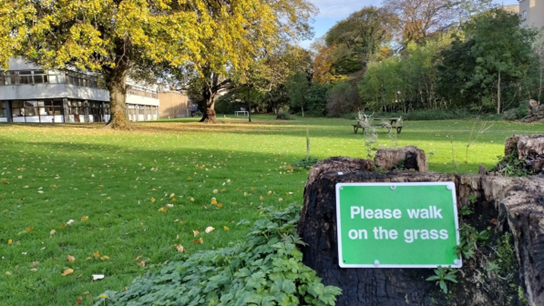
Image Credit: © NHS Lothian
NHS Lothian Green Space.
|
||
|
||
|
Dr Shauna Golden is NHS Lothian’s first Medical Education Fellow with a particular focus on environmental sustainability. A few months into her role, she shares her experience so far, the importance of engaging with climate action in healthcare – and combatting cynicism.
“I went into medicine because I was interested in humanitarian work from a pretty young age, and I liked the idea of having a skillset.
“And despite getting older, I have failed to become more cynical.”
Dr Golden – appointed to the first role of her kind in Scotland this August – spoke with healthandcare.scot about her background and the necessity of advocacy and education roles in climate action within healthcare.
What is an Environmental Sustainability Medical Education Fellow?
Dr Golden also works within the Facilities Management team with NHS Lothian’s Lead for Sustainability, Dr Jane Hopton:
“Trying to focus on both staff and patient experience, I work as part of a team of medical education fellows but my role is uniquely sustainability based.
“I work in medical education under the MED team, led by Simon Edgar, and the team has had huge success in NHS Lothian. Their focus is on improving quality and medical education for undergraduate medical students, doctors in training and improving overall quality of experience and safety for patients – they have some cool projects at the moment in terms of joy at work, green flag work.
Alongside sustainability, global health, health inequalities and humanitarian medicine, she continues to work fortnightly shifts in the Royal Infirmary of Edinburgh’s Emergency Department (ED).
Dr Golden adds that a huge part of all fellows’ roles is developing leaders for healthcare – to be able to lead positively and make changes in their specialised focus upon return to clinical roles.
Within her fellowship role, Dr Golden develops and actively leads on broader frameworks happening across NHS Scotland and NHS Lothian, including sustainable models of care, green prescribing, green theatres and green ED. Beyond these projects, she is supported to deliver educational content through both the University of Edinburgh and the NHS:
Here, she says her work involves connecting people with management or across different teams within NHS Lothian who would not naturally overlap and helping them to follow-through projects. Dr Golden adds that she particularly enjoys this work as disconnectedness can be disempowering in terms of making progress towards a net zero NHS.
What brought you to this role?
She says that hearing Professor Hugh Montgomery, who led the Lancet Commission on climate and health, speak around climate change “really brought home” the link between climate, health and social inequalities.
She adds that the former President of Ireland, Mary Robinson – who now advocates for climate justice – emphasises the idea that “it’s about human rights and people having a future” which further inspired Dr Golden, from Ireland herself, to work at this intersection.
“We have direct implications on health. So we see this in the rising of allergic conditions and new infectious diseases tracked to obstetric patients and respiratory conditions with an increase in respiratory deaths related directly to environmental impacts. We’ve also seen a rise in heatstroke and heatstroke-related deaths.”
Secondly, she explains, there are the indirect impacts on health from the climate crisis:
“Then, indirectly when we can see impacts on health from the climate crisis through the social determinants model of health. It's also been emphasised by One Health – wherein the things we need to live, be healthy and happy, are not being guaranteed.”
A One Health approach, building wellbeing and environment into healthcare, was highlighted by the University of Glasgow’s Professor Muscatelli earlier this month.
Dr Golden outlines examples of key indirect impacts that have been worsening in recent years:
“We see this most acutely with fires and flooding throughout the UK. The rising cost of food because of famine and drought from our food production. Then there’s the exorbitant energy crisis that we can’t maintain – exacerbated by lack of insulation in houses and our dependence on fossil fuels and high energy production.
The third way, she says, in which the climate crisis impacts our health is through health and care delivery:
“NHS Scotland and Scottish government released their climate action plan and it strongly makes points of adaptation and mitigation plans.
“They're not theorising but are actively planning for flooding, rolling energy blackouts which will impact on the ability of me and my colleagues to deliver health care.”
Launching the NHS Scotland sustainability strategy this August, Scotland's Cabinet Secretary for Health, Humza Yousaf, said that climate change is the greatest threat to human health and that good care means environmentally sustainable care.
How do you stay positive?
“I'm not really interested in problems, I’m much more interested in solutions. So that’s how I stay focused, it’s all about how we can act. I also think you have to recognise, particularly as clinicians, that we have both a very privileged role and a leadership role in society.
“That's not to negate the struggles that people have on all different levels of society. But my own personal view is that I have a lot of privileges and structural advantages so there's a duty of care – both to patients in front of me and to tackling things more upstream.”
“Focusing on direct impacts for people and their solutions is really interesting for me – and I think cynicism only exists to hold up the status quo. These are all very personal views but I think sometimes cynicism enhances structural power that is blocking change.”
With 1 in 23 people in Scotland employed by the NHS, Dr Golden says local boards have the opportunity to implement positive change at all levels:
“We are leaders in the community, and this was reflected in COVID-19. If you think of the NHS’s impact on health – we can look to the question of, are we doing no harm? Clearly many of our actions are harming the environment. But there’s a second question: could we do it better?
“Many of the actions we can take to minimise our carbon footprint and provide healthcare that ties into planetary care – that’s green space, promoting active travel and realistic medicine while reducing unnecessary pharmaceuticals.”
The Royal Pharmaceutical Society has praised Scotland’s climate emergency strategy for highlighting a realistic medicines approach – bringing patients into decision-making in care and limiting medicines waste where possible.
What’s next in this role?
For her “teamwork is everything” across both the teams she operates within, having received a lot of support on projects and specifically developing team work, communication and presentation skills.
Eventually Dr Golden is looking to leave a framework for how to work on climate action and sustainability projects alongside connecting people who want to improve their impact.
While she wants to help create a clear pathway for continuous work on broader NHS Scotland projects, she says reducing a sense of isolation to support positive climate work is key:
“If by the end of the year, people are feeling less eco-anxiety and isolated, I’ll be happy – obviously reducing waste and carbon emissions is going to be the big hits but people just not feeling so alone with these concerns is important.”
Dr Golden adds that there is a spectrum of impact and calls for local action as Scotland’s emissions are still too high and require more action on both a national and local level. She says we need more people working in sustainability groups across healthcare:
“There’s always callouts for more posts to be created and filled – much like the NHS staffing crisis, the sustainability crisis can’t be run by a team of five.”
Dr Golden is happy to be reached by email: shauna.golden@nhslothian.scot.nhs.uk if anyone is interested in contributing to or learning more about the work across NHS Lothian.
Read more: Working together for climate action and good health; Realistic medicine to help the climate; Disposable gloves to protect patients and the planet
Sign up to our bulletin for key health & social care updates straight to your inbox and you can follow healthandcare.scot on Google News. |

