|
Glasgow: Working together for a healthy city |
Related newsResearch enabled innovation spotlighted NHS saves £82m a year through outdoor spaces Chief Medical Officer: ‘Critical connections’ priority Collaboration on NHS procurement key to healthy future Protecting public health through pathogen genomics Making cervical cancer a ‘rare disease’ Holyrood hears evidence on abortion legislation Questions remain as hospital delay bill rises to £28m Hospital safety inquiry chair revealed MSPs to quiz health secretary over hospital crises Multiple Sclerosis register a ‘powerful new resource’ New health & social care governance initiative 
|
|

|
||
|
||
|
Speaking with Glasgow researcher Dr Annika Hjelmskog during a break from the first UN conference on Sustainable Development Goals, healthandcare.scot heard about the work of GALLANT, including collaborating for climate and wellbeing.
From transforming the economic framework to understanding the intersecting aspects of health and wellbeing with our ecological surroundings and the impact of the climate crisis, Dr Hjelmskog shared the challenges and solutions her team are working on.
Established in the University of Glasgow, ‘Glasgow as A Living Lab Accelerating Novel Transformation’ (GALLANT) works to support climate resilience through a whole-systems approach, looking at health, social and economic inequalities.
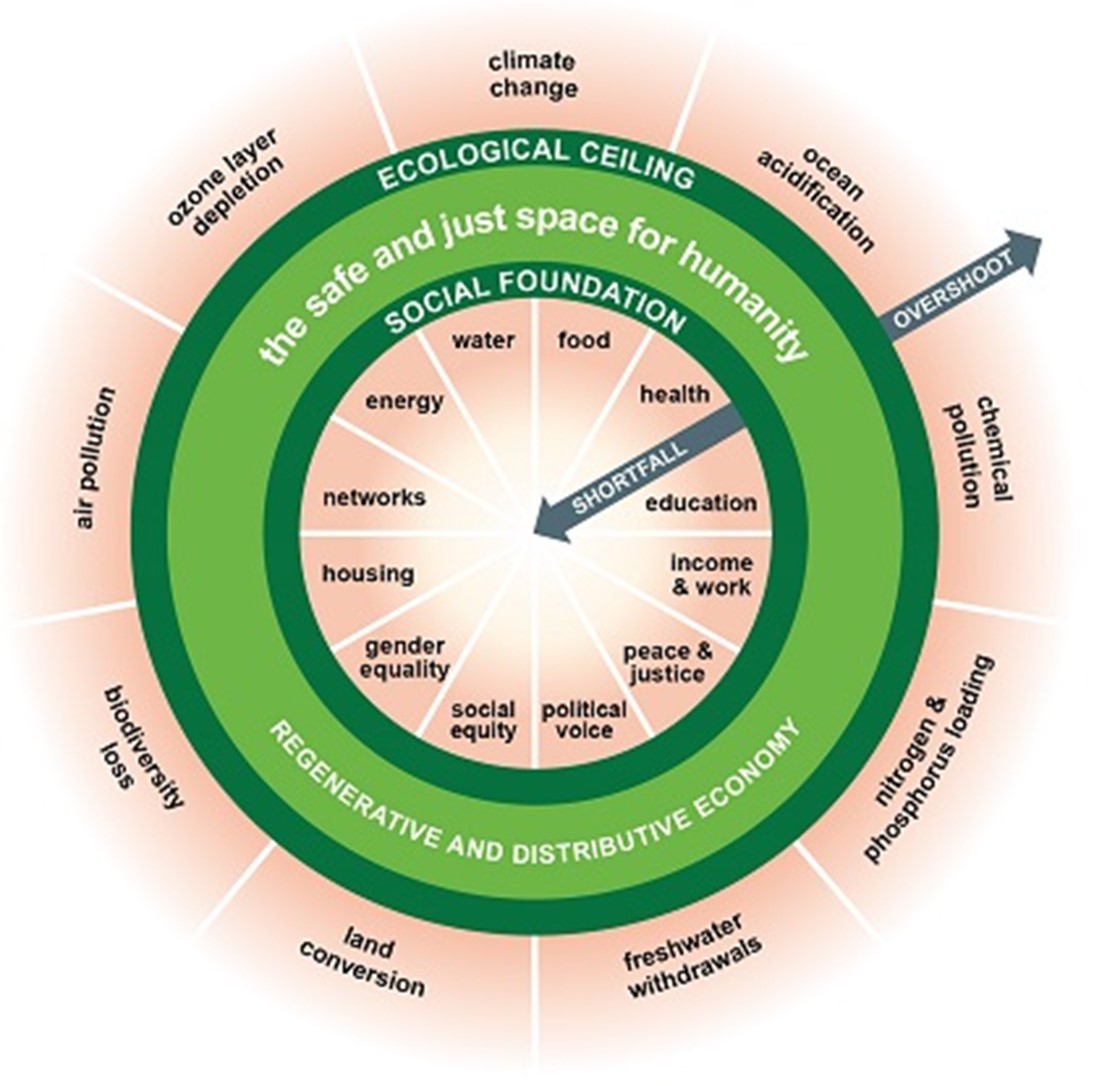
Dr Hjelmskog and her colleagues utilise Doughnut Economics to develop a City Portrait, which considers the social foundations of health and wellbeing and the ecological ceiling associated with planetary boundaries to meet the needs of all within the means of a safe, liveable planet.
© Kate Raworth’s Doughnut Economics framework via GALLANT.
Informed by economist Kate Raworth’s concept to Glasgow, the GALLANT team can track the shortfalls within the social foundations and the potential overshoot beyond the ecological boundaries – including biodiversity loss, air and chemical pollution, and climate change.
Primarily, the partnership of GALLANT is between the “large and interdisciplinary group of academics” working in Glasgow university and different departments in Glasgow City Council. Dr Hjelmskog explained:
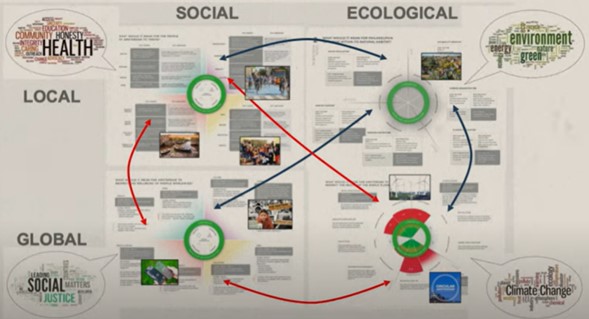
“We have a sort of four lens process to understand how Glasgow is doing and where it wants to get to in terms of climate and wellbeing.
“We set out by reviewing the existing targets, ambitions, strategies of the city, and what its goals are already in terms of the different doughnut dimensions. And then we connected indicators from publicly available statistics that show some degree of performance or measurement against those same dimensions.”
These four interconnected lenses for creating a City Portrait of Glasgow are the local, global, social and ecological factors which influence both the public and the environmental wellbeing.
Glasgow needs to maintain healthy natural environments in communities for its citizens and their wellbeing to thrive. As Scotland’s largest city, Glasgow also influences “a multitude of social and ecological outcomes” globally, from the impact of emissions and rising temperatures to consumption and waste from organisations like NHS Scotland and citizens.
Dr Hjelmskog adds:
“We’re doing a series of workshops with stakeholders across the city.
“This is to try and gain more insights about what that would mean in practice and for the different organisations and departments of Glasgow City Council to help enrich our findings and add to the data collected to produce this City Portrait which is more three dimensional.”
Health risks from climate change
Dr Hjelmskog says the work of GALLANT and other programmes of research and work to address climate change presents a “real opportunity to tackle health inequalities” by considering inequalities in designing approaches to adaptation and mitigation. She said:
“Climate change is impacting health and wellbeing in Glasgow in so many ways. I think a very clear and obvious example of risk to wellbeing in Glasgow and across Scotland is flooding – that’s one of the focuses of GALLANT, reducing flood risks.
“As soon as you realise how many different elements are connected to human health and planetary health, you realise that there’s a huge spread of experts working out there with really valuable perspectives and understanding to bring to the issue.”
Earlier this year as part of its urban profile on Glasgow, WHO identified flooding a major climate and health hazard, with around 45,200 homes, businesses and services considered at risk of flooding.
Following this year’s heatwaves, Glasgow experienced flash flooding brought on by the climate emergency – and with the ground hardened dry from the hot weather, the extent and impact of floods led to Met Office warnings to avoid driving and cancelled public transport.
Dr Hjelmskog explains that increasing temperatures and rainfall are impacting our rivers and infrastructure already and work is needed not just to adapt to flood risks but also to develop improved housing for people.
With additional concerns from fuel poverty, Dr Hjelmskog says that both long and short-term work is needed to support people with insulation and energy efficient housing and financial support for increased bills.
She says work underway in Glasgow to ‘green retro-fit’ housing, to reduce damp and make homes cheaper to heat, will help both the climate and public health.
From Dr Hjelmskog’s perspective, it is only possible to develop good health and wellbeing resilience to climate change in Scotland by working together globally and taking into account all the intersecting aspects.
NHS Lothian’s recently appointed Environmental Sustainability Medical Education Fellow says her work involves bridging the gap between clinical healthcare workers who want to support climate solutions and those at a management level with wider oversight.
GALLANT’s Dr Hjelmskog says that it is important to recognise that some complex solutions are needed to support climate and human health:
“We’re dealing with really complex issues of climate change, poor health and health inequalities, with interrelated and complex causes – they are chains of events that lead to these bad outcomes. So the solutions are also going to be really complex and take place across different parts of the system.
“Just like there aren’t silver-bullet solutions to climate change, we’re not expecting silver-bullet solutions to the human health crises, but we can think in terms of super interventions: policies and interventions that touch on multiple parts of the system.”
Such ‘super interventions’ for health and wellbeing, she says, require widespread engagement and ideally touch upon both social and ecological wellbeing. One example would be active travel initiatives which supports physical activity among Scots while lowering greenhouse gas emissions from cars.
Community and academic work
Speaking with healthandcare.scot during the first ever Global Sustainable Development Goals (SDG) Congress held in Glasgow, Dr Hjelmskog explained that a lot of her team’s work involves holding community sessions, engaging with community partners for climate and health to deliver effective action.
She added that those whose health and wellbeing suffers most from a degraded climate and often those that contribute least towards its degradation, with those in the most polluted parts of Glasgow likely to find it most difficult to manage expensive adaptations
Dr Hjelmskog said there is a large focus in GALLANT’s work on ensuring developing adaptations or mitigations are made easy and bring “the most additional co-benefits” to groups and communities who have the most to gain.
She says, for example, it is essential that adaptation strategies must be designed to be accessible and support people who most need additional support and benefits:
“So what we don’t want is just to put in a load of cycle lanes and bike infrastructure for active travel while leaving the existing traffic black spots – where pollution is worst – in areas that are already experiencing the poor health outcomes from climate change, such as air pollution and fuel poverty.
“We don’t want to leave those as they are at the expense of putting in green infrastructure where it may be easiest – sometimes it’s more difficult where it would make the most difference, but I think it’s really important that we push to do it in the right places.”
Air pollution has become increasingly concerning in Scotland as, despite some of the strongest targets on emissions and air quality, Friends of the Earth have estimated that air pollution contributes to over 2,000 deaths every year in Scotland. In 2017, Glasgow City had twice as many deaths attributable to air pollution in adults 25 years or older than any other Scottish city.
GALLANT will publish a full report of its ‘Glasgow City Portrait’ in 2023, with insight from research, policy reviews alongside and workshops held with communities, policy-makers, politicians, organisations and the general public.
Read more: Can Scotland make health fairer?; Realistic medicine to help the climate; NHS sustainability strategy launched
Sign up to our bulletin for key health & social care updates straight to your inbox and you can follow healthandcare.scot on Google News. |