|
Leaders pledge on sustainable prescribing |
Related newsFears new Boots owner will walk GPs hit back at critical Holyrood prescribing report Briefing: Freeman to give primary care evidence Call to rethink rollout of walk-in GP services Community Link Workers reducing stress on GPs Scientists to help cut NHS medical device waste Edinburgh IJB faces judicial review over cuts Scotland’s new Chief Nurse appointed Urgent plea to safeguard advocacy amid local cuts New gene study offers arthritis treatment insights New Edinburgh hub set to transform global healthcare 
|
|

|
||
|
||
|
The two professional bodies for Scotland’s GPs and pharmacists say they want to find a way to deliver greener prescribing of medicines to tackle climate change.
The Royal College of General Practitioners (RCGP) in Scotland and the Royal Pharmaceutical Society (RPS) Scotland say that further collaboration is necessary to achieve a transition to more sustainable prescribing.
Together, the organisations last year issued a statement saying that tackling the impact of prescribing will be a key part of meeting Scotland’s ambition of a net zero by 2040 at the very latest. Last week, they met again to discuss how both prescribing policies and decisions can change to reduce the emissions and waste around medicines.
Hosted by RPS and RCGP Scotland in Edinburgh, Laura Wilson, RPS Director for Scotland, said the event aimed to reach across partners in the work towards sustainable prescribing:
“I’m proud of the role RPS Scotland is playing, together with prescribing professional leadership bodies across Scotland, to highlight the huge potential that exists to reduce carbon emissions by prescribing in a greener and more sustainable way.
“At this event, we hope to secure even more support from partners who will commit to joining our international movement for sustainable prescribing.
“Together our actions will make a real difference and support our net zero ambitions for healthcare, both across Scotland and the world.”
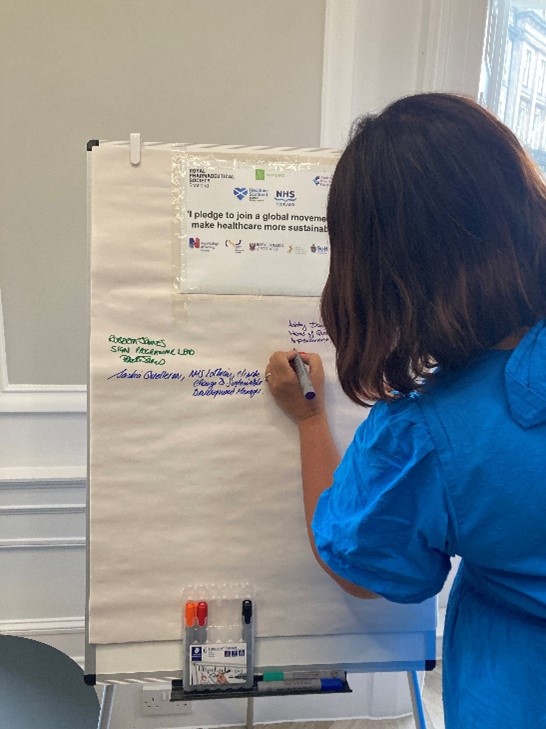
Organisers say the event marked an opportunity for health professionals and decision-makers to join the ‘global movement of sustainability in healthcare’ and pledge to continue work to prioritise the highest level of patient care while reducing medicines’ climate impact.
Attendees were invited to commit professionally to more sustainable healthcare.
Speaking with healthandcare.scot at the event, Gillian Mackay, the Scottish Green's spokesperson for Health and Care, said every minister and party spokesperson is effectively a health minister as all portfolios contribute to health and wellbeing.
She highlighted the recent interest in parliament in responding to concerns around children and young people using disposable vapes.
Attendees also heard about the government’s priorities for medicines and a net zero NHS from Scotland’s National Clinical Director, Jason Leitch, and the government’s Head of Effective Prescribing and Therapeutics, Alpana Mair, whose team issues national best practice guidance for prescribing.
Ms Mair said working to reduce medicines waste will contribute to more effective patient care and a wider environmental benefit – with around one in ten medicines currently wasted. She said to achieve a net zero NHS in Scotland, collaboration is vital.
Ms Mair, a pharmacist, highlighted the importance of healthcare reviews with patients as part of this – something she says will be a clear recommendation in the updated review of prescribing guidance to come.
A joint prescribing project found that medicines reviews were cost-effective as well as improving patient outcomes and benefiting the environment, as they often showed patients could reduce or remove medicines no longer required.
Dr David Shackles, Joint Chair of RCGP Scotland, echoed Ms Mair’s sentiment on involving patients in discussions and collaborating across professionals, saying:
“Our health is inextricably linked to the health of the planet, so good health care should strive to be environmentally sustainable care.
“We don’t really have any other choice – we’ve all got a role to play. But as Alpana said, we’ve got to take the patients with us.
"Collaboration is key if we are to truly tackle the health systems impact on climate emergency. This event is a welcome opportunity to share best practice and learning across all parts of the health service, to encourage more progress across all decision-making levels, and to give recognition to the pioneers of the sustainable prescribing movement."
Dr Shackles told healthandcare.scot that making the most of different professionals for meeting people’s health and care needs across Scotland is key, including the expanding role of pharmacists and community link workers.
RPS Director for Scotland Laura Wilson told healthandcare.scot that it is essential to see the new prescribing guidance on respiratory medicines such as inhalers, due in the coming months, rolled out with a consistent message, from pharmacists to doctors to nurses.
To do this, she said, it is important to hear from across healthcare professionals and understand the challenges facing each and to continue sharing learning around sustainable practices. At the same time, she invited all prescribers to “look at their own practices and find one small thing” to change:
“If they can find one small thing, and, you know, maybe next month they can find another thing before you know it by the end of the year, we'll be doing quite a lot of different things. And if everybody does that, the impact would be massive.”
Read more: Realistic medicine to help the climate; Working together for climate action and good health; New green inhaler prescribing guidance; Blue-green prescribing for climate and public health; A question of action
Sign up to our bulletin for key health & social care updates straight to your inbox and you can follow healthandcare.scot on Google News. |