|
“Watershed moment” for healthcare sexual misconduct |
Related newsPharmacy’s road to stigma-free drug dependency care New taskforce to drive ADHD and autism improvements Health and charity leaders join forces for NHS reform Call for ‘urgent’ review of ADHD and autism services NHS is working to address “unacceptable” abuse Scientists to help cut NHS medical device waste Edinburgh IJB faces judicial review over cuts Scotland’s new Chief Nurse appointed Urgent plea to safeguard advocacy amid local cuts New gene study offers arthritis treatment insights New Edinburgh hub set to transform global healthcare 
|
|
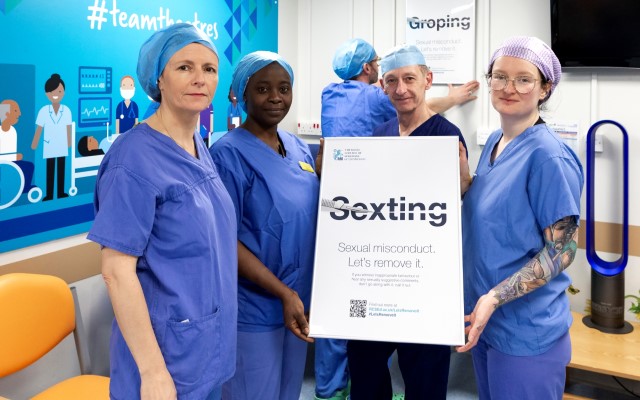
Image Credit: © RCSEd
Clare McNaught, Abisola Omolere, Steven Burns and Meghan Crawshaw.
|
||
|
||
|
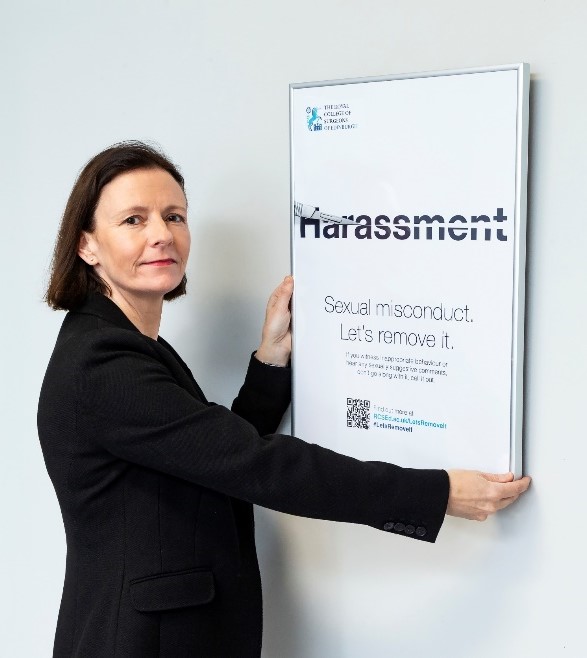
The Royal College of Surgeons of Edinburgh (RCSEd) has launched a UK-wide campaign to raise awareness of sexual misconduct in health and care settings and share a message of zero tolerance.
The ‘Let’s Remove It’ campaign has been launched in response to the harassment and sexual abused faced by many working across healthcare, particularly in surgery.
This campaign, backed by NHS Education for Scotland and Health Education England, will include an online hub of resources and signposting for support, as well as ‘hard-hitting’ posters and billboards to be placed across UK hospitals.
Additionally, an updated code of conducted is being developed for members of the Royal College of Surgeons Edinburgh.
Clare McNaught, Vice President of RCSEd, who is leading the campaign, says:
“This behaviour simply must not happen and the culture that has allowed it to happen must be wiped out.
“Our campaign says ‘Let’s Remove It’ - we are all in this together and can unite to eliminate sexual misconduct in surgery.
“Sexual misconduct in any form is an assault on dignity and encompasses a range of unwanted actions that create an intimidating, hostile or offensive environment for survivors.
“This can include sexual comments or jokes, displaying sexualised pictures, inappropriate emails, texts or WhatsApp messages, unwelcome physical contact, enhanced career opportunities offered for sex, sexual assault, and rape.
“It’s also important to understand that although sexual misconduct is predominately experienced by female staff, it can affect any healthcare worker.”
This comes after research from the University of Glasgow published last year revealed that a third of female surgeons have been sexually assaulted.
The ‘alarming’ results – which found two-thirds of women and almost a quarter of men working in surgery had been the target of sexual harassment from colleagues – were uncovered after researchers worked alongside the Surviving in Scrubs campaign and the Working Party on Sexual Misconduct in Surgery.
This same study reports that 89% of women and 81% of men in the 1,434 participants surveyed have witnessed sexual misconduct in the surgical profession in the last five years.
Meanwhile, the BMA pledged to end sexism in medicine after its survey of 2,458 doctors found that 91% of women doctors in the UK have experienced sexism, with almost half feeling unable to report it.
Herein, the BMA dedicated two of its ten key goals specifically to ending sexual harassment in medicine and ensuring multiple channels for reporting are available to doctors and medical students.
A series of webinars on women in surgery, dealing with sexual misconduct and related topics is also being developed as part of this collaborative project.
“Respect is non-negotiable”
The campaign work will be driven by a newly formed action committee within RCSEd, The Hunter Doig Group, named after two pioneering women in surgery.
Last year, a Women in Healthcare Leadership conference heard that organisational and cultural change is needed in the healthcare profession to address inequalities.
Hosted by the RCSEd and the Royal College of Physicians Edinburgh, the conference called for action to improve diversity at all levels of the workforce.
Now, RCSEd President, Professor Rowan Parks, highlights the responsibility the College holds to bring about this shift:
“We're acutely aware of our role as a College in supporting cultural change to ensure a safer, more inclusive workforce where respect is non-negotiable.
“By launching our ‘Let’s Remove It’ campaign, we say ‘No more’.
“No more turning a blind eye. No more accepting the unacceptable. This must be a watershed moment for our profession.”
The new action committee – composed of 30 women representatives – will be dedicated to wiping out sexual misconduct and serving as mentors, advocates and leaders in a ‘new era of respect’ within the medical profession.
The Let’s Remove It campaign it builds on work to eradicate bullying and undermining in surgery and highlight the ‘destructive impact’ these behaviours have on clinicians and patient care.
Health Education England (HEE) and NHS Education for Scotland (NES) are supporting the campaign’s roll-out, with Medical Director at HEE, Professor Sheona MacLeod saying “harmful cultures must change”.
Professor Emma Watson, Executive Medical Director at NES, adds:
“We are very supportive of this important campaign that aims to remove sexual misconduct from surgery in Scotland.
“Education and training in our NHS are about more than technical skills – respectful, safe, inclusive conduct is just as crucial and a culture that does not support this must be wiped out.”
Read more: Scotland's doctors ‘trying not to lose hope’; Scots women at the forefront of medical sciences; Organisational change needed for women in healthcare; Inside Scotland’s widening health inequalities;Abortion clinic buffer zones - where are we now?; ‘Substantial’ impact of domestic abuse on brain
Sign up to our bulletin for key health & social care updates straight to your inbox and you can follow healthandcare.scot on Google News. |