|
Third sector – not third in line |
Related newsAll public bodies must focus on health, urges charity Health and charity leaders join forces for NHS reform Health Secretary commits to kidney action Chief Medical Officer: ‘Critical connections’ priority “Relentless focus” on health inequalities ‘Unprecedented’ crisis in community health and care 
|
|
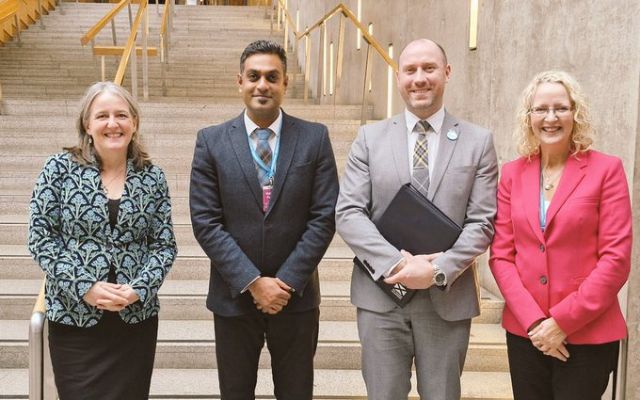
Image: © VHS. Tejesh Mistry (second left) with social care minister Maree Todd, health secretary Neil Gray, and VHS Chair Christine Carlin in the Scottish parliament
|
||
|
||
|
The Scottish government is being called upon to demonstrate that it recognises third sector health organisations as equal partners in realising the ambitions for a healthier Scotland – not simply the ones left to mop up any tasks and budget after the NHS and councils have had first pick.
Speaking to healthandcare.scot ahead of Voluntary Health Scotland’s 20th anniversary conference, his first in post as chief executive, Tejesh Mistry says ministers recognise what community and not for profit health and care organisations do, but seem unwilling to embed or fund them to deliver the work they can do best.
“We have to start with what voluntary sector health and social care organisations are doing,” says Tejesh Mistry, “and then ask what the impact would be if that wasn’t happening.
“We are there in cancer prehabilitation, rehabilitation and support. So, there's a cancer patient there that will do less well without those vital services.
“There's the person who’s accessing support with their housing, experiencing severe damp and may have to leave. That family could be at risk of homelessness if that support isn't provided. And there are the people who are living hungry and in poverty, not able to access enough food who, without that food pantry and that local food bank and people to help them get over a language barrier, will not eat.
“The government knows what we as a sector do on the ground, but where they really struggle is to understand how to balance helping to fund that as an integral part of social services against protecting statutory services where there are no-redundancy policies in place alongside annual pay rises.
“It can both feel and look like the voluntary health sector only gets what is left over, because of that disconnect between knowing how important the third sector is while not embedding the sector’s work within policy and budget setting.”
The health of the voluntary sector
Tejesh and Voluntary Health Scotland (VHS) Chair Christine Carlin were in the Scottish parliament last week to meet the health secretary and social care minister, on behalf of VHS members and members of the Scottish Community Link Worker Network, to make the case for a third sector in health that is itself fit and well.
“Unfortunately, the sector isn't that well,” says Mr Mistry, “and that's completely symptomatic of what we're experiencing in terms of approaches to fair funding and commissioning which is having a devastating impact on the stability and sustainability of organisations.
“What we are seeing is very short-term funding, very late confirmations of funding – sometimes well into the financial year – and an expectation upon staff, leadership teams and boards that they will have to carry the risk around all of those things. So, we see the inefficiencies and challenges to operational delivery that come with that.
“High staff turnover is a result of that, as is the concern and disenchantment of volunteers because the commitment they're trying to give is accompanied by uncertainty. And, as resources are continuously squeezed, so the experience for staff, for volunteers and for people within communities is deteriorating.”
VHS: vital health sector
Tejesh Mistry says the forthcoming conference is about people coming together to demonstrate the value of health and care services provided by the third sector in Scotland – and the “catastrophic” impact if Scotland is not able to sustain them – and to look at new solutions and new opportunities.
The agenda includes a discussion on practical approaches to address ‘missingness in health’ – which was originally about missed GP appointments but now is recognised as the risk of people dropping off the health map altogether.
Mr Mistry says it will be services and support within communities that will help bring people back in:
“The biggest opportunity is to reach people through social connection, providing support through trusted and safe relationships to hold people and enable people to live their own lives happily and healthily.
“With support, people can have more control and agency over decisions that impact them. The third sector has valuable expertise in creating social connection, mobilising volunteers, community outreach; establishing health services within their local area and giving people opportunities to participate, to be active, to get outdoors and to benefit from nature.
“We’re talking about prevention and early intervention, helping before it's too late – by which time the cost to the individual and the state becomes debilitating.
“These are just some of the things that the third sector supports: helping with access to safe and secure housing, advising on how to access a basic level of income to live, giving people access to further support and information, making sure they get the healthcare they need – and to understand their rights and what they fundamentally deserve.
“This advice, support and advocacy, from organisations that are trusted because of their lived experience within their community, perhaps as people from an ethnic minority with personal knowledge of the barriers others face, helps makes a difference for many of the people that the NHS and health and social care organisations struggle to reach.”
The VHS 20th Anniversary conference “Scotland’s Vital Health Sector” takes place in Edinburgh on Wednesday 23 October.
Visit the VHS eventpage here where you can view the full agenda and book a place.
healthandcare.scot is pleased to be a media partner with VHS for the conference.
Read more: Health and care workforce to be bolstered over winter; Carers and people with dementia deserve better; Number of carers grows by more than 25%; Link worker funding to help people in fuel poverty
Sign up to our bulletin for key health & social care updates straight to your inbox. |