|
Gypsy/Traveller advocates build health service trust |
Related newsLink worker profile: Small grants and big impacts College: Invest in digital transformation for GPs Scotland’s chief medic seeks to redefine healthcare Health Secretary commits to kidney action GPs are the solution to NHS crisis, says College Partnership urges action over Scotland’s mental health 
|
|
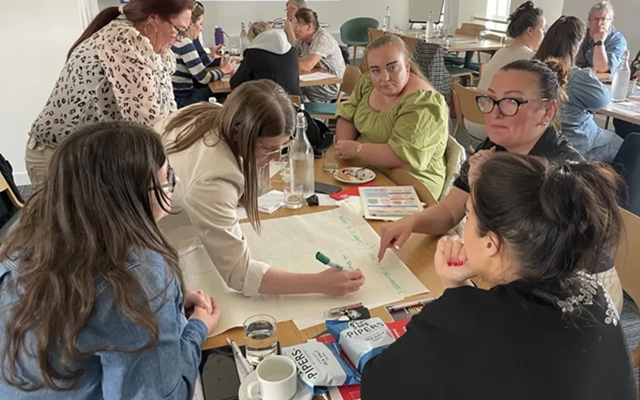
© University of Dundee
A focus group part of the evaluation of the Gypsy/Travellers community health worker service
|
||
|
||
|
A service training up members of one of Scotland’s most marginalised groups as health and social care advocates has been found to effectively bridge the gap between communities and services.
A University of Dundee evaluation of the two-year project, which saw Gypsy/Travellers community health workers trained in health advocacy, found the service was ‘essential’ to breaking down barriers faced by the community in accessing healthcare and other services.
The service was delivered by third sector organisation Minority Ethnic Carers of People Project (MECOPP) and was designed to address the major health inequalities faced by Gypsy/Travellers in Scotland.
Participants highlighted benefits including support to engage with and access vaccination and screening appointments, and the building of trust between the community and services.
Most importantly, the participants expressed the value of having someone reliable to provide support and information.
Violet Stewart, one of the community members present at the evaluation’s launch event, said the health workers being part of the community was crucial:
“The community health workers are so important because they are Travelling people and I am so grateful for how they are helping to improve the health of the community.”
The researchers recommend the service now be made accessible to all Gypsy/Travellers in Scotland, in efforts to tackle the significant health disparities faced by this group.
Dr Camila Biazus-Dalcin, from the University of Dundee’s School of Health Sciences, said:
“On almost every measure, Gypsy/Travellers experience worse outcomes than the general population and similarly disadvantaged groups.
“Structural racism is a key reason for this, and community health workers are best placed to reduce stigma and improve access to treatment and preventative measures.”
Life expectancy for Gypsy/Travellers is lower than the general population by around 15 years for men and 11 years for women.
They also face high rates of homelessness, unemployment and poverty, as well as regular discrimination.
While only 4,000 people in Scotland have self-identified as members of this community, it is thought the true number of Gypsy/Travellers may be between 15 and 20,000.
Between December 2021 and August 2023, the community health workers made initial contact with around 1,000 Gypsy/Travellers across Scotland.
The health workers also extended support and information to the wider Gypsy/Traveller community due to their influence and close-knit culture.
In providing locally appropriate support, the community health workers were found to be able to more easily provide services to meet Gypsy/Traveller needs, while also improving health provider knowledge and perceptions of the community.
Having a trusted third sector organisation deliver the service was also essential to ensure the service was community-led, according to the evaluation.
Researchers now recommend health boards offer flexible appointments and drop-in services for Gypsy/Travellers to encourage participation, and collaborate with community health workers to develop innovative strategies to further improve access to health services.
During the launch event, public health minister Jenni Minto thanks MECOPP and the Dundee researchers for their work.
She said:
“The achievements today have only been possible through collaboration and partnership working with a clear shared vision to reduce racialised health inequalities and improve health outcomes in Scotland.
“You are tackling the unique challenges that are experienced by the Gypsy/Traveller community head on, and I am very grateful for that.”
Read more: Community support ‘vital’ to asylum-seeking families; ‘Unprecedented' crisis in community health and care;
|