|
Chief Medical Officer: ‘Critical connections’ priority |
Related newsScotland at the table with UN healthy air commission Respiratory care vision unveiled Pharmacy’s road to stigma-free drug dependency care GPs are the solution to NHS crisis, says College Health and charity leaders join forces for NHS reform Call for ‘urgent’ review of ADHD and autism services Medical trainee abuse reports ‘shut down and silenced’ Politicians must take ‘bold’ action on child poverty Glasgow district nurses ready to strike NHS and Glasgow rethink routes into healthcare ‘Major’ update to One Health AMR register Glasgow LEZ success sparks call for expansion 
|
|

|
||
|
||
|
Scotland’s Chief Medical Officer says connections – be it with healthcare providers, friends, family or the environment – are essential to addressing loneliness, social isolation and inequities in health.
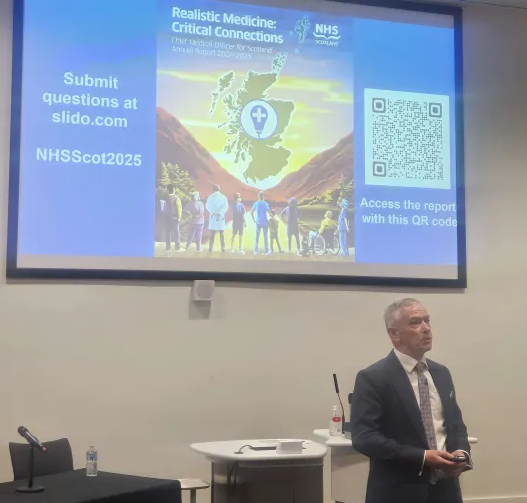
Scotland’s Chief Medical Officer, Professor Sir Gregor Smith launched his annual report at the NHS Scotland event held in Glasgow last week.
As well as his statutory obligation to report on the health of the nation, Sir Gregor said that the Realistic Medicine: Critical Connections report spotlights how fostering social connections is essential for improving health:
“Connection is fundamental to the human experience, helps nourish us, promotes empathy, sparks creativity and develops relationships and trust between different members of society.
“But connection also improves our health, not mental health, but our physical health – there’s a body of evidence which shows social connection makes you less likely to suffer physical illnesses as wide a field as cardiovascular disease or dementia.
“In the report, I discuses some of the ways we can promote that connection.”
His comments echo recent Edinburgh-led research linked depression to poorer physical health outcomes including arthritis, diabetes and heart disease.
Sir Gregor added that the report illustrates the need for connection not just with other people, but the planet – emphasising that preventing ill health goes hand-in-hand with addressing the climate crisis.
The CMO explained that recognising the intersecting population health challenges facing Scotland is vital to delivering a sustainable healthcare system of the future:
“The ongoing challenges of infectious disease, the changing trajectory we've seen in both life expectancy and healthy life expectancy, of achieving a sustainable health and care system, but also the challenges posed to humans by the planetary health crisis.
“Why is connection important? In our society, there is a need for us to make greater in-roads into the prevention of disease and the promotion of health and wellbeing lies at the heart of how we unlock the secret to meeting these challenges.
“Promoting social connection is only one aspect – [so is] promoting connection with our environment and our planet.”
In recent years, the CMO annual reports have increasingly focused on how Realistic Medicine has to be about both people and sustainable healthcare.
In this year’s report, the CMO outlines how engaging with the environment through physical activity, and spending time in nature – green and blue spaces outdoors – brings health benefits.
This comes as Edinburgh welcomed its first outdoor brain health centre for people living with dementia.
Connections with healthcare
The CMO told the conference delivering continuity of care and good relationships with healthcare providers – a key focus of the recent report on the value of GPs – must be central to NHS reform:
“I’ve spoken before about the risk of modern medicine around the world becoming an industrialised, transactional process.
“The promotion of careful and kind care across Scotland is where we need to ensure we target our efforts in education and the systems we develop.
“The message of our report ultimately is optimistic. I believe we’re well on the road to achieving the type of care that we want to see in Scotland. The next big frontier for us is to make sure alongside that care, we're reconfiguring our NHS and social care systems.
“Moving to public health, population-health focused, preventative organisations, and away from the repair shop model that the NHS has been for decades.”
While welcoming the report, RCGP Scotland Chair, Dr Chris Provan told healthandcare.scot the challenges remains delivering the workforce needed to meet demand:
“RCGP Scotland is fully supportive of action to address the barriers to continuity of care. The mismatch between workforce and workload has led to increased pressure across general practice which is hampering our ability to deliver continuity of care.
“GPs are as frustrated as patients when there are issues with access. Fundamentally, it is the significant workload and workforce challenges that are the major barrier to good access.
“We continue to advocate for a comprehensive, long-term workforce strategy to expand the capacity of general practice and enable the delivery of both timely and continuous care. RCGP Scotland remains committed to supporting policies that prioritise continuity of care as a pillar of high-quality, patient-centred general practice.”
Read more: First Minster pledges people will see GP sooner; Holyrood passes Care Reform Bill; “Relentless focus” on addressing health inequalities; Scotland needs more Carer Positive employers; Longest NHS waits a funding priority, says government; Watchdog criticises homelessness service cuts; NHS Scotland: waiting lists and beyond; ‘Urgent' review of ADHD and autism services; Care management ‘on its knees’
Sign up to our bulletin for key health & social care updates straight to your inbox. |