|
Tayside team achieves global kidney study milestone |
Related newsNew gene study offers arthritis treatment insights Scotland can play central role in mRNA New treatment for rare genetic condition approved Scottish life sciences to be £25bn sector Scots to benefit from new NHS heart treatment ‘Major’ update to One Health AMR register 
|
|
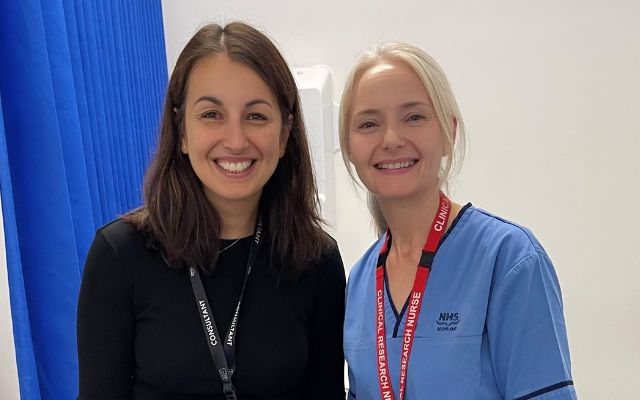
Image: © NHS Research Scotland
Professor Samira Bell, Principal Investigator for the study (left) and Senior Clinical Research Nurse, Frances McGregor
|
||
|
||
|
The University of Dundee and NHS Tayside have recruited the world’s first participant to an international study assessing a new combination treatment for adults with advanced chronic kidney disease.
Sponsored by AstraZeneca, the BalanceD-CKD study will assess whether balcinrenone combined with dapagliflozin reduces renal and cardiovascular risks more effectively than dapagliflozin alone in patients with Stage 3b and 4 chronic kidney disease (CKD).
CKD is a long-term condition in which the kidneys do not work effectively. It affects an estimated 600,000 people in Scotland, which is about 1 in 10 of the population, and is expected to become the world’s fifth leading cause of mortality by 2040.
Stages 3b and 4 indicate moderate-to-severe kidney damage, with function reduced to less than half of normal levels. Close medical care is needed to help protect remaining kidney function, and the impact on quality of life can be profound. Careful dietary and medical management can help slow progression towards kidney failure, but there remains an urgent need for more effective treatment options.
The global Phase III trial is investigating whether the combination of balcinrenone and dapagliflozin can better protect kidney function and reduce cardiovascular complications in people with advanced chronic kidney disease than current standard treatment alone.
Professor Samira Bell, Clinical Professor and Honorary Consultant Nephrologist at the University of Dundee and NHS Tayside, is Principal Investigator for the study.
She said:
“This milestone demonstrates the strength of Scotland's clinical research environment and our ability to deliver internationally important studies rapidly and effectively. Chronic kidney disease affects millions of people worldwide and is a major driver of cardiovascular illness, hospitalisation and healthcare costs.
“By recruiting the first participant to the BalanceD-CKD study, NHS Tayside is helping to accelerate the development of new treatments that could improve outcomes for patients with advanced kidney disease both in Scotland and internationally.”
The study will run at 550 sites across approximately 30 countries and is expected to involve 2,800 participants.
Ready on day one
In an exceptional display of operational readiness, the study team at NHS Tayside recruited the first participant on the same day the study opened, becoming the first in Europe and the world to recruit to the study. It also surpassed the 30-day target from study opening to first participant recruited that forms part of the UK’s overarching 150-day commercial clinical trial set-up metric.
This target was set in October 2025 as part of the Life Sciences Sector Plan and is designed to cut unnecessary delays in the set-up of clinical trials with the goal of attracting more investment and opportunities, improving health outcomes, and accelerating the development of future medicines and therapies.
Scotland has made significant progress in strengthening its research ecosystem, building collaboration across the NHS, academia and industry, and expanding opportunities for people to take part in research trials.
In 2024, the Scottish Government announced a partnership to accelerate research into chronic kidney disease. This has enabled NHS Scotland, AstraZeneca and the Universities of Dundee and Glasgow to collaborate on new medicines that could slow CKD progression and reduce the likelihood of patients needing dialysis or a kidney transplant.
Professor Dame Anna Dominiczak, Chief Scientist (Health) at Scottish government said:
“This achievement reflects the strength of the landmark triple helix partnership launched in 2024. Since then, we have worked at pace to bring together the people, data, and infrastructure needed to expand clinical trial opportunities for people living with kidney disease.
“Being the first site in the world to recruit a patient to this study is a tremendous credit to the team. It demonstrates Scotland’s commitment and capability, and most importantly, opens more opportunities for patients to take part in vital research.”
World-class research capability
Alex Gueret-Wardle, Medical & Scientific Affairs Director, AstraZeneca UK said:
“Reaching this first patient milestone in the BalanceD-CKD study is an important achievement and highlights the strength of Scotland's clinical research environment.
“Through close collaboration between NHS Scotland, academia, government and AstraZeneca, we are helping to accelerate high-quality clinical research and bringing innovation to patients more quickly. Scotland continues to demonstrate world-class research capability and we’re proud to work alongside partners who are helping to shape the future of kidney care and trial delivery.”
Health Secretary Angela Constance said:
“Preventing the progression of chronic kidney disease will be key to ensuring people are able to live longer, better lives, free from other consequences of the condition such as heart failure, cardiovascular disease and stroke.
“I welcome this important milestone in the research, which helps to demonstrate how collaboration between the NHS, Scottish Government, academia and industry can accelerate health studies and improve the quality of life for people living with kidney disease.”
Commercial clinical research is a key priority for Scotland, supporting better patient care, health innovation and life sciences investment. Four Commercial Research Delivery Centres (CRDCs) were established in Scotland last year.
Together, these hubs are part of the UK-wide CRDC Network, which connects 35 centres across primary, secondary and specialist care to strengthen the UK’s position as a global leader in commercial clinical research.
Working with the pharmaceutical industry, the Network provides coordinated UK-wide infrastructure for fast, reliable and consistent trial delivery at scale. It gives industry access to high-performing research sites and supports inclusive, decentralised trials, enabling more people across NHS communities to take part in research.
This article is written as part of a promotional agreement between NHS Research Scotland (NRS) and Healthcare News Scotland.
Read more from NHS Research Scotland Patient and Public Involvement 2027 showcase; Scottish health research register celebrates 15 years; NHS researchers to explore Highland opportunities; Patients benefiting from clinical trials progress; GP practice launches dedicated research facility; Scotland leads world first in premature baby gut trial;
Sign up to receive our bulletin for key health & social care updates straight to your inbox. |
