|
Community link workers now “indispensable” |
Related newsAwards celebrate great link working Link worker profile: Small grants and big impacts College: Invest in digital transformation for GPs Scotland’s chief medic seeks to redefine healthcare Health Secretary commits to kidney action GPs are the solution to NHS crisis, says College 
|
|
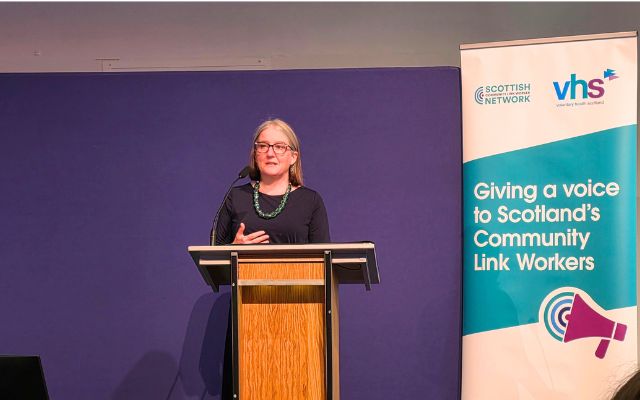
Maree Todd MSP
|
||
|
||
|
Scotland’s minister responsible for social prescribing says the nation’s community link workers should be proud of the work they are doing and can look to the future with confidence. Her comments came at a conference and awards organised by Voluntary Health Scotland to celebrate the fifth anniversary of the creation of the Scottish Community Link Worker Network.
Across the UK, the research into the value and impact of the national rollout of ‘Social Prescribing Link Workers’ in primary care is showing they are becoming key members of the health and wellbeing teams in their neighbourhoods,
National policy on social prescribing in Scotland is overseen by Maree Todd, the Minister for Mental Wellbeing, Public Health, Sport, Alcohol and Drugs.
She told the conference of link workers in Edinburgh that, given that health is shaped by far more than healthcare alone, the work of link workers in addressing housing, employability, social connections and access to community support is having a “profound impact” on the health and wellbeing of those referred to them:
“You as community link workers help address these wider determinants of health, supporting people to access practical help while reducing isolation and strengthening resilience, and that's particularly important when it comes to mental health and wellbeing.
“Many of the people who you come into contact with may be experiencing loneliness, financial pressures, bereavement, caring responsibilities or other challenges that affect their wellbeing. By connecting people to community resources, to peer support, to advice services, local groups and activities, you help people to build confidence, develop relationships and regain a sense of belonging.
“And, at a time when many communities continue to face significant inequalities, the contribution that you all make has never been more important. Your work demonstrates the value of prevention, early intervention and person-centred support, helping people to access the right support at the right, and often preventing challenges from becoming crises.”
Asked about the role and position of community link workers in multidisciplinary primary care teams, Ms Todd recollected her own years as a specialist pharmacist working in mental health:
“The way that we worked there was about equal respect across the team. Everybody was not the same. They didn’t have the same role. So, it is about understanding each other's roles and respecting the differences and knowing, and having confidence in, each other's expertise.
“I think we're pretty keen for the broader workforce to understand what community link workers do. I think there's some general understanding. Certainly, the people who have been helped by community link workers know the magic that you do. You don't have to persuade them, they understand that you have made a massive difference to their lives.”
She added:
“Every community link worker represented in this room should feel really proud of the contribution that they make to improving outcomes for people and the communities that they serve. As we celebrate five years with the network, we can look ahead with confidence.”
Evaluating impact
Earlier this year the Royal College of General Practitioners in Scotland reported that community link workers were playing a key role in “reducing moral distress and possibly reducing workload” for general practitioners.
The conference heard from researchers commissioned to evaluate the impact of increased use of social prescribing, and the benefits to both patients and those who refer them of a community link worker’s help.
The data collected suggests the number of GP appointments sought by people after they had been helped by a link worker reduced.
Researcher Dr Eddie Donaghy from the Usher Institute at the University of Edinburgh told the conference the benefits are also being reported in interviews he has conducted with both referrers and patients, who believe community link workers have become indispensable:
One GP told him:
“As a GP, I don’t think I can work without a link worker now. Not without that moral thing. Is it moral distress? I have less of those feelings working with a link worker.”
Another GP said:
“One of the things that’s critical to this, what a link worker does, it keeps me working as a GP for a start… Honestly!
A patient in Lothian who also had significant caring commitments told Dr Donaghy:
“The link worker got me a CAP [Community Access Programme] card. Back to the gym and swimming. A godsend. Through a charity, they got me access to a trained counsellor once a week. With another charity, they got me funding for a short holiday. A game changer.”
The person added:
“This was the first time I’d been hopeful about my future… I’m now trying to make plans.”
Conference chair, Chief Executive of Voluntary Health Scotland, Tejesh Mistry concluded:
“Community link working is part of the solution, an incredibly important part of the national solution that we need for our health service. And, for our people moving forward, I think that's undeniable.
“For us as Voluntary Health Scotland, we will continue to champion and advocate that voice to make sure people understand the benefits… that this is always part of the solution.”
Read more: Link worker profile: Small grants and big impacts; Edinburgh GP to chair BMA in Scotland; Community Link Workers reducing stress on GPs; Film series showcases power of link workers
Sign up to receive our bulletin for key health & social care updates straight to your inbox. |