|
COVID findings must be ‘mandate for lasting change’ |
Related newsCare home visits promote wellbeing New discharge to care homes programme Donald Macaskill: Where is Scotland going? One precedent, inconsistently applied IJB costs driving councils’ unsustainable funding gap Additional funds for care and hospices 
|
|
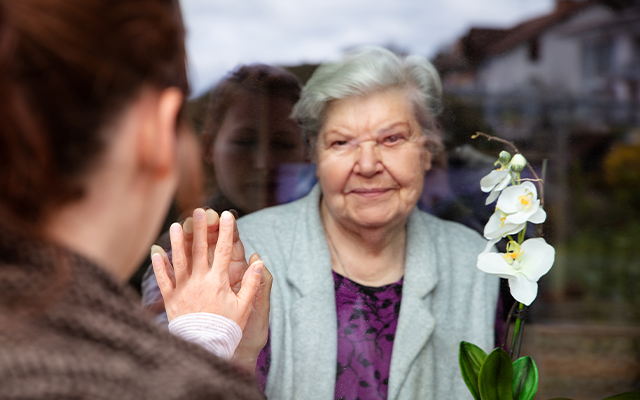
Image © M.Dörr & M.Frommherz / Adobe Stock photos
|
||
|
||
|
The UK COVID-19 inquiry has concluded that the adult social care sector was treated as an afterthought with people who were infected discharged from hospital into social care without testing despite governments knowing that people already living in care homes were particularly vulnerable.
As the Scottish government says it will consider the latest report carefully, we hear the response of two organisations representing staff working in Scotland’s care sector, both calling for the recommendations of the inquiry to be acted upon, and for social care never again to be regarded – or funded – as peripheral or secondary to the NHS.
The inquiry, chaired by Baroness Heather Hallett, found that government policies in Scotland and the rest of the UK, coupled with inadequate infection-control measures, created conditions in which COVID-19 could spread rapidly through care homes.
The report of the module focusing on the care sector states: “the adult social care sector as a whole also appeared to be something of an afterthought, where the mantra of ‘protecting the NHS’ sometimes came at the expense of the users and providers of care”.
Care homes
The edict to discharge as many people from hospital into care settings at the start of the pandemic came in response to estimates that the demand for healthcare beds in Scotland would outstrip supply by some 37,000 places.
The lack of testing capacity at this stage of the pandemic, alongside conflicting advice on its value, meant that, over the following weeks, many patients were discharged to care homes or their own homes, without knowing whether they had COVID-19.
Despite deep concerns from those in social care, the inquiry noted that the National Care Home Contract in Scotland gave little choice, requiring that homes “should not ordinarily refuse admission unless there were very clear clinical reasons not to do so”.
The inquiry reports that 3,595 patients were discharged from Scottish hospitals into care homes between 1 March and 21 April 2020, 82% of whom had not been tested for COVID-19.
The late Jeane Freeman, then Cabinet Secretary for Health and Sport, had told the inquiry that, had there been sufficient testing capacity, she would have introduced testing on admission to care homes earlier.
Scotland was the first UK nation to advise isolation of all people discharged from hospital and admitted to care homes, including those who had not been tested.
The inquiry says the impact was particularly severe during the first wave, with almost a third of Scottish care homes experiencing a COVID outbreak between March and June 2020.
There were 1,925 COVID-related deaths across 321 care homes for older people across the four months. In some care homes, COVID-related deaths represented as much as four in ten registered places.
Baroness Hallett’s report criticises the failure to ensure adequate testing, isolation arrangements and protection for residents, alongside shortcomings in pandemic planning and the involvement of health and social care partnerships.
Responding to the publication, the Scottish government said it would take the necessary time to consider its findings and recommendations carefully, reiterating that the overriding objective throughout the pandemic had been to protect people and minimise loss of life.
The ‘learning lessons’ mantra
The body representing Scotland’s trades unions, the STUC, described the report as 'damning and disastrous'.
STUC General Secretary Roz Foyer says the policy of discharging untested patients from hospital put workers and care home residents in harm’s way:
“This damning report confirms that care worker deaths were not centrally recorded, which limited the understanding of the serious risks workers were exposed to.
“This report cannot be ignored nor sidelined by either the Scottish or UK government. Governments were responsible for multiple failings that impacted workers, including a lack of PPE, unrealistic guidance, understaffing and the resulting burnout and trauma caused as an increasing number of people being cared for died needlessly. The government must accept and act on all the recommendations, along with a full and unequivocal apology to all those workers and care users who unnecessarily suffered because of government decisions.
“The tired mantra from governments promising to ‘learn lessons’ besmirches the memory of those who died. If Ministers really want to avoid another catastrophic incident, they should not be proposing to underfund and cut our public services, including health and social care. Doing so will only further embed the government’s ‘afterthought’ approach to social care in Scotland.
“Our thoughts are rightly with every worker and care user impacted by the government’s lack of preparedness for COVID-19. Our movement’s pledge remains clear: to remember the dead and fight for the living.”
A mandate for lasting change
Scottish Care, the organisation representing the independent care sector, says the report “is a solemn reflection on an unprecedented period” of death, separation and isolation, where unpaid and paid carers bore exceptionally difficult responsibilities with commitment and compassion.
Chief Executive, Donald Macaskill says the inquiry’s conclusions confirm many of the concerns raised by the sector and families throughout the pandemic:
“Social care entered COVID-19 already under severe pressure, weakened by workforce shortages, recruitment and retention challenges, and longstanding structural fragility. Known risks had been identified before the pandemic, yet they were not adequately addressed, and care services were not sufficiently embedded within emergency planning and response arrangements.
“The report is particularly significant in acknowledging that social care was too often treated as an afterthought rather than as an equal partner within our system of public protection. Providers struggled to access PPE, worked without sufficiently clear and tailored guidance in the earliest stages, and were required to make impossible decisions while doing everything they could to protect those in their care. The inquiry records that Scottish Care issued its own guidance before official sector guidance became available. That reflects both the urgency of the situation and the extent to which providers felt they could not wait for national systems to catch up.
“The inquiry also acknowledges the enormous challenges around staffing, funding and operational support, while recognising the remarkable efforts of providers and staff to protect and care for people in extraordinarily difficult circumstances. It is essential that responsibility for systemic failure is not displaced onto the very organisations and individuals who were left trying to hold services together.
“Accountability matters, but this report cannot be only about past failure. It must become a mandate for lasting change. The clearest lesson is that social care can never again be regarded as peripheral or secondary, especially during a national emergency. Social care is critical national infrastructure. It sustains the lives, rights, wellbeing and dignity of hundreds of thousands of people and is an indispensable part of Scotland’s social fabric.
“We welcome the inquiry’s emphasis on stronger preparedness, workforce support, better data, robust planning, adequate resources and the meaningful inclusion of social care in decision-making. These are not abstract or technical recommendations. They are measures that protect rights, uphold dignity and save lives. The challenge now is implementation, not further delay or another cycle of review.
“Above all, we remember every person who lost their life, all those who were bereaved, and everyone whose health, relationships and wellbeing were profoundly affected. We also remember the thousands of social care staff who continued to provide support with courage, compassion and professionalism under relentless pressure. Many went to work frightened and exhausted, often feeling forgotten. They deserve more than our thanks. They deserve a firm commitment that the lessons identified by this inquiry will be acted upon fully and without delay.”
Sign up to receive our bulletin for key health & social care updates straight to your inbox. |
