|
NHS Scotland moves to ‘emergency footing’ |
Related newsInfection risk petition set to fail Aberdeen A&E first to offer routine HIV tests ‘Major’ update to One Health AMR register Children’s doctor new Chief Scientific Adviser Chief Medical Officer: ‘Critical connections’ priority Livingston-made vaccine gets UK green light 
|
|
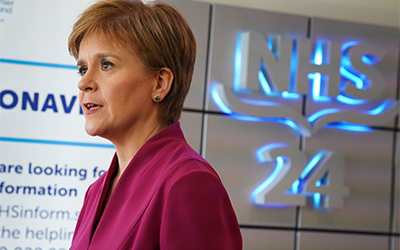
Courtesy of the Scottish government
|
||
|
||
|
The NHS in Scotland is to move to an emergency footing for at least three months as it deals with the coronavirus outbreak.
An extra 3,000 beds will be added, and new oxygen treatment devices will be brought in and ferries could be used to move islands patients to the mainland as part of what the health secretary called the “most rapid reconfiguration of our health service in its 71 year history.”
To reduce the burden on the health service that a surge would bring, Nicola Sturgeon said the public would have to make “unprecedented” changes to their way of life.
It comes shortly after the second Scots patient died after testing positive for the condition. Stringent new social distancing measures were announced yesterday in a bid to hold down the number of cases so NHS beds do not run out.
There are just under 200 cases in Scotland but the true number is thought to be much higher.
People are being advised to cut down on all unnecessary social contact. The health service is to contact the most vulnerable next week telling them to take stringent steps to protect themselves from Covid-19.
Speaking in the Scottish Parliament before the NHS shake-up was announced, the first minister said the steps would likely cause an “economic emergency” for businesses.
“We as a government are asking people to take unprecedented actions,” she said.
“And we recognise, I recognise, the response from government must also be unprecedented.”
The “swift and radical” changes to the NHS were needed to deal with a “substantial and sustained” increase in Covid-19 cases, the health secretary said.
She pledged frontline workers would be tested so they did not have to isolate unnecessarily and surveillance testing normally used for flu would be scaled up to cover a representative sample of 1.5 million Scots.
Private hospitals will be enlisted to provide extra beds while health bosses are trying to discharge as many patients as possible before the end of the month.
Emergency, urgent, maternity and vital cancer treatment will continue but other services will be curtailed.
Ms Freeman said homecare support should continue even if people have symptoms, after Conservative leader Jackson Carlaw said some vulnerable people were having their care packages cancelled after contracting the virus.
In response to Shetland MSP Beatrice Wishart, Ms Freeman also said ferry services could be used to move islands patients to intensive care units on the mainland in the event that air transfers became unviable. Tags: Infectious disease. |
