|
NHS staff isolate ‘needlessly’ amid test shortage |
Related newsInfection risk petition set to fail Aberdeen A&E first to offer routine HIV tests ‘Major’ update to One Health AMR register Children’s doctor new Chief Scientific Adviser Chief Medical Officer: ‘Critical connections’ priority Livingston-made vaccine gets UK green light 
|
|
Scottish Parliament TV
|
||
|
||
|
The health secretary has promised testing capacity is being ramped and a new antibodies test is on the horizon, amid concerns a lack of testing is reducing workforce numbers just as demand surges during the pandemic.
healthandcare.scot has heard from some frontline NHS staff that a lack of sufficient protective equipment and testing has left them worried that although they may not have any symptoms of the condition, they could be unknowingly passing it on to patients.
Scotland has moved on to what are called sentinel surveillance protocols – where selected groups are tested for the virus and any results extrapolated to provide a border picture of where the virus is and how it is behaving.
All health and social care staff involved in responding to the pandemic are not yet being routinely tested – a move Bacteriology Professor Hugh Pennington called for in an interview with healthandcare.scot last week.
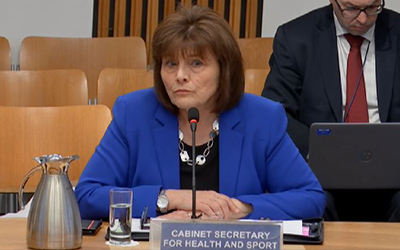
Concerns that a lack of testing for covid-19 among NHS staff is causing some with cold-or flu-like symptoms to self-isolate needlessly were put to Cabinet Secretary for Health Jeane Freeman this morning as she appeared before Holyrood’s health and sport committee.
The Scottish government recently published details of three categories of workers. Those in category one – critical front-line NHS workers – are being tested first, the Cabinet Secretary explained. They are frontline NHS staff “without whom the coronavirus response would be significantly compromised”, she said.
“A significant amount of work is underway to increase capacity in the volume of tests that can be done within a day and the speed the response can then be given to individuals.
“A final agreement has not yet been reached across the UK – so I can’t say more – but that will be announced fairly shortly. That work will significantly increase our testing capacity.
“That is to allow those healthcare workers who are in household isolation to return to work if they test negative. At the moment the test tells me whether at this moment in time I have the virus or not. It is a binary test. It does not tell me if I am likely to have the virus next week.”
Work is underway, Ms Freeman explained, to produce a covid-19 antibodies test that would let frontline healthcare workers know if they had had the virus but were not aware.
Antibodies are produced as part of the body’s response to becoming infected with a virus and can appear one to three weeks after infection.
The new test could detect antibodies in workers who do not know if they have actually been infected with covid-19 because they never developed symptoms, or those symptoms were never identified and attributed to this particular coronavirus, potentially meaning they could continue working on the assumption they had built up immunity.
She added: “Work is well underway on the antibody test – in terms of the key worker that is a really important test.
“It’s a quick test once we have it in place and we would expect it to be in place in the near future, but I can’t be more accurate than that.”
Sign up to our bulletin sent twice a week so you don’t miss out on the latest health and social care news.
Tags: Infectious disease. |
