|
“National tragedy”: Drug deaths highest on record |
Related newsRural alcohol and drug rehab centre opens Drug harms on the rise in Scotland Scots living with liver disease set to rise by 54% MSPs debate new approach to prison alcohol care Families to shape campaign against stigma Watchdog: action needed now on NHS reform 
|
|
©arska n
|
||
|
||
|
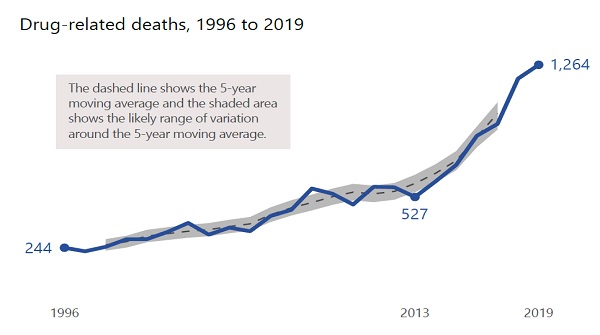
The number of drug deaths in Scotland has increased again to the highest level in more than 20 years.
New statistics reveal there were 1,264 deaths linked to drugs in 2018-2019, up 6% from the year before and the most since records began in 1996.
This works out as the highest drug death rate in Europe and around 3.5 times higher than the rest of the UK.
David Liddell, CEO of the Scottish Drugs Forum, said the deaths were a “national tragedy and a disgrace”.
He called for action on stigma, an increased range of services, including safe consumption rooms, and the decriminalisation of all drugs.
Minister Joe FitzPatrick said the Scottish government was doing everything in its power to tackle rising deaths but warned “there is no shortcut that will suddenly solve this”.
National Records of Scotland, which produced the figures, said heroin and morphine were implicated in more deaths than any previous year, making up more than half of the total
People dying tended to be male, middle aged and living in the central belt.
Deaths were concentrated in five health board areas, with 404 recorded in Greater Glasgow & Clyde, 163 in Lanarkshire and 155 in Lothian.
Nearly seven in ten deaths were men and more than two-thirds were between 35-54. The average age of someone dying has increased from 28 to 42 over the last two decades.
In 94% of the deaths more than one substance was involved. Heroin and/or morphine were the most common single drug types, followed by methadone, which was implicated in 560 deaths – 44% of the total.
As a majority of deaths involve more than one drug, National Records of Scotland says it is not possible to pinpoint one particular drug.
Cocaine and ‘street’ benzodiazepines were some of the other drugs linked to the most deaths since records began, as well as opiates, a category including heroin and morphine.
The Scottish Drugs Forum’s David Liddell said: “None of us should regard these preventable deaths as acceptable or as anything other than a national tragedy and disgrace.
“The need for change is obvious and that change is long overdue.
“Thankfully, we are fortunate that the evidence shows us exactly what changes need to be made. We need people to be in high quality treatment that protects them from overdose and death.
“Recently published treatment standards for Scotland can be a real driver of this necessary change and we are seeing encouraging improvements in services - but we must quicken the pace of change.
“The new standards insist that people gain quick access to treatment; have a choice of medication that best suits them; get the support they need to stay in treatment and access to any other supports they may benefit from.
“Broadly, the challenge in terms of treatment is to ensure that people with a drug problem are treated with dignity and respect.
“In addition, we need to increase the range of services across Scotland to include drug consumption rooms, heroin-assisted treatment and assertive outreach.
Mr Liddell added: “We need to end the alienation, marginalisation and stigmatisation of people with a drug problem - the root cause of this issue, which reflects badly on a culture and mindset that we have allowed to develop unchallenged over many years.
“The time to challenge and end all of that has come. As part of this approach, we should decriminalise the possession of all drugs and extend the current recorded police warning for cannabis possession to apply to all other drugs.
“There is a need for leadership and a national effort to ensure this potential is realised.”
Public Health Minister Joe FitzPatrick said: “The Scottish Government is doing everything in its powers to tackle rising drug deaths, and we are working urgently to put in place high-quality, person-centred services for those most at risk.”
“These deaths stem from a longstanding and complex set of challenges, and there is no shortcut that will suddenly solve this,” he added.
“There is, however, action that we are taking right now that will have an impact more immediately, such as maximising the availability of Naloxone and the routes by which it can be supplied.
“Our work to introduce Medication Assisted Treatment standards is one of the most significant changes to the way in which treatment services operate.
“Furthermore, we have seen the introduction of a range of new and innovative approaches, including Scotland’s first heroin assisted treatment service in Glasgow.
“We will continue to work with the Taskforce and other partners to identify and put in place measures to tackle this issue and save lives.
“We also continue to urge the UK Government to take action to change the law so that overdose prevention facilities can be established as quickly as possible, either by taking the necessary steps themselves or by devolving powers to Scotland.”
Sign up to our bulletin for key health & social care updates straight to your inbox. Tags: Scottish Government; Substance Misuse. |