|
Pam Duncan-Glancy: Where’s the care restart? |
Related newsPoliticians told: “Carers cannot wait” National Care Service Forum 2025 Analysis: abolishing non-residential care charges Smart houses ‘paving way’ for independent living Turning policies into social care practice Holyrood scrutinises self-directed support 10 years on 
|
|
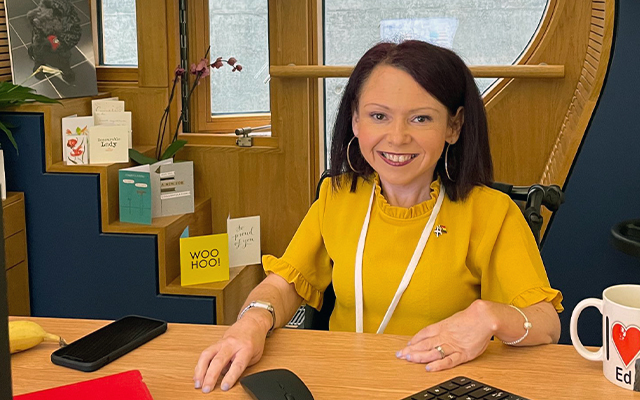
Labour MSP Pam Duncan-Glancy
|
||
|
||
|
Newly elected MSP Pam Duncan-Glancy has been campaigning for the rights of disabled people for over 15 years.
Recently named Scottish Labour Shadow Cabinet Secretary for Social Justice and Social Security, Ms Duncan-Glancy has not waited long to raise concerns about the pace at which social care services have been restarted as restrictions ease.
Both the Glasgow region MSP and her husband use social care, and unlike many others, their support was kept at the same level during the pandemic.
As the NHS remobilises various services that were suspended during the pandemic, Ms Duncan-Glancy says “it doesn’t feel like a restart at all” for social care.
“There is no doubt about it, we were lucky because our carers kept coming to make sure we could continue to live our lives while putting their own at risk,” she tells healthandcare.scot.
“But so many disabled people and others in our position haven’t been able to get the support that they need because it has been stopped and to be honest it is far too slow to be restarted.”
“I think we need a review of funding social care that mirrored the Dilnot commission in the rest of the UK.
The Feeley report touches on some of those funding issues but I’m not sure it really goes to the heart of what that would mean…”
Ms Duncan-Glancy, who previously worked in a national human rights charity and raised the state of care and support, continued: “Social care, before the pandemic, was already in crisis.
“…Disabled and older people were not getting the care they needed then; there were people left lying in incontinence pads for 12 hours a day because it was too expensive to send someone in to change them more often. People weren’t able get the care they needed so they could go out and see their families or friends, it was literally life and limb.
“They would be helped to get up, get their meals and then go to bed again. Young people would be going to bed at seven o’clock at night. Social care was completely broken before the pandemic - the pandemic has just made it much worse and it has definitely not started back again quickly enough.”
Billed as a solution to the problems that came under the spotlight because of covid, a National Care Service is being backed by both Labour and the SNP. While many agree on the need for change, few have agreed or indeed laid out the costs of such a service.
One of the members of the adult social care review panel suggested recently that current calculations could be short by hundreds of millions of pounds.
“A National Care Service needs to have the basic principles of human rights at its heart, but it also needs the money to back that up,” Ms Duncan-Glancy says.
“For a long time we have had good rhetoric from this government around human rights. They have said the right words in the right places but what they haven’t done is allow that to transfer into practice.
“It shows that the very basic things like a right to private and family life are not open to many disabled people in Scotland.”
“Look at the number of disabled people in employment and that number is woefully low…or you look at the number of disabled people living in poverty which is incredibly high and the number who don’t have the care and support they need to get up and about properly.
“About 10,000 disabled people are still waiting on an accessible home. It shows that the very basic things like a right to private and family life are not open to many disabled people in Scotland.
“I said previously that I think we needed a review of funding social care that mirrored the Dilnot commission in the rest of the UK. The Feeley report touches on some of those funding issues but I’m not sure it really goes to the heart of what that would mean so we probably need to do a Beveridge on it and do what the Labour government did after the war.
“…It needs to be free at the point of delivery and it needs to have enough funding to protect and respect the rights of the people who use it, but also the people who work in it.
“I don’t think we can create another system that exploits workers and doesn’t pay them at least £12 an hour, moving to £15 an hour as soon as possible.
“It doesn’t take career progression seriously at the moment and it doesn’t have collective bargaining - all of these things need to happen as part of the National Care Service.”
When it comes to social care support, Ms Duncan Glancy hopes the experience of the pandemic may have raised the bar when it comes to what social care should help people to do. If the pandemic has shown us anything, she says, it is surely that being confined to your own house and locality, to not have the freedom to go where you want to and spend time with the people you want see is very hard.
“That has been the reality for disabled people for decades; it’s almost systemically built-in for them.
“We are at a moment in time where we can say to people if you didn’t like it surely you cannot tolerate it for anyone else – we need to not miss this opportunity.”
Nicola Sturgeon’s most recent cabinet appointments after the May election saw social security downgraded to a ministerial portfolio, no longer a cabinet secretary role – a move Ms Duncan-Glancy says could lead to less scrutiny of this area – in Parliament at least – at a time when more benefits are set to be devolved to Scotland.
Few people seem to doubt the Scottish government’s sincerity when it says it wants to do benefits differently to Westminster’s Department for Work & Pensions. But is Ms Duncan-Glancy hopeful a new system will mean a better experience for service users?
“The carers and disability benefits are good examples because what the Scottish government has said is the social security agency will deliver a safe transition, so that means in practice that nobody currently receiving disability payments from the DWP will drop off the system by accident.
“That is important – but we need to move from safe and secure to looking at what the rulebook we are playing by here is, because whilst I’m sure the assessment process will be less hostile…what we have yet to see is whether eligibility is going to be changed.
“…We need to move very quickly onto extending eligibility and making sure more people get funding…then reassess whether the money being paid is enough.”
One of her party’s election pledges this year was to introduce a minimum income standard when it comes to social security in Scotland. Labour highlights the Joseph Rowntree Foundation estimates a single person must earn £19,200 a year, and a couple with two children need to earn £18,700 each, for a ‘minimum acceptable living standard in 2020’.
This would mark a significant shift away from the current standpoint, Ms Duncan-Glancy says, where the living standard set by Universal Credit “is almost destitution”.
“It’s really difficult to live on that amount of money so I don’t think we are in a position any more as a society where we can accept that that level of funding is adequate to allow people to participate in society, to enjoy, fulfil and protect their human rights.
“We need to move to position where we acknowledge everybody needs to have a certain amount of money in order to be able to contribute to society.
“We need to ask the question of the people Scotland and say well what is that, what do you think that figure should be?”
Read more: Insight: Better breaks for unpaid carers; Review member questions cost of care reforms; Audit Scotland: National Care Service funding unclear
Sign up to our bulletin for key health & social care updates straight to your inbox. Tags: Disability; Older People; Social Care. |
