|
Renal research needed to advance care, says nurse |
Related newsMum scrubs-in to help deliver her baby by c-section Frailty services supported with £85m Corridor care ‘the norm’ in struggling hospitals Rural hospitals and the child nurse predicament Scots honoured in health, care and sciences New initiative helps parents hop through labour steps NHS problems ‘still need fixed’ despite pandemic focus NHS whistleblowing champions appointed NHS ‘financially unsustainable’, auditors say Briefing: Scotland’s health & care intelligence Phage therapy approved for resistant infections RCN: Staff need to see light at the end of the tunnel 
|
|
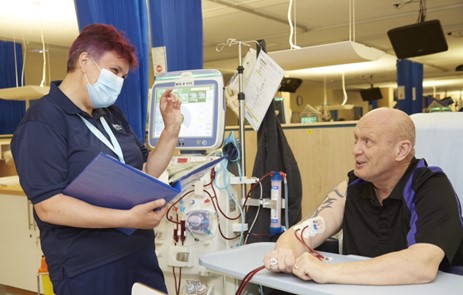
Image Credit: © Guy Hinks
|
||
|
||
|
Rachel Cox, a renal nurse and practice educator at University Hospital Crosshouse in Kilmarnock, shares her experience for International Nurse’s Day and calls for more research to develop at-home care for patients with kidney disease.
Ms Cox has partnered with Kidney Research UK to provide insight into the renal ward at the NHS Ayrshire & Arran hospital. As both a kidney donor and renal nurse with 30 years’ experience, Ms Cox says it is important to continue research to improve the lives of patients:
“I want to do the best I can, so patients’ experiences are as positive as possible and I hope it makes a difference. Whilst I am proud of our unit, in the next 30 years I really want research to make a marked advance in treatments, so they are less onerous on patients, such as developing smaller machines to allow even more people to receive dialysis at home and still get the quality treatment they deserve.”
She says that much has changed over 30 years and treatments are generally easier on staff and patients, but research needs to progress much further to improve quality-of-life for patients.
Discussing her own day-to-day on the renal unit on Kidney Research UK’s Twitter, she said:
“The renal unit staff have put on [dialysis machines] all the renal patients this morning; the ward staff have got all the patients up, given them their breakfast and made sure they’ve had all their medications and they are now waiting to see the doctors to find out what’s going on with them.
“And some of them will have also had dialysis treatment started up the stairs. So it’s been a very busy day and I’ve not even started yet.”
Recently, healthandcare.scot reported that an addtional £3.6m funding will be distributed to NHS health boards to develop their Hospital at Home services, providing acute care to people in their homes.
Sandra Currie, Chief Executive Officer at Kidney Research UK, says the work that nurses do every day to make sure patients get the optimum caret is “remarkable”. She explains that too many kidney patients are reliant on units such as Rachel’s for care waiting for, during or after a transplant.
She explained:
“Even those who have been fortunate enough to receive a transplant may not have seen the last of the ward forever. Many transplants only last for around 15-20 years, meaning patients may need to return to dialysis treatment while they wait for another transplant, or for their ongoing care.
“We’re very grateful to Rachel and NHS Ayrshire & Arran for their support. We hope that by showing what life is really like on the wards, more people will understand just how vital their work is and why more research is needed to improve kidney patients’ lives.”
Recent research from a collaboration across Scottish hospitals and universities found that patients with kidney failure in Scotland are less protected by the first and second dose of the covid-19 vaccine than non-renal patients.
Using patients from the Scottish Renal Registry, the researchers explained it is vital that renal patients receive booster vaccines to avoid breakthrough infection and better protect them from covid-19.
Read more: Hospital at home effective alternative to admission; Scotland's midwives struggling to cope; “More questions than answers” in workforce plan
Sign up to our bulletin for key health & social care updates straight to your inbox. |
