|
Calls to pause national care service legislation |
Related newsSceptical response to government’s care proposals Bid to block IJB voting rights extension Holyrood passes Care Reform Bill Carers charities urge greater transparency in reforms National Care Service plans scrapped Minister: NCS has exposed "polar opposite" views Borders welcomes community dementia nurse Shocking levels of violence towards NHS staff Tourist lets make rural NHS recruitment harder Cancer patient support bolstered by new funding Rapid cancer diagnostic network improves outcomes Communities’ role in climate and public health 
|
|
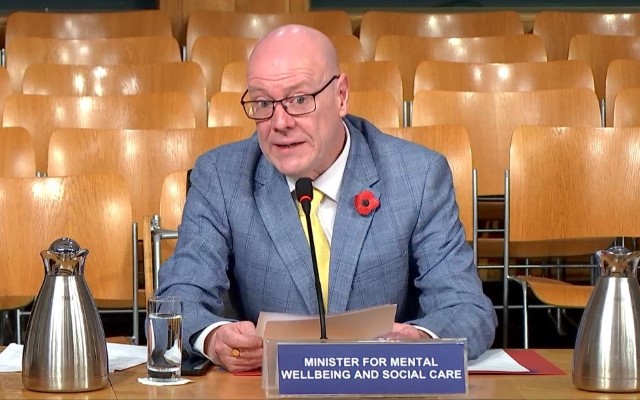
Image: Scottish Parliament TV
Minister for Mental Wellbeing and Social Care, Kevin Stewart MSP
|
||
|
||
|
Scotland's Minister for Social Care has insisted that the process towards setting up a national care service (NCS) for Scotland is on track and has defended the cost estimates that the government has published for the process.
Giving evidence to Holyrood's Finance and Public Administration Committee, which is scrutinising the financial memorandum accompanying the National Care Service (Scotland) Bill, Kevin Stewart MSP said the government cannot yet put a figure on the cost of delivering many of the details of the NCS because they are still being worked out through a process of co-design.
SNP MSP Michelle Thomson said she recognised that the legislation before the parliament is a framework that allows the detailed arrangements to be delivered through secondary legislation, but that numbers attached to the bill are not robust enough:
“I am sympathetic to the complexity and the nature of this type of work. I'm entirely sympathetic to that. But I think it's not unreasonable to suggest that it's just not quite landed at the right level in terms of this finance committee.
“Setting aside the ambition around wanting to change social care, from a scrutiny of the financial memorandum, from a confidence perspective, I don't think you could say, particularly at the first session, the committee emerged with confidence in the estimates and the articulation of the unknown unknowns.”
Scottish Green MSP Ross Greer asked why the co-design process couldn't have happened before the legislation was presented to the parliament.
Scottish Conservative MSP Liz Smith called for the bill’s progress through parliament to be paused to allow more financial modelling to be undertaken:
“You've said persistently that this bill is about people. I understand that. But to ensure that we are delivering first class services for people, it needs some structures surrounding that.
“What the Scottish government is proposing is that there is a vastly different structure put in place from the existing one. Now, that may have merit. But, in order for us to be persuaded of that merit, it is surely incumbent on the Scottish government to set out as much detail as it possibly can to help us along the way to persuade us that the change that the Scottish government wants to make is not just desirable but is actually workable and deliverable.
“At the moment, we have far too many people around the country telling us that they have serious concerns about what it is that they will be asked to do to make that work and, certainly, whether the costs are applicable. Do you accept at least that there is very genuine concern, and that's another reason why this bill should be paused for the time being?”
Mr Stewart replied that he did not think the bill should be paused, adding that he couldn’t provide costings for decisions that haven’t yet been made:
“I come back to the point that some folks out there… whereby folks want answers to some of the questions that we have said are subject to co-design. I cannot, at this moment, give assumptions around about that or we lose the confidence of those folks who want to help us co-design the services as we move forward.”
Ms Smith also asked the minister to respond to evidence from the chair of Scotland's NHS chief executives’ group that suggested that NHS leaders were unhappy not only with the legislation, but that it is being presented at a time when those running existing services are under such pressure.
Mr Stewart replied:
“We continue to listen to NHS board chairs, chief executives and others in all of this and they are obviously key and helping us design the services as we move forward, and we'll be involved all the way through this process.
“I get that some folks want to see delay. I recognise the pressures that there are out there. But in terms of pressures, in terms of delivery of care itself, that will only grow over the years because we have a changing demography, a changing population and we cannot have stasis here. We need to invest now, which we're doing and we're investing over the course of this winter, and we need to get this right for the future. Stasis is not an option here.”
Last week the Deputy First Minister, John Swinney announced a £70m cut in spending on the NCS this year as part of a series of measures included in an emergency budget review, aimed at freeing up £400m to cope with inflation and meet NHS pay deals.
Expert witnesses have told the committee that inflation estimates built into the financial plans are now far short of the current inflation rate.
Committee convener, Kenneth Gibson MSP, suggested that the NCS could be “hobbled from the start” if inflation isn’t taken into account properly.
The minister said that the financial memorandum was not a budget but, as the business cases for each change were drawn up, the government would take into account inflation. He also said one of the aims of the NCS is to reduce high cost crisis spending and move to more preventative care.
Mr Stewart refused to be drawn on how many new care boards will be set up. The committee heard officials are taking advice on the best model for these, including seeking VAT exemption.
The minister told the committee he remains convinced of the importance of creating the new service and, far from pausing it, the voices of lived experience he has been hearing have been making it clear that progress has been too slow:
“I've heard this story time and time again where folk have been punished from pillar to post, [being told] ‘that's not our responsibility, that's the responsibility of the health and social care partnership’, or ‘that’s not ours, that’s the council’s responsibility here’ or, ‘no, that's the NHS’ responsibility here’. And that leads to real difficulties for people, and we need to change that. And that's why we need this change to make sure that that accountability is there so that people know what they can expect from a care system.”
Read more: Legal experts: NCS Bill too vague on human rights; Cuts will delay national care service plans; NHS leader: NCS threatens smaller boards; Joint call for major National Care Service rethink;
Sign up to our bulletin for key health & social care updates straight to your inbox
You can now follow healthandcare.scot on Google News. |
