|
£153 a week for bread and jam |
Related newsNational Care Service Forum 2025 Playing politics while social care support burns National Care Service: if not now, when? A timeline of Scotland’s National Care Service Independent Living Fund reopening moves forward Review: More social care staff should be regulated 
|
|
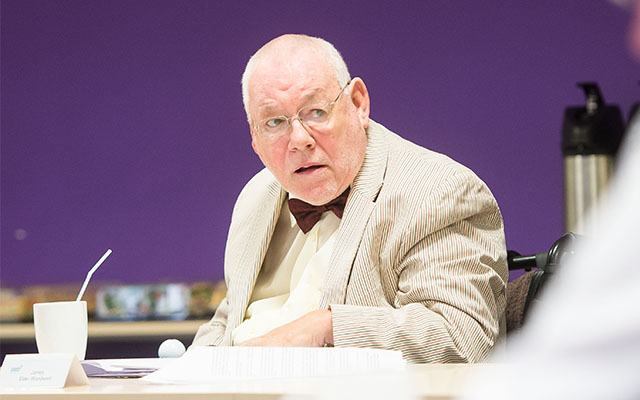
Dr Jim Elder-Woodward
|
||
|
||
|
Dr Jim Elder-Woodward, OBE, Vice Chair of Inclusion Scotland and disabled activist, challenges the idea that local authorities are best placed to manage local social care services, arguing that the current structure places money over the human rights of disabled people - part of a broken system that no amount of money alone could fix.
We had just finished our family Christmas dinner. My family had driven up from England to make it to Christmas in my adapted house, as that was easier for me than having to manoeuvre my chair around theirs. Drinking by the fireside, my niece recalled how her mother and she drove up and down the M6 to take care of her Gran during the last days of her life. And how they used to leave prepared meals in the freezer, for her to eat in their absence. In between times, Gran paid the local authority £153 per week to feed and care for her.
When they discovered the meals were not being eaten, my niece and her mother decided to hide in the spare bedroom when the care worker appeared to give Gran her breakfast.
“What would you like to eat, dearie?”, asked the care worker.
“Can I have porridge and toast, with a cup of tea?” Gran asked.
“Sorry dearie, there’s only bread and jam,” the care worker replied.
Later the same carer came back to tell Gran she could only have bread and jam for lunch; and at teatime the same announcement was made.
By this time an enraged daughter and grand-daughter burst into the room and asked the carer to accompany them into the kitchen. There, she was shown a freezer and cupboard full of food. The carer was removed, after a formal complaint, but it is understood, never fired.
Only this week, I once again heard of poor care delivery, receiving an email from a friend, who has cerebral palsy. He has recently been discharged from hospital. He wanted some advice, because he was only getting help to wash three times a week.
This is the broken system that the National Care Service discontents wish to maintain. They are in denial of the way social care is managed today. They say all that is needed to improve services is more money. There is no mention of a managerial culture which places the pound over the dignity and human rights of the people they serve, let alone, as in the case of my mother and friend, the abatement of their suffering. Nor is there any apology, or even recognition, of their tactics of obstructing Scottish government improvements of the social care system over the years.
As an example, despite being given an increased grant to compensate for the introduction of free personal care, research has shown local councils were taking a further £800,000 more in non-residential care charges, two years later. This, despite it being the first year of COVID in which services were reduced to essential support only, whilst others were stopped altogether.
The discontents say that the national system will deny local democracy. The value of such is questionable when local democracy denies the input of minorities, such as those with living experience of the services they provide. About twenty years ago, the Independent Living Movement, alongside the Coalition of Carers in Scotland, sat with the Convention of Scottish Local Authorities (COSLA). For three years, we tried to resolve issues within this broken system, based on 17th century poor law. These issues included the postcode lottery, where the type and amount of support people get depends upon where they live in Scotland. And, if you were to move from one local authority to another you automatically lose your support package. We also discussed the issue of the taxation (euphemistically called ‘contribution’) of social care and support.
After three years of COSLA blockading our arguments and suggestions, we finally walked away.
The sociologist Keith Kahn-Harris defines denial as; ‘a process in which systematic attempts are made to overturn an overwhelming consensus and overwhelming evidence, using pseudo-scholarly tools, for dangerous ends.” He goes on to explain denialism is an expansion, an intensification, of denial. Denial and denialism are simply a subset of the many ways humans have developed to use language to deceive others and themselves. Denialists can be found in such debates in which they argue anthropogenic climate change is a myth; that evolution is a scientific impossibility; and that all manner of other scientific and historical orthodoxies must be rejected. To this esteem list may be added that social care and support in Scotland is not broken and is quite safe in the hands of local authority’s managerial neoliberalism.
The sex psychotherapist, Bill Herring, has summarised the four denials of his patient’s asocial behaviour, as follows: denial of fact says that the offense in question never happened; denial of impact trivializes the consequences of the inappropriate behaviour; denial of responsibility attempts to justify or excuse the behaviour; and denial of hope shows that the person is unwilling to take active steps to make things better. Space within this article precludes the detailed application of Herring’s framework to the analysis of local authority management of social care and support. However, in summary; the denial of fact can be seen in the vehement opposition to the Bill; the denial of impact in the continual obstruction of Scottish Government improvements, such as free personal care and self-directed support; denial of responsibility in the blame of reduction of resources; and denial of hope in not propitiously listening to those in receipt of their services and not being prepared to make things better.
It is submitted that a more detailed investigation along these lines might highlight the reasons why those of us, who have long suffered the outcomes of such denialism, look forward to being finally and propitiously heard during the construction and delivery of the National Care Service. We can only hope that things will get better.
The views of columnists and people who write other guest insights articles are their own.
Read more from Dr Jim Elder-Woodward: The right to have needs met by the NCS; A rebuttal to NCS discontents; Don’t let ILF wither on the vine
Sign up to receive our bulletin for key health & social care updates straight to your inbox. Tags: Disability; National Care Service; Social Care. |
