|
Where is lived experience in care regulation review? |
Related newsPraise for charity CEO who turned down MBE Politicians told: “Carers cannot wait” National Care Service Forum 2025 ILF Scotland at 10: "Collaboration + enthusiasm" ‘Leaps’ needed to secure change for disabled people Playing politics while social care support burns 
|
|
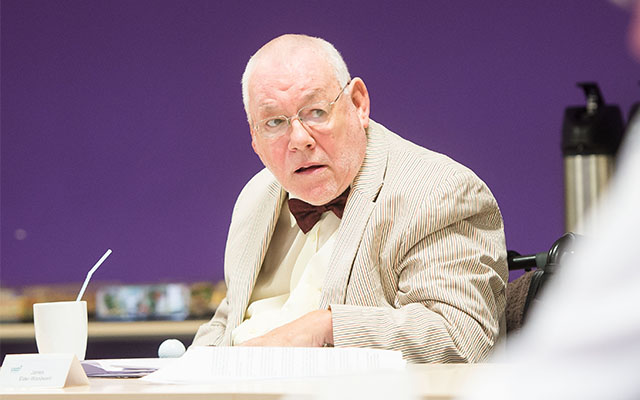
Dr Jim Elder-Woodward OBE
|
||
|
||
|
An independent review of inspection, scrutiny and regulation of social care services, launched in response to concerns that the sector’s regulatory framework is not fit for purpose, is due to report its findings in June 2023.
Dr Jim Elder-Woodward OBE says an absence of the voices of lived experience during the inquiry means those to be most affected have effectively been silenced. As a disabled activist, he argues for the inclusion of these true experts as equal partners within the inspection and regulatory landscape and for the embedment throughout of the values, principles and practices of independent living; without this, he says, any improvement strategy will fall short.
The Scottish government is undertaking yet another independent review of social care: this time of inspection, scrutiny and registration. Unlike the Independent Review of Adult Social Care, this review has no representative on its Review Panel from those with lived experience of services.
This is truly unfortunate, as the Scottish government has stated its quest is to involve those with lived experience of social care support in the future development and maintenance of the sector. Inspection, scrutiny and registration has, or should have, a major impact on the quality of life of those the system purports to support; and who best to ascertain that but those in receipt of its services? Before making its recommendations, the Review may confer with its “Practitioners and Stakeholders Panel”. This constitutes 29 organisations from the social care support sector, of which three are organisations of people with lived experience of services.
This skewed membership results in the scenario of the ‘police’ not only ‘policing’ themselves, but deciding on how such ‘policing’ should be conducted – all of which lacks meaningful independence and validity.
The Review has just completed its consultation phase, which revealed how myopic it is. Instead of taking a radical approach to the sector, it looks at each service separately. It would not have taken a gigantic leap to view a more radical approach, such as that taken by the Scottish Health Service after several incidents of poor service.
The service radically shifted to base its management structures on the principles of the improvement model, as espoused by the American management guru Gerald Langley and his colleagues. The health service changed its mantra, “What’s the matter with you?”, to “What matters to you?”, then built its improvement strategy around that patient driven outlook.
This Review takes improvement as the outcome, or by-product, of inspection and registration, rather than the framework within which services and their control mechanisms need to be developed and maintained.
Before attempting to decide how services should be inspected and registered, space and time should have been allotted to a discussion on what social care support should do, and how it should be conducted.
It is suggested here that, instead of social services being based on the assessment of deficit, as they are today, they should apply the principles and practices of social pedagogy to social care support. This would be done by assessing the potential and strengths of the individual to develop their empowerment and emancipation. Such an approach is not new; it’s been advocated by the University of Dundee’s Professor Mark Smith, and is mainly practiced in childcare.
Social pedagogy describes a holistic and relationship-centred way of working in social care support and educational settings with people across the course of their lives. It has a long-standing tradition as a field of practice and academic discipline concerned with addressing social inequality and facilitating social change by nurturing learning, well-being and connection at both an individual and community level.
It is akin with strength-based practice, which emphasises people's self-determination and strengths. It is a way of viewing people as resourceful and resilient in the face of adversity. It is person-led (not person-centred), with a focus on future outcomes and strengths, which people bring. When such an assessment is completed, the barriers to the realisation of their potential can be ascertained, as can joint decisions over the supports to overcome these barriers. A social pedagogical approach would not only change the present view that the person is the ‘object’, rather than the ‘subject’, of social care support, but their collective would have a more significant role to play in the improvement mechanisms of social care support.
If truth be told, there is a lack of trust amongst those who employ their own personal assistants that there will not be ‘mission creep’ in the registration of the profession. This would, ultimately, turn their family home into a care home. Potentially, it would also be an invasion of people’s privacy; people who are already the focus of much misplaced opprobrium. It is quite worrying that the consultation only asked what should be regulated, not what should not.
Rather than inspecting and regulating the lives of those in receipt of personal assistance, through that of their assistants, there is an argument that those with lived experience should take an active role in the inspection of mainstream services and provisions.
At the moment a number of people are trained by the Care Inspectorate to accompany their inspectors on their visits. Their role is to talk to the service recipients and garner intelligence from them. It is suggested here that such volunteers should be supported and trained, not only by the Care Inspectorate, but by the disabled people’s Independent Living Movement.
This would enable them to bring the values, principles and practices of independent living, alongside that training which the Care Inspectorate provides, and become valued as equal professional inspectors with lived experience.
In addition, it is also suggested that such an inclusive system of inspection would benefit from a system of ‘Buddies’. The Movement would be resourced to develop and support ‘Buddies’ to enter services and provisions to work with both providers and recipients. The ‘Buddies’ would discuss with recipients the provision they receive and raise awareness amongst them of its quality. They would then facilitate recipients to support each other when raising any concern or comment.
These ‘Buddies’ would also help recipients to read and comment upon any Care Inspectorate report on their provision. This ‘Buddy’ system was proven to be most useful during the closure of institutions in Glasgow in the 1990s.
Indeed, there is so much more to be considered before we can settle on an optimum system of improvement, facilitated by inspection, scrutiny and registration.
The views of columnists and people who write other guest insights articles are their own.
Read more from Dr Jim Elder-Woodward: £153 a week for bread and jam; The right to have needs met by the NCS; A rebuttal to NCS discontents; Don’t let ILF wither on the vine
Sign up to receive our bulletin for key health & social care updates straight to your inbox. Tags: Disability; Social Care. |
