|
Community Link Workers can’t solve inequalities alone |
Related newsCollege: Invest in digital transformation for GPs GPs are the solution to NHS crisis, says College Partnership urges action over Scotland’s mental health All public bodies must focus on health, urges charity Holyrood hears calls for more inclusive communication Dementia campaign success to inform government actions Medical trainee abuse reports ‘shut down and silenced’ Politicians must take ‘bold’ action on child poverty Glasgow district nurses ready to strike NHS and Glasgow rethink routes into healthcare ‘Major’ update to One Health AMR register Glasgow LEZ success sparks call for expansion 
|
|

Image Credit: © Evrymmnt__
|
||
|
||
|
In its first ever Scottish Community Link Worker Network (SCLWN) Conference, Voluntary Health Scotland hosted speakers including the Minister for Social Care and Mental Wellbeing and the University of Glasgow’s Professor of Wellbeing Economy.
Discussing the role and impact of link workers and the outstanding challenges in tackling health inequalities, healthandcare.scot heard both calls for celebration of the positive contributions thus far and more action for the workforce and Scotland’s population.
Some of Scotland’s 300-strong cohort of community link workers (CLWs) joined the conference in Glasgow to network, workshop and hear from the day’s keynote speakers on how CLWs can help tackle health inequalities.
Concerns around funding and lack of evidence around CLWs dominated conversations, with one academic saying the profession must be realistic of their impact in the face of rising health inequalities.
Professor Gerry McCartney, Professor of Wellbeing Economy at the University of Glasgow and a lead researcher into health inequalities with Glasgow Centre for Population Health (GCPH), explained that while CLWs are key supports, austerity continues as a major driver of health inequalities.
A colleague at GCPH told MSPs last year that the “scandalous” austerity programme has contributed to increasing death rates across UK.
Professor McCartney added:
“Be wary of reports, analyses and interventions that suggest they’ll reduce health inequalities without addressing fundamental drivers of health inequalities – the work you do is hugely important but we all work within a policy framework, where we need to be advocates for the kind of interventions needed.
“We all can do stuff, particularly when we work together – if CLWs weren’t here, things would be worse, there’s no doubt about that. But can we fix it with just CLWs? Of course we can’t, we don’t want to be naïve, but we don’t want to be disempowering.”
Attendees also heard from Lorna Kelly, the National Strategic Lead for Primary Care in Health and Social Care Scotland, who highlighted the vital role of primary care in tackling health inequalities.
However, Ms Kelly pointed out that it “can’t solve inequalities alone”, drawing from the government’s primary care health inequalities short-life working group report.
She highlighted key takeaways to invest in tackling health inequalities, including develop a strategy for wellbeing communities and training multi-disciplinary teams in health inequalities.
Earlier this year, the independent review of Scotland’s health inequalities concluded – with a meeting on the review including calls for actions to address austerity and build relationships at a national, local and third sector level.
Ministerial address
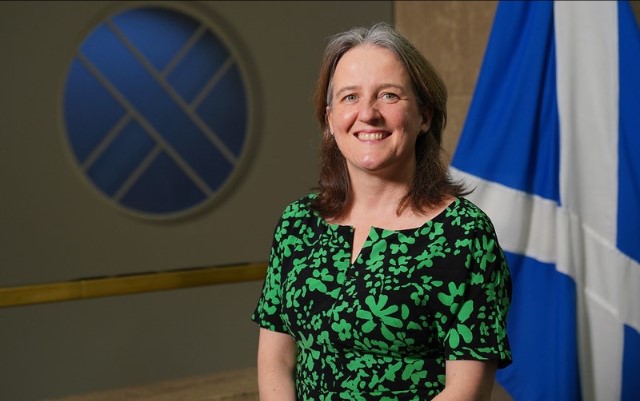
Maree Todd offered a ministerial perspective on where Scotland is in terms of health inequalities and the changes over the last decade which she says have allowed link workers to “really come into the fore to improve population health”. The Minister for Social Care and Mental Wellbeing said:
“We are all aware of the challenges experienced by individuals and communities right now and the pressure that health and other services are under. I’m under absolutely no illusion that the work that you do day in, day out can be really tough – and there's a sense of uncertainty about the future.
“But let me say, it is because of your individual and collective efforts that we so often say Community Link Workers are at the forefront of our efforts to tackle health inequalities. You’ve shown yourselves to be adaptable to the changing ways of working, proving yourselves invaluable in helping to assist people – food banks, benefits advice, mental health provision.”
Despite uncertainty, she highlighted that it’s important to celebrate “just how far” the network of CLWs has come, from its pilot scheme in a handful of practice to having CLWs included as one of the services “necessary” to the 2018 GP contract.
Link workers often operate out of general practices, alongside pharmacists, mental health nurses and other healthcare professionals as part of multidisciplinary teams (MDTs).
She said that with over 300 CLWs in post now, the Scottish government “surpassed” its target to reach at least 250, and the First Minister’s new policy prospective also commits to “sustained investment” in GPs through the Primary Care Fund.
While on track by March 2022, the target for an additional 250 CLWs pledged by the end of 2021 was in fact missed with just 218 CLWs in post by March 2021.
Ms Todd added:
“Now in terms of funding for multidisciplinary teams – or MDTs – we have committed a minimum funding position of a £170m for 23/24 and future years. By March 2022, more than 3,220 FTE healthcare professionals including link workers had been recruited into MDTs since 2018 and we would expect that to increase further this year.”
However, an audience member challenged Ms Todd and said staff are leaving because services cannot afford to pay them.
Ms Todd said wages and conditions that reflect the true value of CLWs are essential, admitting that:
“We are working really hard to find money across the board and recognising, particularly for social care with a low-paid and largely female workforce, that we have to tackle those things. We’re not going to fix this with the wave of a wand, but I can assure you the government is committed to improving and valuing social care.”
VHS is currently mapping the CLW network, with the organisation’s Policy and Research Officer giving an insight into some of the findings from the work – and a final report due later this month.
Read more: Insight: Links workers' vital role; Can Scotland make health fairer?; Inside Scotland's widening health inequalities
Sign up to our bulletin for key health & social care updates straight to your inbox and you can follow healthandcare.scot on Google News. |