|
Home podiatry visits rise to stop hospital admissions |
Related news‘Clear strategy’ needed to protect care homes Care homes urged to act early on improvement Government to establish West Highlands care review Care home staff numbers increase after record low Chief Medical Officer: ‘Critical connections’ priority Fixing social care funding must be council “priority” NHS Glasgow told be ‘more transparent’ over infections Plea to public on virus advice as covid wards fill Landmark Glasgow MND trials begins City-wide guard of honour for NHS volunteers Virtual appointments here to stay Glaswegians urged to use NHS wisely in winter 
|
|
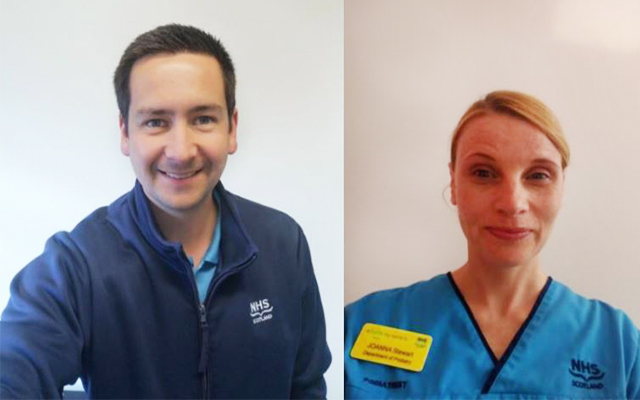
James MacKinnon and Joanna Stewart
|
||
|
||
|
Unlike many NHS services that reduced face-to-face contact over the past few months, podiatrists have been providing many more home visits to keep high-risk patients out of hospital as covid-19 cases peaked earlier this year.
James MacKinnon and Joanna Stewart – specialist podiatrists within NHS Greater Glasgow and Clyde – have told of the many changes that were made so they could keep treating patients.
“The podiatry service has had to adapt very quickly in the way it provides its service,” they write.
“To protect the public and reduce footfall in health centres we have had to reduce the number of clinical locations available.
“Working in high-risk foot protection, we have had to ensure that we continue to provide care to our most high-risk patients.
“Home visits have substantially increased to provide continued wound care to high risk patients who are shielding.
“A main priority is to keep those patients out of hospital. Managing the risk of infection by continuing to provide wound care in community ulcer clinics and through home visits, and supporting patients and carers to manage dressings via virtual appointments.
“Focusing care on these patients reduces hospital admission rates and attendance at A&E. We provided support to fellow podiatrists who have had to adopt new roles and practice at short notice.
“District Nurses were also asked to take on new roles and to facilitate this we took on their caseloads of foot and ankle wounds.”
A new working rota meant members of the team could work from home and support better social distancing throughout lockdown, Joanna and James explain.
“Before covid, we had initially been piloting virtual (Near Me) clinics for wound review and providing support to patients, their families and carers for managing their own treatments.
“During this time only 16 patients opted to use Near Me and 81% of those did not attend.
“During covid this picture changed dramatically and 184 patients attended during a nine week period with only 18% not attending, with technology being cited as the biggest reason for this.”
The pair write that Near Me now feels like a “very normal way” of consulting with patients.
“This has been especially useful in triaging patients from care homes. Working alongside the nurses and support staff in these settings, we have been able to continue to provide a consistently high level of care.
“Communication has been key between staff, patients and carers. There has been great support between colleagues and management in embracing new ways of communicating.
“This has allowed us to discuss patient management plans, tweak rotas but I think most importantly allowed us to continue to interact and bounce off of each other despite not being in the same room which has definitely helped morale.”
Any disruption or difficulties brought about by the virus only served to make their team stronger, James and Joanna say, as staff pulled together to help each other and their patients “through a strange and challenging time”.
“For patients, virtual clinics have given them the peace of mind that they are able to continue to access the service despite shielding, and their foot health has not suffered as a result.
“This has also provided support to staff and patients in care homes & nursing homes, helping them feel supported. Patients have shown a real willingness to be more involved in their care which has been a great help to the service over this difficult time.”
They both say they feel proud of how their colleagues and patients have dealt with what the past few months has thrown at them, particularly as some patients have become more pro-active in their own care.
“We have learned we are all stronger and more resilient than we think – that in times of adversity and uncertainty you take on challenges that previously may have seemed daunting.”
James and Joanna’s experiences were gathered as part of the personal outcomes collaboration’s changing practice under covid-19 project.
Sign up to our bulletin sent twice a week so you don’t miss out on the latest jobs and health and social care news. |
