|
Eye health innovators sought |
Related newsScottish health research collaboration extended Digital health: This is the moment AI for lung cancer care to help tackle “hidden killer” Cardiac innovation gets public showcase New model can predict pre-eclampsia risk Redefining clinical meaningfulness 
|
|
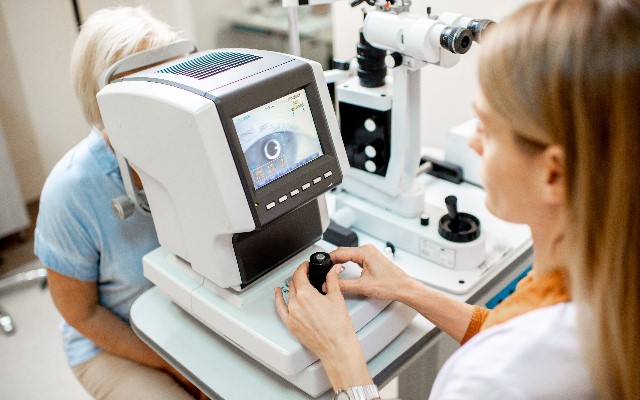
Image © rh2010
|
||
|
||
|
A drive is being launched to encourage NHS staff in Scotland to share ideas for innovation in eye care as ophthalmology and optometry services face what one Professor is describing as “massive backlogs” in appointments and treatment created by the pandemic.
As well as eyesight testing, concerns are being raised that conditions that account for the majority of outpatient appointments – diabetic retinopathy, age related macular degeneration (wet and dry), glaucoma and cataract – may be going undiagnosed or unmanaged.
The Ophthalmology Lead at the Chief Scientist Office for NHS Research Scotland, Professor Roshini Sanders, says services are struggling:
“The NHS is currently challenged with massive backlogs.
“Those with chronic long-term eye diseases such as glaucoma accounting for over 60,000 patients in Scotland stand to lose vision with delayed appointments.”
Professor Sanders is backing a call being made by InnoScot Health, the organisation that supports NHS staff to assess, develop and spin out solutions put forward by NHS Scotland staff, which she says could help services identify meaningful solutions to supporting patients.
InnoScot Health will host an online seminar on Tuesday to explain the latest innovation call by the organisation and help people to understand the process of taking their ideas forward.
InnoScot Health’s Head of Innovation, Robert Rea says eye health is an area of healthcare that is now under particular strain:
“There are few areas of healthcare that have been as dramatically affected across the last few years as ophthalmology, with the pandemic increasing waiting lists, storing up significant health problems for patients, and placing considerable pressure on staff.
“That’s why our call is so important at this time – to advance innovative eye care solutions for important unmet needs and improve the lives of people living with vision loss and eye disease.
“Innovation has the power to unlock fresh, inspired solutions that can tackle issues head on and lay the foundations for further positive change in diagnosis, treatment, and prevention.
“InnoScot Health is seeking ophthalmic innovations from any health board and any role or medical discipline. So, if you have an idea, then please do get in touch with our team of experts.
“We are particularly looking for innovations that have commercial potential – ones that can be developed as a new product and generate income.
“Innovation in this area is very often, though not always, a new medical device, but could also be an accessory of some sort or a training tool such as an educational board game.
“We also evaluate digital solutions such as forward-thinking apps, and where innovators come to us with ideas relating to new processes or services, we endeavour to identify the most appropriate partner agency to support it and take it further forward.
“Inventions that are co-developed with non-NHS parties can also be supported by us as long as there is a defined NHS input or staff member involved in the project.”
InnoScot Health has worked on a number of ophthalmic innovations born out of the NHS, including Peekaboo Vision, an app created by NHS Greater Glasgow and Clyde; Multifocal Retinal Imager, developed in collaboration with Wideblue; and the iGrading platform, a diabetic retinopathy screening tool developed alongside NHS Grampian, the University of Aberdeen and Medalytix Ltd.
NHS Forth Valley ophthalmologist Dr Iain Livingstone believes his profession is witnessing a clear shift in the tools it uses:
“Personally, I see a major change in the transition from ‘light of sight’ technology to digital presentations.
“There has been some fledgeling work around a new optical system for the slit lamp – a microscope with a bright light used during an eye exam – that is applicable to examination, surgery, and 3D transmission.
“Apple meanwhile is set to announce a headset that has more processing power than its top MacBook, and Meta is set to update its Quest 2 headset.
“I see ophthalmology leaning on mixed/virtual/augmented reality for examination and surgery over the next 10 years.
“Across NHS Scotland, rising patient demand is a major issue, and it’s no different in ophthalmology services. To be able to expand and improve the services that we offer, new ideas and innovations will be key to the overall provision of health and care.
“NHS Scotland has a diverse workforce with innovative ideas from which the quality of care we provide can be improved by virtue of having real, first-hand experience of patient’s needs. InnoScot Health’s remit includes support on taking ideas forward.”
A free to attend virtual briefing event – taking place on Thursday 13 October at 10am – will serve as an introduction to the call while laying out the support available to health and social care staff submitting their ideas. You can register for the event here.
Read more: Tayside CPR invention demonstrates safety benefits; Promoting sustainable healthcare; Innovators need ‘strong understanding’ of regulation.
Sign up to our bulletin for key health & social care updates straight to your inbox. |
