|
AI for lung cancer care to help tackle “hidden killer” |
Related newsGovernment boosts health innovation funding Rapid cancer diagnostic network improves outcomes Cancer outcomes worse for rural patients Digital health: This is the moment Charities spotlight early blood cancer symptoms How data insights will help deliver NHS reform NHS board savings push could see AI replace staff Aberdeen A&E first to offer routine HIV tests Aberdeen honours UK’s first occupational therapist Struggling health board appoints new leader Health board escalated over deepening financial risk Call to expand Huntington’s specialist care 
|
|

|
||
|
||
|
Successful use of artificial intelligence (AI) in the detection of lung cancer across NHS Grampian could now be embedded in lung cancer care across Scotland.
NHS Grampian’s GRACE project first introduced AI software to assess images from chest scans in 2022.
While all chest x-ray images continue to be manually assessed by radiologists, the ‘Annalise CXR’ software scans images for more than 120 potential issues and highlights those that may show signs of lung cancer to be assessed more urgently.
Use of the software across 13 NHS Grampian sites has led to 12% more treatable cancers being found and helped get 95% of people access the treatment they need in 30 days less.
Now, the NHS Grampian team is working alongside the Accelerated National Innovation Adoption (ANIA) Pathway to build on this ‘transformative’ work and trial a system to be delivered across Scotland.
Consultant radiologist Dr Struan Wilkie said this system helps clinicians manage a 50% increase in the number of referrals for urgent suspected cancer over the last five years, while allowing patients receive faster diagnosis and treatment:
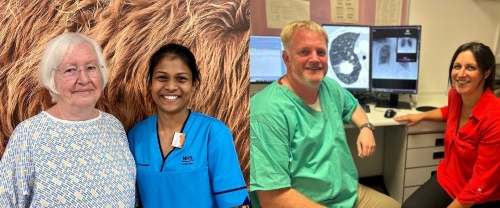
(L-R) Outpatient Morag Carmichael with diagnostic radiographer Shivani Nairy and Dr Wilkie with Lorna Cameron © NHS Grampian.
“While the number of confirmed cases remains relatively stable, this means there’s huge demand for diagnostic radiology services and our teams are using the latest innovations, tools and expertise to ensure patients are treated as quickly as possible.
“We see about 300 chest x-rays per day in Grampian alone and thousands across the country so using the same tech and lessons learned elsewhere has huge potential benefits for both patients and staff.
“As healthcare continues to become ever more specialised, as treatments and technologies evolve, so do the demands on staff. Used in the right way, AI can give us a helping hand but it can’t manage risk or take responsibility for patients, so there will always be a need for checks.”
Dr Wilkie added that, despite it being the most common cancer in Scotland, lung cancer is often a “hidden killer”, with many cases being picked up at a later stage when receiving chest x-rays for something else.
Detecting lung cancer in its early stages with the support of AI to spot potential signs is “invaluable” as a result, according to the consultant.
Clinicians’ time is also being saved by the AI tech by its ability to identify normal x-rays, allowing doctors to quickly review these images which gives them more time to review abnormal x-rays.
Lorna Cameron, Programme Manager for Innovation at NHS Grampian, said:
“It has been fantastic to see our lung cancer diagnostics pathway improving, and now to be realising the potential this technology has to help us with major challenges like the increasing volume of referrals across Scotland.
“Here in Grampian, clinical staff review about 70,000 chest x-rays every year and among those there are 300 or so that will show a previously unknown lung cancer.
“This technology is helping us identify these ‘needles in a haystack’ as quickly as possible and accelerate people to treatment.
“Innovative technology has the potential to help us improve outcomes, make care more accessible and speed up service delivery.”
Outpatient Morag Carmichael who had a chest x-ray at NHS Grampian’s Dr Gray’s Hospital said that if AI in healthcare helps the hospital, nurses, doctors and wider health service improve, it “has got to be a good thing”.
Health Secretary Neil Gray MSP said embracing innovation is “absolutely vital” to address pressures in the NHS and meet future population health challenges, adding:
“Artificial Intelligence is a key part of that, so I warmly welcome NHS Grampian’s adoption of this new tool which supports our ambitions for reducing cancer waiting times and improving outcomes.
“I look forward to seeing how we can learn lessons for the wider health service.”
Read more: AI to help take pressure off A&E; “Huge alarm” at hospital discharge delays; AI for early heart attack diagnosis; Current metrics fail to capture full NHS activity; Dementia home care tech collab invites partners; Pain assessments meet AI in care homes; Making cervical cancer a ‘rare disease'; Social robots show potential in patient support
Sign up to our bulletin for key health & social care updates straight to your inbox. |