|
Insight: Care homes embracing technology |
Related newsUsing VR to understand lived experience of dementia The case for a Highland weighting Care homes urged to act early on improvement Home adaptations – council spend will prevent NHS cost Frailty services supported with £85m Care worker visa changes ‘inhumane’ and risks services 
|
|
|
||
|
||
|
Age Scotland’s head of dementia believes that simple technology can have a meaningful role in helping people with dementia to live well. She shared her thoughts as a University of Stirling tech project reveals “significant impact” for care homes residents by increasing their access to technology.
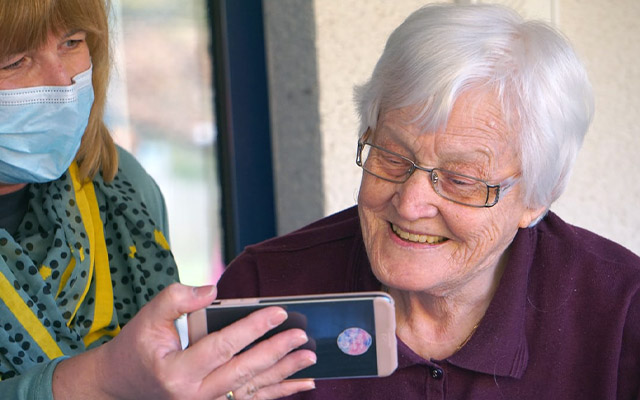
Collaborating with the Digital Health & Care Innovation Centre (DHI) and the Technology Enabled Care (TEC) Programme, University of Stirling researchers have been focusing on how technology can connect people in care homes with their families.
Dr Gibson, a dementia specialist at Stirling university who led the ‘Connecting Residents in Scotland’s Care Homes’ programme said:
“Our findings demonstrate that care home residents and staff have particular support needs and face specific challenges with accessing and using technology, but that technology use is popular among residents when provided with useable technology alongside the right training, information and support.”
Moira Mackenzie, DHI’s Deputy CEO, added that this report clarified the challenges and opportunities associated with digital solutions in Scotland’s care homes.
A significant impact on social isolation from increasing access to technologies was reported by the researchers, noting a particular effect as the project launched in 2020 when the pandemic limited visiting in many care homes.
Dr Manji, Age Scotland’s head of dementia, said that “amazing work across communities” took place during the pandemic providing support for people with dementia. She added that Age Scotland is eager to harness local and wider research work for dementia-friendly communities:
“Being connected is really important. Of course, it’s never a substitute for that face-to-face connection in person, but the pattern with dementia within people’s wider networks, is that, following a diagnosis, these networks tend to shrink.
“When people have access to technology, they can stay connected even if they can’t leave the home as often.”
In this new research, 75% of 1398 registered care homes were provided with at least one iPad and 115 homes received multiple devices.
Technology helped residents make regular video calls with family members and supported physical activity and entertainment benefits.
Residents and staff also used devices for different engaging activities, from listening to music, watching videos, and using Google Maps. Researchers reported that this not only supported social engagement, but also prompted reminiscence among residents.
Music therapy work recently found that beyond listening, playing a musical instrument improves mental health and memory, with residents simply following a light-up keyboard. Age Scotland’s Dr Manji added that utilising such technology can be incredibly effective in supporting people with dementia in Scotland:
“There’s something about not reinventing the wheel – I think simple is often the best and most powerful.
“We had a number of focus groups conversations with people living with the dementia about their needs, priorities and how they felt about technology in their care and a number of people living with dementia really embraced technology.”
Building on work around personalised listening as dementia care, University of Stirling researchers said activities were also personalised for individual residents, by creating individual playlists or YouTube selections.
However, Dr Manji explained that some responses in focus groups showed hesitation or even hostility, with a sense that technology-enabled care can be “geared towards managing care” rather than meeting the needs expressed by people living with dementia.
She said individual support is needed to reap the benefits of care-directed technology, something Age Scotland has heard directly:
“I remember one focus group in Fife and people said if they had gone with what care managers from the council suggested, they would have a cupboard full of things that each did one thing.
“Technology can be a very useful tool but many people living with dementia – especially in the early stages – find that quite challenging if they perceive it as a restriction of their civil liberties or feel under surveillance.”
She shared that getting endorsements from other people living with dementia helps, leading to a greater likelihood of embracing technology as people can trust the shared experience.
This research found that training for carers also helps, with staff in care homes reporting the importance of effectively using technology in their work.
Dr Manji said adopting care-directed technology can be “very complicated and nuanced” in homes:
“Carers themselves have very legitimate concerns about safety and being able to safeguard the best interests of people they’re caring for – and technology can play a very important part in helping that.”
Dr Gibson’s work also reported staff support increased with training, using devices in resident care, online meetings and care planning:
“Our evaluation found that the technology-upskilled staff, with those working as activity or wellbeing coordinators the most likely to embrace the technology, with the project demonstrating just how crucial these staff members are in care homes.”
Despite launching during the pandemic, researchers reported that most care homes continued to use the devices once restrictions eased, finding that the technology enhanced the daily care of residents.
Dr Manji highlighted challenges in continuous funding to support individuals across Scotland. She said this work distributing iPads and training staff can be a low-cost intervention, adding:
“I think it would be wonderful to see that kind of intervention rolled out in collaboration with person-centred conversations around what people want to use it for and the outcomes they want to achieve.
“It’s not enough to just give people an iPad, it’s about that upskilling of staff and empowering people to explore the different ways technology can work for them.”
However, despite aiming to equip all care homes in Scotland with devices and training to support tackling isolation among residents, 25% of homes were not reached and the 115 homes utilising multiple devices only represents 8.2% of all care homes.
The final evaluation of ‘Connecting Residents in Scotland’s Care Homes’ called for a more “responsive and flexible funding stream” to support innovation, develop and expand the programme. A particular emphasis was placed in the evaluation on improving outreach to more deprived areas, with researchers explaining it is important to better understand the technology needs of care homes in deprived areas.
Read more: Music's potential to help with dementia; Insight: Links workers' vital role Tags: Home Care; Older People; Social Care; Tech And Digital. |
