|
Using VR to understand lived experience of dementia |
Related newsDementia home care tech collab invites partners Scotland commits to change the dementia story Music, dance, rugby and dementia Music’s potential to help with dementia Care homes urged to act early on improvement Care worker visa changes ‘inhumane’ and risks services Treatment-resistant cancer focus of new study Enhancing independent living with robotics Law change needed for Scotland’s drug crisis Libraries offer light lift for low winter mood Medics warn pollution is risking children’s health Peer support ‘crucial’ in suicide prevention 
|
|
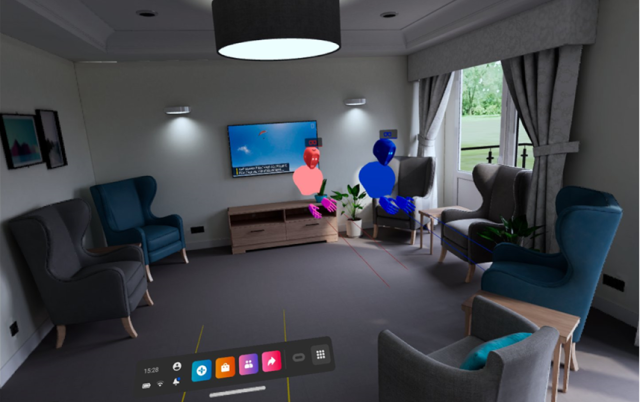
Image Credit: © Age Scotland
|
||
|
||
|
The charity Age Scotland is working with a virtual reality company to provide an insight into the daily lives and challenges of people with dementia by letting designers, housebuilders, planners, carers and care workers see as if through the eyes of someone with the condition.
healthandcare.scot spent an afternoon with Jonathan Park, to see how the technology helps the user understand at first-hand what ‘dementia friendly design’ looks like.
“So when you have the headset, you can physically walk around these places or teleport yourself from space to space with these controllers.”
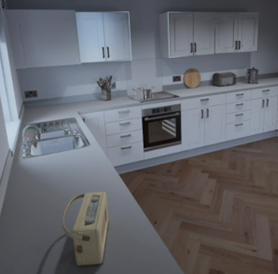
We’re in the shared VR kitchen. Jonathan asks us to look around the space and identify anything that could be a potential challenge for someone living with dementia.
The similarly-coloured walls, cupboards and surface appear to be an issue for someone with cognitive decline, something already recognised by University of Stirling research.
While this is something relatively simple to change, Jonathan explains if people are not aware, they can’t make that change.
The collaboration with VR-EP (Virtual Reality Empathy Platform) creates an experience based on dementia-friendly design principles, with filters to engage carers in the perspective of those they care for.
Jonathan adds that Age Scotland has also listened to people with dementia directly and carers to gain as many insights to the different experiences of dementia as possible.
By delivering workshops to carers and care home workers across Scotland, he hopes to share such and initiate change:
“If you’re met with a wall of silence, it points to the fact that the people you’ve got in the room actually don’t know that much about how dementia affects a person and how cognitive decline impacts daily living.
“So it’s a great barometer of how much information you need to impart and what level is needed for each group of people.”
Risk assessment
Illustrating some risks associated with a person living with dementia in a space that is not particularly dementia friendly, Jonathan walks through a cooking scenario:
“Imagine I have dementia,” he says walking over to the cooker. “I’m in a new apartment trying to cook my first meal – my pasta pot is boiling away and starting to bubble over, so I need to take it off.
“I grab the pan, but the problem is when I try to put it on the sideboard. To me, it all looks the same. I can’t really differentiate between the colour of the pot, the unit and the worktop. So think how easily I could drop the pot off the side.
“Equally, many taps on sinks aren’t marked with hot or cold sides so present a scald risk if people forget and can’t easily tell.”
Jonathan adds that VR comes into its own in these workshops because people can understand just how easily these things could happen.
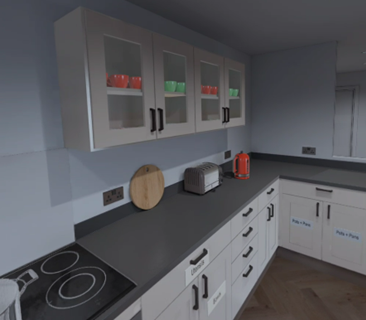
The team have developed a modified, dementia-friendly environment, showing simple changes for those who struggle with memory or vision issues.
They illustrate how contrasting surfaces and cupboards as well as coloured utensils can make a difference.
Darkening the worktops, Jonathan says, helps make the edge of the surface distinct.
Another small change is to simply place some black tape around a lightswitch if you have a white wall and white lightswitch.
Additionally, he says, cupboards can be labelled to avoid confusion:
“It’s common sense, why not have little labels on these or even pictures of what’s in it? These are beneficial to everyone, not just people experiencing cognitive decline.
“For someone with dementia, potentially with short-term memory loss or confusion, you can walk into your kitchen in the morning and find it really frustrating not knowing where anything is.”
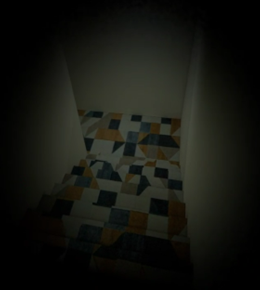
Moving us from the kitchen to the stairwell, Jonathan illustrates how issues for people living with glaucoma or low vision can make stairwells without railings high-risk.
Turning on the glaucoma filter in VR-EP, he shows that patterned carpets instead of a block colour can make it difficult to tell where the steps are.
He explains that for some, this can lead to avoiding going out as often to socialise which can impact their mental wellbeing as they are left feeling isolated or anxious.
Not only is this a falls risk for people, but it also can be incredibly distressing and Jonathan says the VR experience helps people integrate a little more patience and care, or lending an arm in situations where installing a hand-rail is out of their control.
Designing dementia-friendly spaces
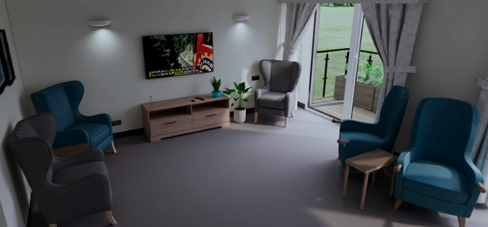
Jonathan takes us next to a shared care home space, showing the “impractical” aspects of the
area (see below right).
With chairs arranged in a way that cover an exit, a clock with roman numerals, patterned curtains, he says:
“There’s loads and loads of things in here that make it not very dementia-friendly.
“Extend your controller out and look at the panel, you can click on the design button and change the space.”
This rearranges the chairs – now angled towards the light and avoiding exits and introduces additional handles on the chairs to support people to get out of them more easily.
With these aspects in mind, Jonathan says carers can recognise, empathise, and modify their behaviour in a person's space.
“You can see, we’re in the same space but it completely transforms the whole feel of the space.
“A simple layout change really makes people feel more at home.”
VR in use
Edinburgh’s Queen Margaret University have already started using VR-EP to train carer workers, nurses, occupational therapists and physiotherapists.
Following their VR workshop, staff Hillcrest Homes shared that it improved their risk-awareness and helped them see meaningful changes and build empathy for residents’ day-to-day challenges with Business and Improvements Manager Chris Robb saying:
“The thing that had the most impact for me was heightening awareness of the environment in which older people are living in and how simple changes to someone's home environment can have a significant impact on the way that somebody with either dementia or with eyesight issues sees their environment.”
Mike Douglas, Age Scotland’s Director of Social Enterprises, said that working with Hillcrest was incredible to see the immediate changes made. He said that while Age Scotland have tried to capture common experiences, each person living with dementia will have a unique experience:
“Of course, for dementia this is not a walk-in-their-shoes experience because everyone’s affected differently by dementia.”
Mike adds that this is all being technically checked by University of Stirling’s Dementia Services Development Centre to ensure the filters portrayal is as accurate as possible and expects formal accreditation from DSDC over the coming weeks.
Reflecting on the work so far and where they hope to see it go, Mike adds that:
“Empathy is what we keep coming back to. I think by building the empathy to let people feel why others are frustrated or behaving in an anxious way – taking the time to recognise having felt it yourself in the VR experience.
“There’s massive community use and a huge intergenerational aspect – engaging young students to understand the challenges faced by someone in later years through VR.”
Mike says he hopes this will become more widely available when the next version of Scotland’s dementia strategy is due for updating.
Ultimately, Age Scotland says it is looking to develop an app for more people to experience the VR environments and drive the accessibility of the work. By next year, the team are working on being able to upload a 360 video of someone’s home or care home and apply filters on top, to personalise it to specific spaces.
Read more: Action needed on women's brain health; The app for more ‘dementia friendly' communities; Unheard: Care workers and COVID; Voices of experience key to dementia care
Sign up to our bulletin for key health & social care updates straight to your inbox and you can follow healthandcare.scot on Google News. |