|
Scotland prioritises neuro-inclusion, says government |
Related newsDelivery of dementia vision moves forward Charting Scotland’s future health and hospital demand How data insights will help deliver NHS reform Charter update for health data researchers New service to bolster Scotland’s health research Providers: children’s service cuts ‘devastating’ Doctors: Action on alcohol “desperately needed” Briefing: Edinburgh’s global neurodiversity meeting ‘Weaknesses’ found in Scotland’s cancer screening “Snapshot” of dentist recovery underway NHS staff say data vital to improving care Regulator promises focus on supporting workforce 
|
|

Image Credit: © Vitalii Vodolazskyi.
|
||
|
||
|
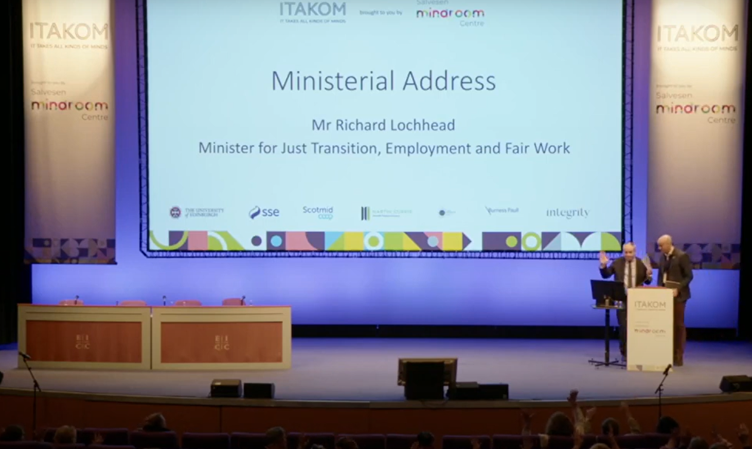
Scotland’s previous Minister for Just Transition, Employment and Fair Work addressed attendees at the international neurodiversity conference in Edinburgh earlier this month, stating that the government is committed to promoting neuro-inclusion across Scotland.
Richard Lochhead joined attendees at the It Takes All Kinds Of Minds conference organised by Salvesen Mindroom Centre earlier this month.
As Just Transition, Employment and Fair Work Minister, Mr Lochhead discussed how the Scottish government is committed to supporting neurodivergent people to live well in Scotland. He said the government is prioritising helping people from a diversity of backgrounds to access and stay in work.
Mr Lochhead added the government’s ambition is to ensure that all people in Scotland including those who are neurodiverse “have the same opportunities as everyone else in our society”:
“Here in Scotland, we want to live in a society in which neurodivergent people are not only respected as individuals, but also one where they really can and do contribute positively to society.
“Now, the Scottish government at the moment is focused on supporting those furthest from the labour market to progress further and move towards entering and sustaining employment, including autistic people and other neurodivergent people as well. And we are going to do all we can to provide as much support that’s required as possible.”
He said that while powers over employment law and regulation lies with the UK government, Scotland is responsible supporting neurodivergent people in work. Two ways in which the government delivers this across Scotland are through the ‘No One Left Behind’ policy and the ‘Fair Start Scotland’ services.
Despite such policies to support neurodivergent people, including people with learning disabilities, the FAI says those with learning disabilities have some of worst health and employment outcomes of any population.
The research institute has launched a programme of work to better inform policy interventions that impact people with learning disabilities, as Scotland is missing systematic data in this area.
Mr Lochhead said:
“We firmly believe that participants [in support services] must remain at the heart of all that we do – and that they feel empowered to play an active and ongoing role in shaping the services that they access.
“So that’s why in Scotland we’re seeing a move away from inflexible national programmes to a person-led approach where support is specifically tailored to meet the needs of the individual.”
Yet, Healthcare Improvement Scotland last year found that 62% of Scots reported being completely unaware that they can inform policy in a national survey.
Mr Lochhead highlighted the Learning Disability, Autism and Neurodiversity Bill and new Disabled Children and Young People Transitions Bill as two key policy changes in development to improve the lives of neurodivergent people. He said:
“The Bill was fully co-designed with people with lived experience, the Bill will potentially seek to establish a National Commissioner for neurodivergent people – we believe that’s the first of its kind – and that’s about protecting people’s rights.
“So it’s a pretty exciting development that has the potential to make a real difference to the lives of neurodivergent people in our society here in Scotland.”
Organisations supporting people with autism and their families raised concerns in January that the timeline to establish a Commissioner has slipped.
However, groups run by and for autistic people have recently led calls to scrap the plans for a Commissioner, saying the campaign has been "done to us as opposed to with us".
A Members Bill which aims to improve opportunities for disabled children and young people as they grow up, introduced by Labour MSP Pam-Duncan Glancy, is currently under examination by parliament.
Co-designed with Inclusion Scotland – a disabled people’s organisations – the Disabled Children and Young People (Transition to Adulthood) Bill aims to give disabled people “a fighting chance” at a future.
Addressing the conference, Mr Lochhead said:
“We recognise the importance of good transitions for young people in particular and so we are going to introduce Scotland’s first national transitions to adulthood strategy in this parliamentary term, as well.
“And that will ensure a joined-up approach to supporting disabled young people as they make their transition to adult life.”
Conference host Salvesen Mindroom runs a ‘Neuroinclusion at Work’ project to support neurodiverse people in their transition to working life and improve workplace awareness of neurodiversity. Mr Lochhead highlighted this as one of 13 projects receiving a share of £800,000 via the Scottish government’s Workplace Equality Fund.
Still, the CEO of Salvesen Mindroom told healthandcare.scot that charities and programmes of work continue to face challenges – particularly with “chronic underfunding” of those supporting neurodivergent individuals.
Mr Lochhead said funding from the Scottish government is supporting a pilot scheme for an Autism National Post-Diagnostic Support Service launched in December 2020. He said that a permanent scheme will be established within this new financial year, supported by £1m annually – and the support will not be dependent on a diagnosis.
Mr Lochhead said that this comes as part of a range of “key priorities to improve the lives of neurodivergent people” and the pilot scheme was co-designed with autistic people and autism support organisations.
Mr Lochhead added:
“The Scottish government believes that the voices of people with real life experience is absolutely vital to all of our work.
“It’s our ongoing aim to make sure that Scotland is a better place to live for neurodivergent people and I just want to finish by reaffirming the Scottish government’s commitment to continue to work towards these ideals – now and in the years ahead.”
Read more: Briefing: Edinburgh's global neurodiversity meeting; New Disabled Children and Young People Transition Bill; Analysis: Why people are left behind; Large scale Scots health study calls for volunteers
Sign up to our bulletin for key health & social care updates straight to your inbox and you can follow healthandcare.scot on Google News. |