|
Briefing: Edinburgh’s global neurodiversity meeting |
Related news‘Bleak picture’: health leaders react to NHS review Briefing: The 5-year plan for NHS, care and science Research enabled innovation spotlighted Scotland at the table with UN healthy air commission Meeting to spotlight NHS Clinical Entrepreneurship Pharmacy’s road to stigma-free drug dependency care Doctors: Action on alcohol “desperately needed” Scotland prioritises neuro-inclusion, says government ‘Weaknesses’ found in Scotland’s cancer screening “Snapshot” of dentist recovery underway NHS staff say data vital to improving care Regulator promises focus on supporting workforce 
|
|
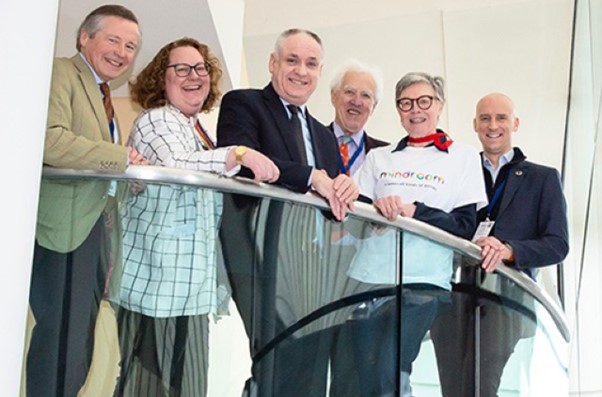
Image Credit: © /JessShurtePhotography/
L-R: Sandy Manson; Sue Fletcher-Watson; Richard Lochhead; Alastair Salvesen; Sophie Dow; Alan Thornburrow
|
||
|
||
|
Held in Edinburgh last week, the It Takes All Kinds Of Minds (ITAKOM) conferences looked across healthcare, education, community and workplace themes to platform neurodiversity. Alan Thornburrow, the CEO of Salvesen Mindroom Centre, which hosted the conference, spoke with healthandcare.scot about the support available and challenges that remain for effectively empowering neurodiverse people.
The conference focused on enabling a better understanding of neurodiversity – whereby different people process information in different ways – and work towards a society where “no mind is left behind”, with all forms of neurodiversity embraced, says the Edinburgh charity.
Its CEO, Mr Thornburrow said that the conference presented an opportunity to bring researchers, people with lived experience and practitioners together in Scotland:
“The first thing we wanted to achieve at the conferences was to put neurodiversity on the platform – it’s not a new topic, but we’re trying to bring it into the mainstream.
“So for schools, for workplaces, for policymakers, professionals across health, social care and otherwise, to bring all of those insights and all of that thinking and practice and research into a place, so we can have better conversations. So that was the purpose of this, and I'm really pleased we’ve been to be able to do a lot of that.”
The conference reflected this aim with panel sessions hearing from people’s lived experiences, workshops facilitated by Edinburgh researchers, an address from Employment and Fair Work minister Richard Lochhead MSPs, and keynotes from leading Professors and speakers spanning different topics under the umbrella of neurodiversity.
Mr Thornburrow said that not only did the programme welcome a variety of stakeholders with different areas to explore, but also those attending the conference represented the different areas from health and wellbeing professionals to individuals.
He explained that ensuring fair access to such spaces for discussing research, policy and personal areas is important:
“Overall, it’s been quite well distributed – quite a lot of people from the research community, parents, carers and young people that are interested in neurodiversity. Clearly employers, policymakers and others are in attendance as well.
“We operated a bursary scheme, so about 50 people who attended were able to do so through support from donors. We’re very much an organisation that puts individual experience at the heart, I know that sounds clichéd but that is very much the case.”
Mr Thornburrow says representation is essential, not just in conversations but across policymaking for healthcare, education and workplace changes to acknowledge and support neurodiversity.
In October 2022, Inclusion Scotland called for the Scottish government to provide more support as the cost-of-living crisis was already proving ‘catastrophic’ for disabled people, who reported cutting back on necessities for their health and wellbeing.
Two months later, the government called for neurodivergent people to help design an inclusive consultation for a Bill to better protect the rights of autistic people and people with learning disabilities.
As part of this they sought applicants for a lived experience panel to improve communication around the Learning Disability, Autism and Neurodiversity Bill and ensure it reaches a diverse range of people, the government proposed between 12 and 20 members would be paid around £75-150 per meeting.
Speaking to healthandcare.scot, Mr Thornburrow said that continued underfunding of charities supporting people with neurodiversity remains a challenge:
“There’s quite a long way to go, however there’s a lot of reasons for optimism as well. Destigmatising, normalising the conversation is the first step.
“Sadly the difficulty we’ve got is chronic underfunding and I know any charity would say that but services like CAHMS are utterly stretched and we totally appreciate that you can’t see everybody, you can’t support everybody.”
Mr Thornburrow says that the Salvesen Mindroom charity has begun working with local authorities to see what support the organisation can offer in terms of mental health needs. He explains that they are hoping to identify people who are awaiting CAHMS treatment but may better benefit – at least more quickly – from a different service.
Recently, care providers and the Royal College of Psychiatry in Scotland have called for the next First Minister to prioritise children and young people’s mental health services, with rising demand requiring more support.
More widely, Mr Thornburrow says learning from each other and acting together is essential, and he hopes those at the conference can ensure something comes from the meeting:
“We're all coming to the table with some degree of expertise, but all of us are learning – and even people here that are probably world-renowned experts, they're learning a lot from practice insights or workplaces insights. That leads us to the next question about: so what?
“You can do something, you personally can do something as an ally, you can challenge stereotypes. But you can also look at your own sphere of influence. Say you're a teacher in a school, say your employer, what might you do to a initiate conversation about neurodiversity in your sphere of influence?
“And then finally, who did you meet? Did you meet somebody interesting you could develop a conversation with them, maybe partner on something in the future. Three things we'd really like to ask people to take away from this are: challenge stereotypes, destigmatise, and be an ally. Go do something, in your world in your field, and work with each other.”
Read more: MS charity: Scrap 20m rule for disability payment; Call for next FM to prioritise CAMHS; Column: New year, same fight for disabled rights; New Disabled Children and Young People Transition Bill; Analysis: Why people are left behind
Sign up to our bulletin for key health & social care updates straight to your inbox and you can follow healthandcare.scot on Google News. |
