|
Significant health inequalities persist across Scotland |
Related newsCharting Scotland’s future health and hospital demand Scottish cancer cases set to keep rising Respiratory care vision unveiled Health Secretary commits to kidney action Childhood adversity health impacts felt at 50 revealed Health and charity leaders join forces for NHS reform 
|
|

|
||
|
||
|
With the exception of the healthy birthweight indicator, the Scottish Government’s long-term monitoring of health inequalities – December 2018 report shows significant health inequalities persist for each indicator.
In 2017, the premature mortality rate in the most deprived areas of Scotland was four times higher than the rate in the least deprived area. From 1997 to 2017, premature mortality rates declined by 43% in the least deprived areas, compared to only 21% in the most deprived areas.
The indicators monitored include healthy life expectancy as well as premature mortality from all causes among those aged under 75, and the mental wellbeing of adults aged 16 and over. The indicators of inequalities in morbidity and mortality are numerous and include alcohol-related deaths, coronary heart disease and cancer deaths and incidences.
Across a number of inequalities - including premature mortality among those under 75 years of age, coronary heart disease and cancer mortality – absolute inequalities, which represent the gap between the most and least deprived areas, have narrowed over the longer term. The cancer mortality gap has reduced by 22% since its widest point in 1998, while the alcohol-related admissions gap has reduced by 43% since 1996. Meanwhile, alcohol-related deaths are currently 30% lower than a peak in 2002 but following a period where the gap narrowed, it has been increasing since 2013 and is now 10% higher than in 1997.
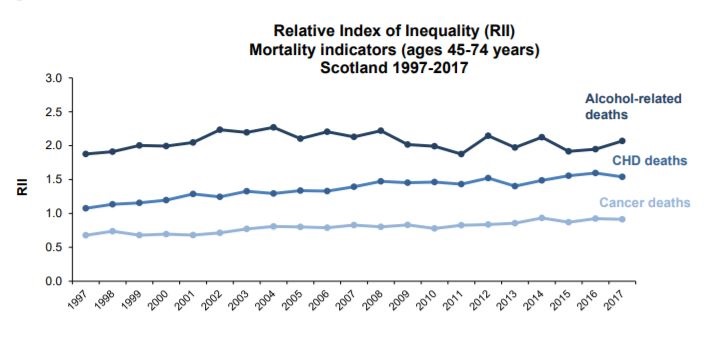
With regard to relative inequalities – which have increased over the longer term and indicate the extent to which health outcomes are worse in the most deprived areas compared to the average throughout Scotland – alcohol-related deaths have shown more year to year fluctuations but ultimately have increased by 10% since 1997. Relative inequalities for coronary heart disease mortality have increased over the longer term, while the relative index for inequality for cancer mortality has increased slightly over the longer term.
A Ministerial taskforce on health inequalities was established in 2007 by then Minister for Public Health, Shona Robison, to identify and prioritise practical actions to reduce the most significant and widening health inequalities in Scotland. In 2008 a technical advisory group recommended the indicators that should be monitored over time, and reflected in annual reports, in order to manage short- and medium-term progress in reducing health inequalities.
Cautioning that care should be taken when interpeting such data and attributing causality, President of the Royal College of Physicians of Edinburgh, Professor Derek Bell, described the report as mixed. He said: "It indicates that while Scotland appears to have made progress on premature mortality, death from coronary heart disease and cancer mortality, the health inequalities gap looks to have widened on alcohol related deaths and is 10% higher than at the start of the time series in 1997. In particular, the College notes that although absolute inequalities in premature death are narrower now than they were anytime pre-2010 – which is to be welcomed - the gap between the most and least deprived communities has grown since 2013.
As the Scottish Parliament Health and Sport Committee reported in November 2018, more work must be done on the preventative agenda - which covers respiratory conditions and type 2 diabetes for example - as a measure to reduce health inequalities. This must be backed by carefully considered and reliable data samples, to establish what we’re doing well, and what can be improved. And we must ensure that the data helps us to understand trends in health inequalities.” |