|
20 years of Voluntary Health Scotland |
Related newsChief Medical Officer: ‘Critical connections’ priority Third sector – not third in line Economic change key to Scotland’s health inequalities Awards celebrate great link working Health Secretary commits to kidney action All public bodies must focus on health, urges charity Scientists to help cut NHS medical device waste Edinburgh IJB faces judicial review over cuts Scotland’s new Chief Nurse appointed Urgent plea to safeguard advocacy amid local cuts New gene study offers arthritis treatment insights New Edinburgh hub set to transform global healthcare 
|
|
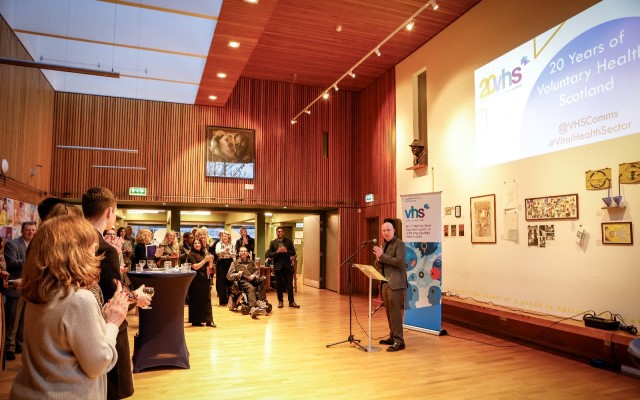
Image Credit: © Voluntary Health Scotland (VHS)
|
||
|
||
|
The efforts of voluntary organisations in the fight against health inequalities was celebrated at an event last week, as the outgoing CEO of Voluntary Health Scotland (CHS) marked two decades of the organisation’s support of the sector.
Opening the evening in Edinburgh last week, Chest Heart & Stroke’s Director of External Engagement, Paul Okroj, said that VHS had worked to “shine a light” onto health inequalities and has had an “amazing reach” across the country with the hugely diverse topics it has explored.
VHS has supported work on prison health inequalities, the digital health gap, racialised health, the role of arts and culture in addressing health inequalities, public health policy on isolation and loneliness, and end-of-life and palliative care inequalities.
With 165 member organisations, the organisation supports, 300 Scottish Community Link Network members and 40 Health Policy Officer Network members.
Paul Okroj told attendees at last week’s event that the organisation has been key in sharing the impact of the third sector on addressing health inequalities, helping to develop national and local policy, as well as holding the government to account for its public health commitments.
He added:
“Everybody from that third sector perspective knows what we do to tackle these but what we needed was to come together collectively and see that evidence shared.
VHS has demonstrated what a difference our sector made to inequalities, particularly in mitigating their impact, and challenging and calling out the underlying socioeconomic issues that are at the root of all healthcare inequalities.
“Most importantly, it’s made an impact on hopefully your life, your organisation’s life and the lives of people across Scotland.”
As Claire Stevens retired from her role as CEO in March, this event also heard from staff across VHS and those who have collaborated with the organisation on essential contribution she has made throughout her time leading VHS.
Christine Carlin, Chair of the organisation’s board told attendees:
“Claire has steered VHS to become a tour de force. Her ability to engage everyone across sectors has grown the partnerships of VHS.
“Claire has been determined in her quest to improve lives, challenge inequalities, and her support to others is legendary. And nothing speaks more highly to her personal leadership qualities than the teams that she has grown.”
Cath Denholm, Interim Chief Executive of the Equality and Human Rights Commission (EHRC) and former Director for Strategy at NHS Health Scotland – now Public Health Scotland – said VHS has played a vital role in communicating research:
“I remember thinking ‘we’ve got a lot of evidence, we’ve got a lot of data’ but we’re not sharing it and it’s not being used – and that was where Claire comes in.
“Fifty-page peer-reviewed journal reports cut it for some people but not for others. VHS has been so influential in terms of getting out, having that energy to translate health inequalities information for a wider audience.”
She said that we all have a role to play and governments and public bodies must take the words and language of human rights “beyond rhetoric” and be brave enough to use it to help make hard decisions, adding:
“Organisations like VHS need to continue to be involved in these debates, use your voices to ask the right questions, set high standards and hold government and other organisations to account.
“So congratulations to VHS for 20 years of being part of this issue. Thank you, Claire, for being a walking example of how to be influential in the things that matter – and let’s all aim for the next 20 years being a story of all of our everyday rights being realised.”
Incoming chief executive of VHS, Tejesh Mistry also reflected on the achievements of Claire Stevens in her twelve-year tenure as he spoke about his first week in the role and what he is looking forward to as head of the organisation:
“Claire’s achievements within the last 12 years and what she’s done for this organisation – and the phrase ‘big shoes’ has come up quite a few times. I take that really seriously, I think it’s hugely impressive. Claire’s one of the reasons I was interested in the role and the organisation.
“This is not an organisation that’s stuck in the past – actually they’re ahead of the game. That energy is already there and the standards and value that we can see a mile away.
“I’m excited about my role and I think it’s important for us to continue that work, to be a better voice for partners, for organisations.
“We’re in a challenging climate. It’s a difficult time for us but we need to mobilise collectively and demonstrate what we already know. We’re not superfluous as a sector: the work we do is absolutely essential for people on the ground and across the country.”
Read more: Inside Scotland's widening health inequalities; Glasgow link workers protected for three years; Working together for climate action and good health;Link workers in 2023: sustainability top of agenda; Call to action for third sector health creators; Economic change key to Scotland’s health inequalities
Sign up to our bulletin for key health & social care updates straight to your inbox and you can follow healthandcare.scot on Google News. |
