|
Why AI can’t replace pharmacy care |
Related newsRespiratory care vision unveiled Greener NHS research funding boost Pharmacies campaign to lead weight loss service Charities spotlight early blood cancer symptoms Less than full-time – behind the NHS trend 
|
|
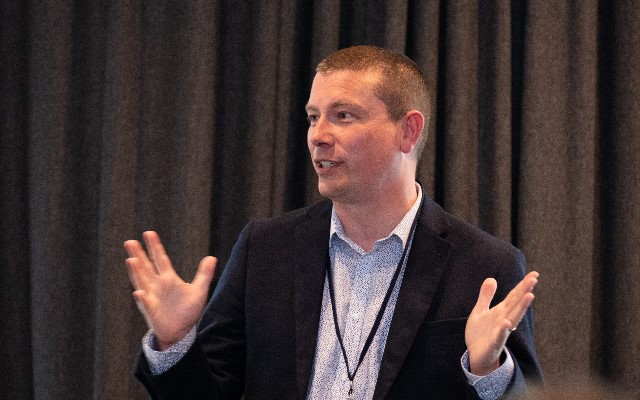
Image: Nikki Morgan/Fledgling Photography
Matt Barclay, CEO of Community Pharmacy Scotland
|
||
|
||
|
Digitised systems, automation and AI, far from being a threat to jobs, will help to cement the role of high street pharmacies as frontline community health hubs, according to the head of the trade organisation representing Scotland’s local pharmacies.
But Matt Barclay, Chief Executive of Community Pharmacy Scotland, said the focus must still remain on preserving and enhancing care for patients – something that only pharmacy teams can deliver.
Some 800,000 people go through the doors of Scotland’s 1,256 community pharmacies each week.
Matt Barclay, in his first major speech since taking over at the helm of Community Pharmacy Scotland in February, said whether the visit is to collect a prescription, to get advice or simply for a chat, the value to patients is from the staff they meet.
In a keynote address to the inaugural Pharmacy in Practice national pharmacy conference, Mr Barclay suggested community pharmacy teams can now build on that foundation:
“Getting to know your communities, going the extra mile for those communities, being that team that can be relied on to give that medicines advice to people – that is something that we do in Scotland in a very unique way, and we are admired for it across the globe.”
He said moves to home deliveries of medicines and 24 hour pick-up points, while positive innovations which offer convenience to some, also risk the “commoditization” of medicine supply:
“I think while these good things are fine, we need to keep the human element and we need to keep that care element alongside these developments.
“Primary care and community pharmacies are highly accessible. We need to maintain that accessibility because it is really important, particularly in areas of deprivation.”
At the height of the pandemic in the summer of 2020, Scotland launched Pharmacy First, a service that allowed any person registered with a GP in Scotland to consult with a pharmacist with the necessary prescribing training about a minor ailment and for them to get advice, and potentially medication, without seeing a doctor.
Pharmacy First in England was launched earlier this year.
Matt Barclay said:
“Scotland has to be recognised as world leader already, although it can often not feel like that. But I've been fortunate to have been in the company of community pharmacists from other countries from time to time, who wonder how we have done it.
“So, I think the vision and persistence of those who came before us shouldn't be forgotten. We should never rest on our laurels. We need to stay ahead of the curve, and keep pushing the boundaries of our pharmacy practice.”
And, he suggested, the way the whole pharmacy team works needs to evolve further:
“At the moment we see a 90-10 split for pharmacists between time spent dispensing and consultation time. We need to flip that on its head. We need to be 90-10 consultation time – quality patient focused time, to dispensing time.
“So how do we do that? We use our people more effectively, investing in them – the whole pharmacy team. We provide safe systems, using technologies to support the cultural shift for pharmacists, supporting and giving confidence to leave the technical aspects to technicians and for pharmacists to focus on clinical care and patient safety.”
“Pharmacy teams are already busy delivering a world-leading service in Scotland. However, by creating the right culture and the right conditions, we can have the right people at the right time making an even bigger impact for patients and clinical services.”
Last year, during protracted negotiations with the Scottish government, Community Pharmacy Scotland issued a statement in which it ‘sounded the alarm’ over the financial viability of high street pharmacy. This year’s negotiations are continuing.
In March 2026, Scotland will see the introduction of a paperless, digital prescribing and dispensing system where every GP prescription written during surgery hours will go directly to a patient’s pharmacy for dispensing.
Robotics are in use in both hospital and community pharmacies to pick medicines from store shelves and manage supplies, while digital systems to identify, scan and track individual items are well established.
Matt Barclay says AI too will have a place – but to support decisions, not to replace staff:
“We need to be relatable as a profession. We need to be able to have those difficult conversations that patients want to have in community pharmacy. It is a real privilege to support people in the community, day in day out. We need to continue to keep it real.
“We can deliver a new world-leading community pharmacy service that everybody wants us to deliver, and people want to come to the sector to deliver. It delivers outstanding value and an outstanding contribution to health at the minute. And that can be continued and can be built on.”
Read more: NHS receives extra cash from medicines scheme; New type of conference for pharmacy; New CEO for Community Pharmacy Scotland; Pharmacy’s crucial role in fair access to health
Sign up to our bulletin for key health & social care updates straight to your inbox and you can follow healthandcare.scot on Google News. |
