|
Less than full-time – behind the NHS trend |
Related newsHealth and charity leaders join forces for NHS reform Probe into future of NHS Scotland’s doctors underway NHS doctors unemployment crisis despite understaffing Doctors: ‘Shocking’ A&E figures require action Doctors say GP funding boost “just the start” Drug harms on the rise in Scotland 
|
|
Image Credit: © NHS Greater Glasgow and Clyde
|
||
|
||
|
As an increasing number of doctors across NHS Scotland are reducing their contracted hours, healthandcare.scot has heard from doctors’ representatives and resident doctors directly about the implications of the trend for individual medics and the wider workforce.
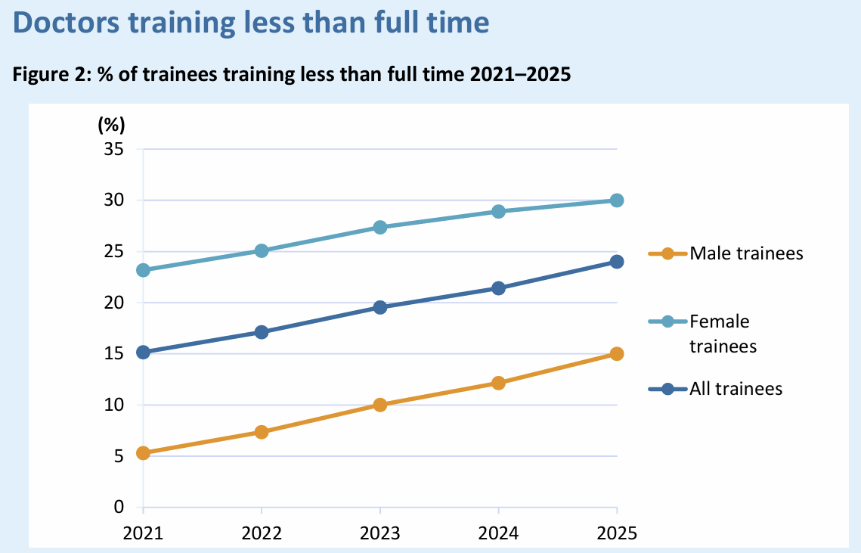
Medical training and practice regulator, the General Medical Council recently revealed a steady increase in the proportion of doctors in training – those generally in the years between graduating from medical school and taking on consultant roles – who are moving to less than full-time work.
Among those reducing their hours, almost half cited childcare responsibilities while two thirds sought a better work-life balance.
The numbers working less than full-time varied between specialities, even between those with similarly heavy workloads.
Around 46% of paediatric and child health doctors reduced their hours in 2025, compared to just 8% of those training in surgery posts.
One Scottish doctor training in paediatrics spoke to healthandcare.scot about their experience of reducing their hours.
Sophia* said, while the expectation to work late or take on overtime varies from health board to health board and speciality to speciality, full-time hours, training and learning needs all add to the working week.
This, combined with a rising on-shift workload and the increasing competition for training jobs despite understaffing, had contributed to Sophia’s feeling of burnout, uncertainty and a difficult decision.
A year and a half into her specialty training programme, Sophia moved to less than full-time.
The GMC found that across NHS Scotland most doctors’ working full-time will see their base hours per week sitting at 48 hours, with the standard ‘less than full-time’ (LTFT) arrangement reducing this to 40 hours.
Now entering the third year of speciality training in paediatrics, and 6 months into her LTFT rota, she explained to us what this looks like for her:
“I’d been a bit overwhelmed, getting a bit burned out and stressed about my career choice, work-life balance, not being able keep up with my portfolio stuff on top of work and not being able to see friends and family or exercise as much as I’d want.
“The pattern is still the same, except most weeks you will have an extra weekday off.
“In theory, most LTFT people will only do three 12.5-hour nightshifts in a row instead of four but, unless you request it, sometimes you’ll still do four and will work upwards of the 48 hours – what would’ve been your base hours for full-time.
“It averages out though and I like work, I don’t mind being in work a lot but you have to do most of your portfolio [documenting case studies, reflecting on learning experiences and professional development throughout training] and learning outside of work.”
Creating time to learn
Despite dedicated ‘study days’, she said the time needed for required learning, portfolio work for their training progress and studying for exams is far beyond the amount etched out by health boards.
Sophia said having more time to study for exams and to complete portfolio work outside of work hours without burning out was a big part of her decision to go LTFT.
She said that having more control over her time has not only helped personally and with study, but how she feels when she is in work:
“I feel like a have a better balance, I’m able to maintain relationships and hobbies, and maybe slightly less overwhelmed by portfolio work but I do still struggle to keep on top of it.
“I try to not let it impact the care of patients but you do get decision fatigue if you don't get as good sleep or rest.
“You lose almost 20% of your wage and I might need to extend the length of my training which I don’t mind. It does mean when I stepped up to being a registrar this month, I didn’t have as much experience under my belt as those that have been full-time.”
Workforce planning and LTFT
While there are personal trade-offs with reducing contracted hours, Sophia recognises that there are wider medical workforce issues:
“As training progresses, more and more people go LTFT, and health boards are short on their senior rotas unless they hire more people. But training posts haven’t increased in line with need, so they rely on short-term contracts to fill gaps.
“If they hired more staff, normalised trainees doing their work portfolio and study during their working hours, that would make a big difference.
“For all specialities, there’s not enough jobs and increasing training posts could meet the potential rise in people going LTFT while having better staffed wards could reduce burnout risk and improve patient care.”
BMA Scotland told healthandcare.scot that with the recent survey of doctors in training revealing 56% are at moderate-to-high risk of burnout, “urgent action” is needed across the NHS.
The survey also heard from both those resident doctors and those training them that failure to deal with rota gaps is holding back training – impacting both patients and staff.
Chair of its Resident Doctors Committee, Dr Chris Smith told healthandcare.scot a “proper workforce plan” detailing how NHS Scotland will recruit and retain the staff it needs must now be delivered:
“The reasons for increased numbers of doctors in training going less than full-time will be varied, but there is no doubt of the huge pressures they are facing.
“However, it should not be left to individual doctors to try to manage and address pressures which are a result of the crisis the health service is facing.
“There will always be some doctors in training who will opt for LTFT, but urgent action must be to be taken to ensure it is a positive choice – and not just because it is necessary to reduce stress and prevent burnout.”
*Sophia is a pseudonym to preserve the doctor’s anonymity.
Read more: Doctors invited to shape medical workforce reforms; A question of action; Agency staff paid as high as 400% to fill NHS gaps; A team sport: caring from the community up; Growing patient safety & career concerns for doctors; Shocking levels of violence towards NHS staff; A pharmacist on the frontline; Watchdog criticises homelessness care cuts; Racism in NHS Scotland still rampant; Scotland to work on Physician Associate reform
Sign up to our bulletin for key health & social care updates straight to your inbox. |