|
Too many doctors hesitant to ask for help |
Related newsHealth and charity leaders join forces for NHS reform Watchdog criticises homelessness health service cuts NHS is working to address “unacceptable” abuse Pharmacy’s road to stigma-free drug dependency care Medical trainee abuse reports ‘shut down and silenced’ 
|
|

Image Credit: © Rawpixel.com
|
||
|
||
|
Over half of Scotland’s qualified doctors in speciality training are at a moderate-to-high risk of burnout. A national survey of medics working on the frontline across specialities highlights risks for patient safety from both rota gaps and reluctance amongst these ‘trainee’ doctors to ask for help from their supervisors.
The report today by regulator, the General Medical Council (GMC) heard from over 71,000 doctors in training – formerly ‘junior’, now resident doctors – and their trainers about their workplace experiences.
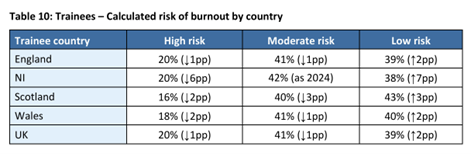
One in five were at calculated to be at high-risk of burnout.
In his foreword to the report, GMC Chief Executive Charlie Massey said if the UK’s medical training system “fails to adapt” in the light of the findings, it risks losing doctors from the workforce.
He said staff wellbeing and the knock-on effect for patient care remain a real concern.
Over 4,400 of the respondents work in NHS Scotland, which reports the lowest risk of burnout among its doctors in training, with 16% at high risk.
While the proportion of trainees at high-risk of burnout across the UK has decreased for a second year, it is still double pre-pandemic levels.
In Scotland, 56% are at moderate-to-high risk of burnout, while the average across the UK sits at 61% of trainee doctors.
Just under two thirds (64%) of trainees said they always or often feel worn out at the end of the working day.
The speciality with the highest risk of burnout is emergency medicine, while public health residents are least likely to be at risk of burnout.
A concern heard by the GMC from both trainees and trainers across the NHS was that training is held back by rota gaps that are not being dealt with appropriately.
Asking for help
One in five trainees across the UK reported feeling apprehensive about escalating a patient to a supervisor at least once in the last year.
GMC Medical Director Professor Pushpinder Mangat said these findings are “extremely concerning” and it is vital that doctors feel comfortable escalating.
In the survey, 79% of doctors in training said they have never felt apprehensive or hesitant about escalating a patient to a supervising clinician.
However, around 10% said they have felt hesitant to escalate patients to a supervisor either weekly or monthly.
Dr Massey said this “deeply troubling” number of trainees feeling uncomfortable to raise concerns with senior colleagues points to an “unhealthy culture” that risks patient safety.
Trainees from obstetrics and gynaecology, surgery and emergency medicine expressed the greatest apprehension – specialities that also report higher levels of workload stress and bullying.
The Royal College of Physicians of Edinburgh, which has a global role in supporting doctors through education, training and examinations, said the findings also recognise that the experience for most doctors in training is a good one.
In a joint response, RCPE Deans, Dr Kerri Baker and Dr Marion Slater, added that the survey highlights key areas for improvement:
“Rota gaps carry risks for patient safety. They negatively impact on the ability to train, and create a mismatch at a time when the UK is characterised by more competition and bottlenecks for those entering training.”
NHS Scotland’s resident doctors have reported facing unemployment despite understaffing, highlighting the need for more training posts.
The College says better workforce planning and a commitment by governments to “urgently review” training numbers is needed to create a medical workforce that meet the needs of the population.
It says protected learning time and supporting senior clinicians to deliver training are both key to improving resident doctor experiences and patient care.
It adds that ensuring training is supportive and free from discrimination is “non-negotiable”, as 28% of doctors in training reported experiences of discriminatory behaviour.
GMC Chief Dr Massey described discrimination as a “stain on modern medicine”, saying as the medical workforce continues to diversify and evolve, culture and working practices must evolve
Read more: Chief Medic: ‘Critical connections’ priority; Government to merge two national NHS boards; NHS waits pushing patients private; ‘Big leaps’ needed to secure change for disabled people Insight: Scotland’s ‘invisible’ patients and carers; Watchdog criticises homelessness service cuts; Racism in NHS Scotland still rampant
Sign up to our bulletin for key health & social care updates straight to your inbox. |