|
Challenging medicine in beautiful places |
Related newsScots honoured in health, care and sciences New NHS staff data makes case for workforce plan ‘Bleak picture’: health leaders react to NHS review Pre-eclampsia test approved for NHS Scotland Respiratory care vision unveiled Insight: Put nurses at heart of community health 
|
|
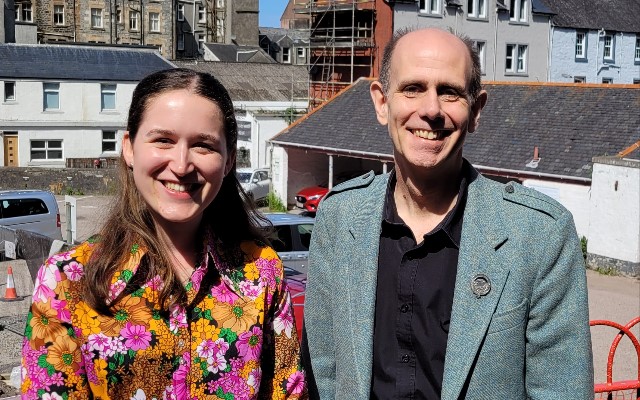
Heather Wightman and Dr Jamie Houston in Oban
|
||
|
||
|
Early career doctors and medical students have been told a career in a remote and rural community will offer them as many challenges and rewards as working in a large urban area – and give them self-reliance and relationships that city practice cannot offer.
Members of the Glasgow University Remote and Rural Medicine Society met for their annual conference in Oban last weekend. healthandcare.scot went along to meet a couple of those involved in the event.
Thirty medical students and recent graduates from Glasgow, Aberdeen, Dundee and Edinburgh heard from speakers working in remote and rural practice who shared tales of practice hours by road, ferry or helicopter from Scotland’s main hospitals.
One of the organisers, final year medical student Heather Wightman:
“We like to get people thinking about their future career. For myself, I want to be a remote and rural GP probably somewhere further down the line in my career.
“I think working in remote and rural healthcare gives you the opportunity for a real breadth of practice. Because you are a bit more isolated, you get to see and do a lot more – whereas, if you were in a city you’d probably be more highly specialised.”
One of the speakers, Consultant Paediatrician Dr Jamie Houston covering much of Argyll, including working Oban’s Lorn and Islands Hospital.:
“I went to Glasgow University myself. We had very little rural experience training. It's great that there’s a much greater variety of experience on offer to students now.
Jamie – a keen kayaker – says, while there are huge advantages having the countryside and sea on his doorstep for downtime, the day job in a rural setting is as pressurised as working anywhere else in the NHS:
“Yes, there's more breathing space outwith your work. But I have worked in Glasgow much of my career, as well as Argyll, and I’m just as busy in my clinics here on a day-to-day basis.
“Plus, you're more impacted if someone's off sick or a colleague leaves or retires. If you've only got a team of three or four people, you're suddenly down by a third or a quarter, so it can be a challenge to deliver an effective service sometimes.”
Jamie says recruiting to remote and rural teams is a continuing struggle, and is keen to point out that the impact of not having allied health professionals or nurses is every bit as great as not having enough doctors.
Scotland’s first graduate entry medical programme – the ScotGEM course – run by Aberdeen and Dundee Universities focuses particularly on remote and rural medicine.
Meanwhile, Jamie says he is seeing more undergraduate students on placement in Oban and Argyll:
“This conference is great to help people and enthuse them. Because if you don't even think about rural medicine, then you’ll do what you know. You’ll work in a hospital in the city, or in the city practice because that's where you feel safe.”
Last year, the Glasgow University Remote and Rural Medicine Society held its conference in Stornoway.
“We really hope we can inspire people to do some of their Foundation year training somewhere remote,” says Heather.
“We had one student last year when we were up in Stornoway, who then applied to do Foundation training at the hospital in Stornoway. And these are jobs that typically can be quite hard to recruit to.
“I know there's some Foundation trainees in Oban here, some in Stornoway and at other rural hospitals. So, we are aiming to get people to consider doing their training in a rural place – and maybe that will inspire them to look at remote and rural healthcare for their long-term career.
“If you do want to work in remote and rural communities you definitely need to be somebody who can be calm in potentially risky scenarios.
“But you also need to be somebody who is really good at building up relationships because, as we’ve been hearing at the conference, part of working in a rural place is actually having really, really good relationships with the specialists in the city.
“So, if you find yourself in a scenario where you don't quite know what's going on, you can just pick up the phone and get advice from your colleagues.
“You need to be somebody, I think, who is in touch with the limits of their capabilities and good at building relationship with colleagues across the country as well as your own community.”
Read more: From the frontline: The GP Nomad; Care crisis to hit rural regions hardest; Scotland’s first postgrad medical degree "on track"
Sign up to our bulletin for key health & social care updates straight to your inbox and you can follow healthandcare.scot on Google News. |
