|
Enhancing independent living with robotics |
Related newsHome adaptations – council spend will prevent NHS cost Using VR to understand lived experience of dementia Exercise key to combatting frailty epidemic Glasgow hosts global care gathering Care homes urged to act early on improvement Care worker visa changes ‘inhumane’ and risks services Treatment-resistant cancer focus of new study Law change needed for Scotland’s drug crisis Libraries offer light lift for low winter mood Medics warn pollution is risking children’s health Peer support ‘crucial’ in suicide prevention Psychedelic trial to begin Scottish phase 
|
|
Image Credit: © Anke Thomass
|
||
|
||
|
A new project has spotlighted the potential of robotic technical to support independent living and social engagement for people living in assisted residential accommodation, at the same time as ensuring a quick response when things go wrong.
Scottish researchers partnered with charity and specialist home care provider, Blackwood Homes and Care to explore how robotics might work alongside, and potentially improve, Blackwood’s existing care systems.
Lead researcher and expert in assistive robotics, Heriot-Watt University’s Dr Mauro Dragone said:
“Robotics offers a powerful solution for independent living, enabling remote monitoring, reducing staff pressures, and increasing personal choice and care flexibility.
“Projects like this help de-risk innovation by embedding technical expertise into care environments, ensuring reliability and user acceptance.
“To achieve lasting impact, partnerships — such as with the National Robotarium at Heriot-Watt — are essential.
“They provide the research, support and training needed to scale new technologies responsibly and effectively across Scotland’s health and care sector.”
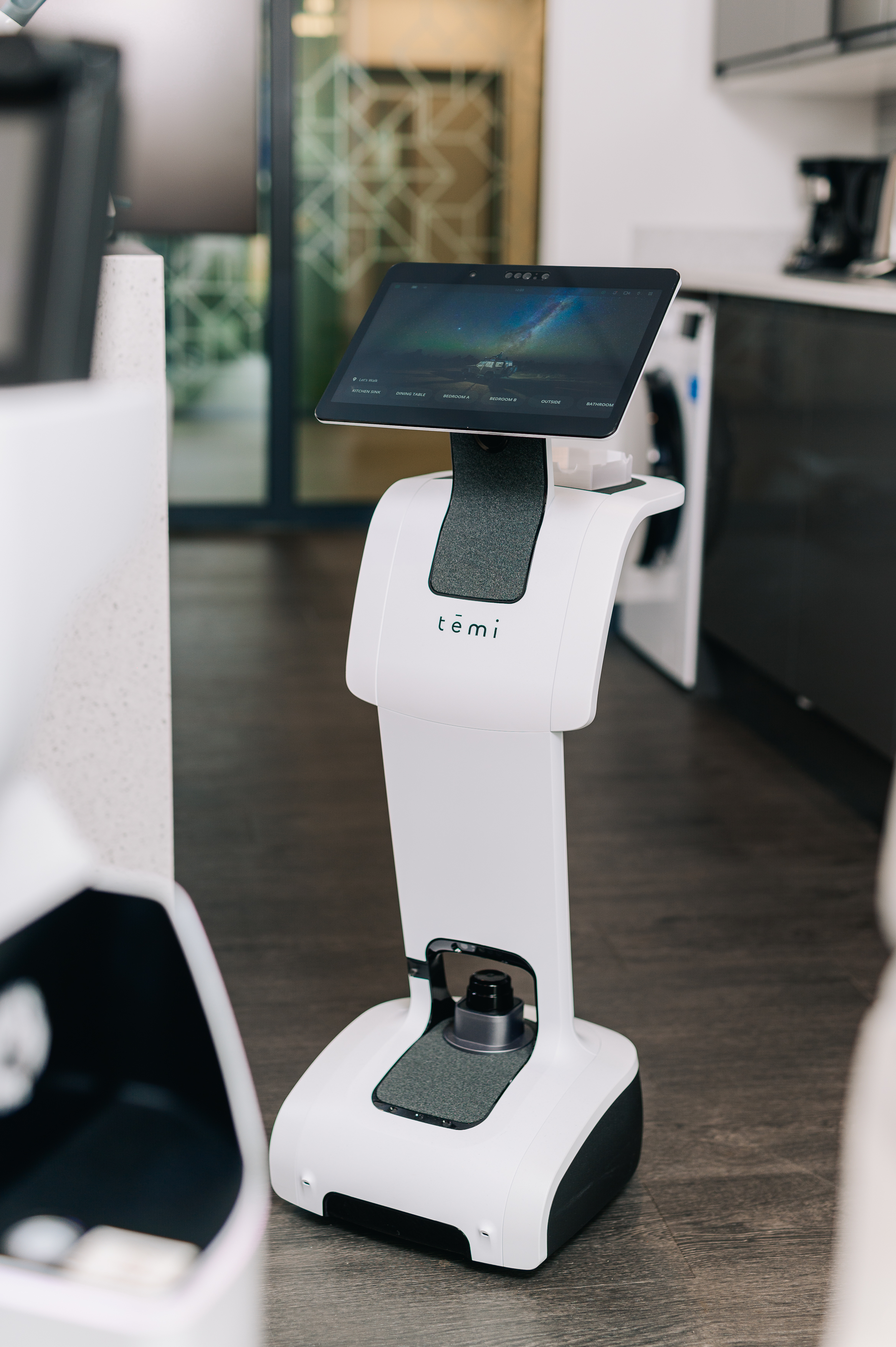
At the heart of the project was the ‘Temi’ robot, which was integrated with the digital telecare systems already used across three buildings in Glasgow.
Temi could reach people in their apartments to help Blackwood’s Homes and Care 24/7 emergency response team and carry out routine health and wellbeing check-ins.
Dr Dragone told healthandcare.scot that the robots have been developed with input from staff and residents:
“These robots acted as first responders, automatically travelling to residents’ flats during emergencies and enabling live video contact with care teams. Unlike traditional devices, they ensured support even when residents couldn’t access their phones or tablets.
“Beyond emergency response, the robots also carried out daily mental health and wellbeing check-ins.
“Developed through co-design with residents and staff, the robot could ask questions, play music, and facilitate contact with the care team — adding value to day-to-day life and increasing social interaction.
“One of the most successful aspects of the collaboration between the research team at Heriot-Watt University and the innovation team in Blackwood was these participatory design activities, to understand their concerns but also their aspiration, preferences and desires for the new technology.”
Participants in the trial reported increased satisfaction with the enhanced service, highlighting Temi’s contribution to both social engagement and accessibility of care services.
A care work team leader who attended one of the sessions demonstrating how the robotics work described themselves as “totally converted” from a non-believer in robotics to seeing it as something that can help “shape the future of care”.
Scotland’s National Robotarium played a ‘pivotal role’ in advancing robotic and software solutions through this partnership, with Heriot-Watt researchers developing “custom software and user interfaces” for Temi.
The research team also trained staff, and integrated the system within Blackwood’s residences, and now hope to continue to advance robotic-assisted independent living and care.
One person involved in the trial said they had “immensely enjoyed” the process, adding:
“I initially got involved as I was curious about what robotics encompassed, and despite being unsure about technology, I kept an open mind. From the very first workshop, I saw how they could be of benefit. Contributing ideas from a service user point of view felt such a privilege and now that I have seen my ‘mental health check-in’ idea has been incorporated into the robot, is just mind blowing!
“It makes me feel not only proud of my idea, but more importantly, that it can be of benefit to others. That makes me happy to know that someone else might feel better because of it.”
Remote triage
One challenge the teams worked to address for remote care staff is that systems often rely on the person who is in trouble to trigger an emergency video call.
The researchers explain this can “difficult to manage”, as it may not be possible if someone has fallen out of sight of the device or is feeling ill or confused.
Dr Dragone explained Temi could respond to an emergency being trigged without residents using a phone or tablet.
It travels from the ground floor, using the building’s lifts if needed, to reach and connect residents with a virtual care team through a live video feed.
Once connected, the responder from the remote care team takes control of the robot, assesses the situation and can speak to the resident.
Dr Dragone said:
“This allowed remote staff to assess the situation accurately and quickly enhanced emergency response and enabling care even during travel restrictions.
“Temi is a mobile robot with a tablet and camera for video calls, combined with obstacle detection, navigation software, and the ability to operate lifts and doors.
“While Temi doesn’t currently carry out physical tasks, Heriot-Watt is now developing smart home devices and modular robotic furniture to work alongside robots like Temi — extending their support potential in care settings.”
He added that this is particularly helpful during stations where there are travel or social distancing restrictions, as seen during the COVID crisis.
Dr Dragone emphasised that robotics is an increasing key component of independent living, not just for remote monitoring but also promoting social connections and self-management at times of self-isolation or travel restrictions.
Read more: Robots could play part in combatting loneliness; Government boosts health innovation funding; Using VR to understand lived experience of dementia; Chief medic: Innovate to tackle health & planet crises; Dementia home care tech collab invites partners
|