|
IJBs’ design shuts out key voices |
Related newsAll public bodies must focus on health, urges charity Health and charity leaders join forces for NHS reform Dementia home care tech collab invites partners Third sector – not third in line ‘Unprecedented’ crisis in community health and care Two million Scots to be offered flu vaccination New funds for home healthcare tech innovators Medics warn pollution is risking children’s health New benefit launched for unpaid carers Scotland’s first Advanced MS Champion appointed Students help shape Perth complex needs housing Blood Bikes expands across Tayside 
|
|

©Seventyfour
|
||
|
||
|
Unpaid carers and lived experience representatives on integration joint boards (IJBs) are effectively excluded from local decision making due to inequitable voting rights, according to a panel of experts.
Local authorities and NHS boards have been directed since 2014 to work together with unpaid carers, people with lived experience and staff representatives to plan local social and community care.
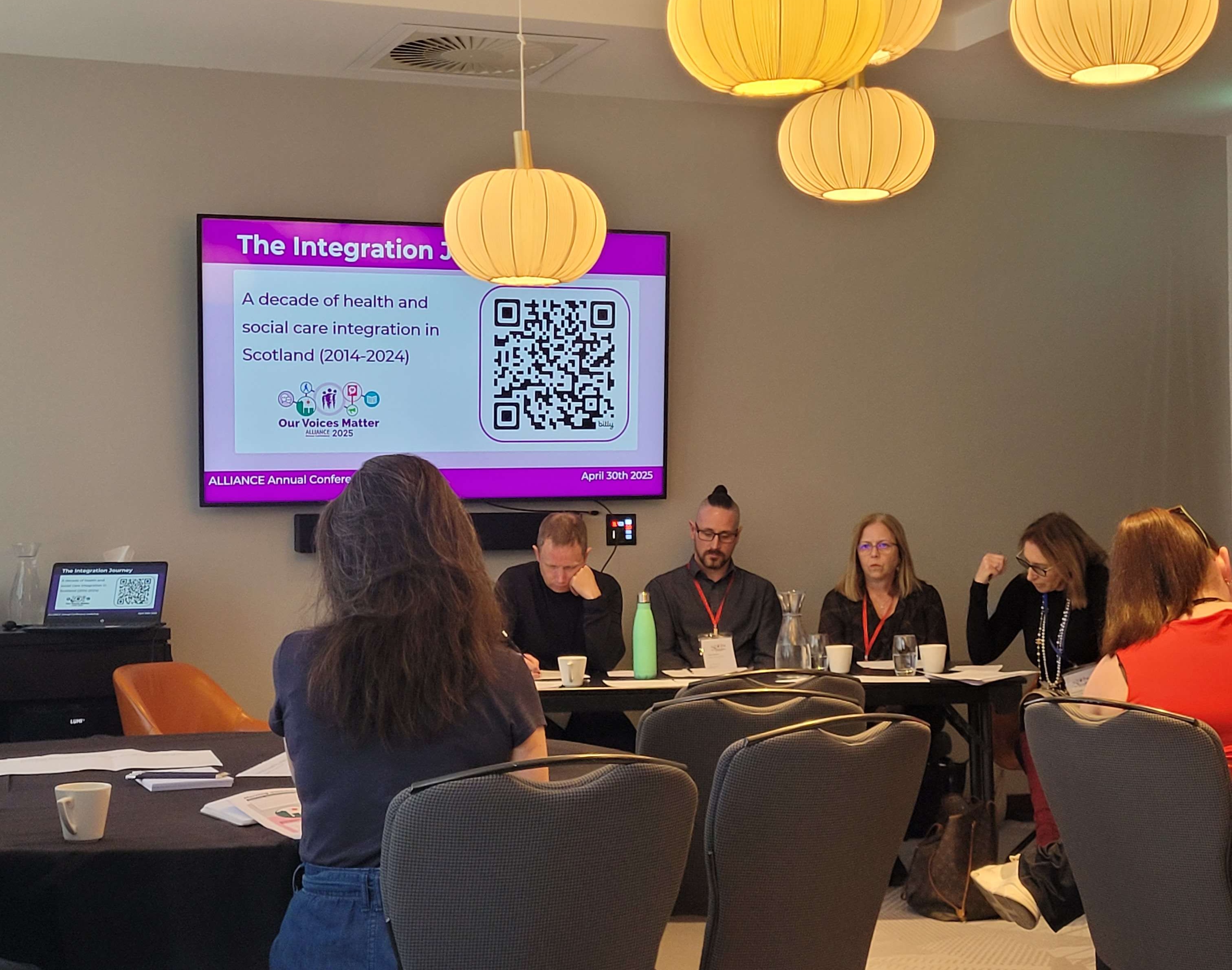
However, representatives of third sector organisations and people with lived experience speaking during a panel discussion at the ALLIANCE’s annual conference said their inability to vote on IJBs has hampered attempts to better join up health and social care over the past decade.
They said their status as non-voting members means their inclusion is largely ‘tokenistic’ and they have limited opportunity to meaningfully feed into the design of local services.
One panel member involved in the original drafting of the framework for integrating adult health and social care support that led to the creation of IJBs in most areas of Scotland said his opinion on voting rights, 10 years on, has changed.
Ron Culley, who worked for local authority organisation COSLA during the drafting of the Joint Working Act and is now CEO of social care charity Quarriers, told attendees:
“I think if I could have that time again, I would change my view [on voting rights].
“The reason that the legislation is damaging here is because – and I put this quite starkly – you don’t need to be worried about the views of unpaid carers, or the views of third sector providers and others because, in the end, it’s really just the statutory partners that will make that decision.
“And I think that is fundamentally one of the things that has held back integration when I look back, and I mean that not just in the sense of ensuring that people’s voices count, but also actually how radical we have been prepared to be as a country in designing the health and social care services we want.”
Fellow panel member Sandra Auld, a service user public partner on Perth and Kinross (P&K) IJB, said current arrangements leave non-voting members sidelined.
She told healthandcare.scot that P&K IJB has taken some positive steps, increasing public partner representatives from two to four and introducing indicative voting rights, but that it will take national secondary legislation to achieve true equity.
Speaking at the panel session, Ms Auld said:
“It’s not just about voting on papers that come to the IJB. In Perth and Kinross, we are excluded from other groups purely on the basis that we’re not voting members. So, from the outset, we’re not allowed to input.
“We need to have equity in the decision making to be able to reflect service users’ voices.”
Both were speaking at a conference workshop reflecting on Scotland’s integration journey, set to coincide with the publication of an ALLIANCE report on progress and barriers 10 years on.
The report says financial challenges faced by integration authorities, the bodies responsible for local service planning, undermine both the ability and long-term sustainability of third sector organisations to provide high-quality preventative care and early intervention.
Third sector organisations and people with lived experience also told the ALLIANCE that greater investment in primary, community and social care is needed to realise the original ambitions of integration in enabling a more person-led approach.
Meanwhile, pockets of good practice, where the third sector, public bodies and NHS services have worked together to improved outcomes, are, according to the report, yet to be adapted and introduced at scale.
Issues around inclusive communication, inconsistent access to support for unpaid carers and the absence of integrated care records were also raised by third sector organisations and people with lived experience.
Their reflections on the previous decade’s journey toward health and social care integration reveal the system is now at a ‘crossroad’.
In her foreword to the report, Chief Development Officer at the ALLIANCE Sara Redmond says it is vital integration authorities and third sector partners now carry forward learnings from the past 10 years:
‘At the ALLIANCE, we aim to create a Scotland where everyone has a strong voice and enjoys their right to live well with dignity and respect.
‘To achieve this ambition, integration authorities need to prioritise collaboration and partnership, value lived experience and the role of the third sector.
‘This report urges us to achieve the ambitions of integration to provide holistic, person centred, rights-based care and support for everyone in Scotland.’
Read more: Scotland can be a Marmot Nation; “Relentless focus” on addressing health inequalities; IJBs face almost half a billion funding gap
Sign up to our bulletin for key health & social care updates straight to your inbox. |