|
Matching breast cancer patients to newest trials |
Related newsAncestry clues to lottery of who gets cancer Discarded bowel tests offer ‘unparalleled’ insights Conference to build on cancer research partnerships Treatment-resistant cancer focus of new study Scots patient first to join leukaemia study Scots honoured in health, care and life sciences 
|
|
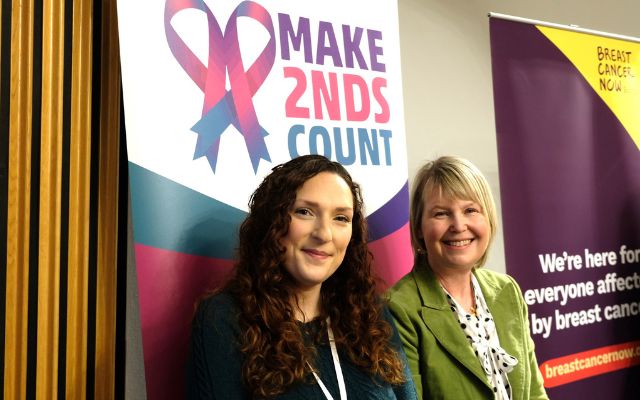
Emma Hall (left) and Lesley Stephen, Make 2nds Count at a meeting in the Scottish Parliament last year
|
||
|
||
|
A Scottish-based charity for people living with later stage breast cancers this month held a three day Patient Summit as part of its mission to match every person with metastatic breast cancer to a clinical trial of a treatment that might work for them.
Make 2nds Count says the window of opportunity for people to receive experimental treatments is often quite small, and too few people living with secondary breast cancer find out they are eligible to be enrolled into one of the many studies taking place across the UK at any one time.
The charity founded in 2018 now employs two research nurses and reaches across the UK. Its Trial Matching Service has so far supported over 2,000 breast cancer patients.
Its summit in Liverpool this month was the third major meeting of its kind for people affected to hear from leading experts, researchers, and clinicians about the latest treatments, clinical trials, and supportive care.
Lesley Stephen has been living with metastatic, late stage, breast cancer for 12 years. The turning point came for her when she was given a new medicine as part of a clinical trial.
She told healthandcare.scot: “I owe much of that time to a phase one clinical trial that I joined, thanks to my oncologists at the Western General in Edinburgh and the Beatson in Glasgow,”
“Prior to me going on that trial in 2015, I was told to get my affairs in order. So, it was literally a lifesaver for me. It enabled me to live well and achieve some of the milestones with my family that I didn't think I was ever going to see.”
The experience led Lesley to become a patient advocate working with various charities, and a trustee of Make 2nds Count.
“I'm trying to provide a voice for women who are living less well with the disease than me,” she added.
Emma Hall, Deputy Chief Executive of Make 2nds Count told healthandcare.scot that living with a metastatic diagnosis – where the cancer has spread to other parts of their body – is both mentally and physically gruelling, for the patient and their loved ones.
The charity researches ways to improve quality of life for patients and offers peer support, face to face and online groups, and wellbeing retreats.
“The biggest part of our work,” Emma said, “is now our focus on empowering patients through increasing their knowledge and understanding of research and treatments.
“We offer a free information service, our Trial Matching Service, to all patients so they can get a referral, or refer themselves, to a clinical trial. People can speak to one of our clinical trial nurses who will look into options for clinical trials for them.
“They can then take that information to their oncologist and have a talk about clinical trials to see if that is an option as part of the treatment pathway.”
The power to ask
The charity sought help from with the universities of Liverpool and Warwick to ask patients with metastatic breast cancer about their needs and experiences – and their thoughts on taking part in a clinical trial.
Lesley Stephen says that survey found it was a lack of information that was the biggest hurdle to people joining a trial:
“We wanted to know why more women don't seem to access clinical trials given my own very positive personal experience of one.
“Trials can be a potential new treatment option for patients who have a limited number of remaining treatment lines. They advance our understanding of the disease through research, and give patients hope, which is what I as a patient – and I think my other fellow patients – really want.”
The survey showed fewer than a quarter of patients had ever had a conversation with their clinician about a clinical trial, and even fewer had actually been enrolled onto a trial.
Trials are free
“There were lots of misunderstandings and a general lack of information about trials,” Lesley said.
“People thought they were a last resort or that they'd be given a placebo rather than an alternative cancer treatment – or be treated as a guinea pig. There were concerns about how far patients might have to travel and what the cost might be, not knowing that patients enrolled in trials have their costs met.
“The only reason I knew about clinical trials was because of a friend who had blood cancer and was being flown down to the Royal Marsden Hospital in London every month for treatment, and the company behind the new medicine was paying for her expenses. I thought that was amazing. She did really well, and it turns out that the medicine she was on is now ‘standard of care’ for her type of blood cancer.”
Lesley accepts that being told your cancer is metastatic is a shock in itself, and the thought then of being part of research is a lot for people to cope with. But, she said, people are generally keen to consider it.
“Not everyone will get onto a trial who asks – for many there won’t be one that’s suitable. But we hope they’ll know more, they’ll be a bit more empowered to ask their clinician.
“Equally, I hope, as more clinicians become aware of the service, they won’t just talk about the trials they know about but also point people to our service to find out about research going on somewhere else that their patient might be able to get involved in.”
You can find out about the clinical trials service on the Make 2nds Count web pages.
Last year, Lesley Stephen was awarded an MBE in the King’s birthday honours list for services to secondary breast cancer and research.
Read more: GP practice launches dedicated research facility: Scottish life sciences to be £25bn sector; Scotland to open four new commercial research hubs; We “cannot be complacent” on breast cancer rise
Sign up to receive our bulletin for key health & social care updates straight to your inbox.
Tags: Cancer; Life Sciences; Research & Innovation. |
